
24 Years After Gujarat: Keeping Memory Alive, Demanding Justice Now
Content note: This post references mass violence, arson, sexual violence, and displacement.
On February 27, 2002, a train coach caught fire near Godhra, killing dozens of Hindu passengers. What followed was not merely “unrest,” but a terrifying unraveling: widespread anti-Muslim violence across Gujarat—killings, arson, sexual violence, and displacement—whose wounds have never been allowed to fully close.
Twenty-four years later, remembrance cannot be a ritual we perform once a year and then shelve. It has to be something more demanding: a refusal to let violence be renamed into inevitability, and a refusal to let survivors carry the burden of memory alone.
Memory without myth
Power loves two outcomes: silence, or a story so “balanced” it becomes empty. We reject both.
Human Rights Watch documented patterns of violence that did not resemble randomness—attacks unfolding within view of police posts, and testimony from survivors describing official inaction and complicity.
Naming this matters because euphemism is one of impunity’s most reliable tools. When mass violence is softened into “clashes,” accountability becomes optional.
And complexity does not mean confusion. We can hold multiple truths at once: grief for those killed in Godhra, and clarity about what followed across Gujarat; recognition that violence harms everyone, and an unsparing honesty about who was overwhelmingly targeted and dispossessed.
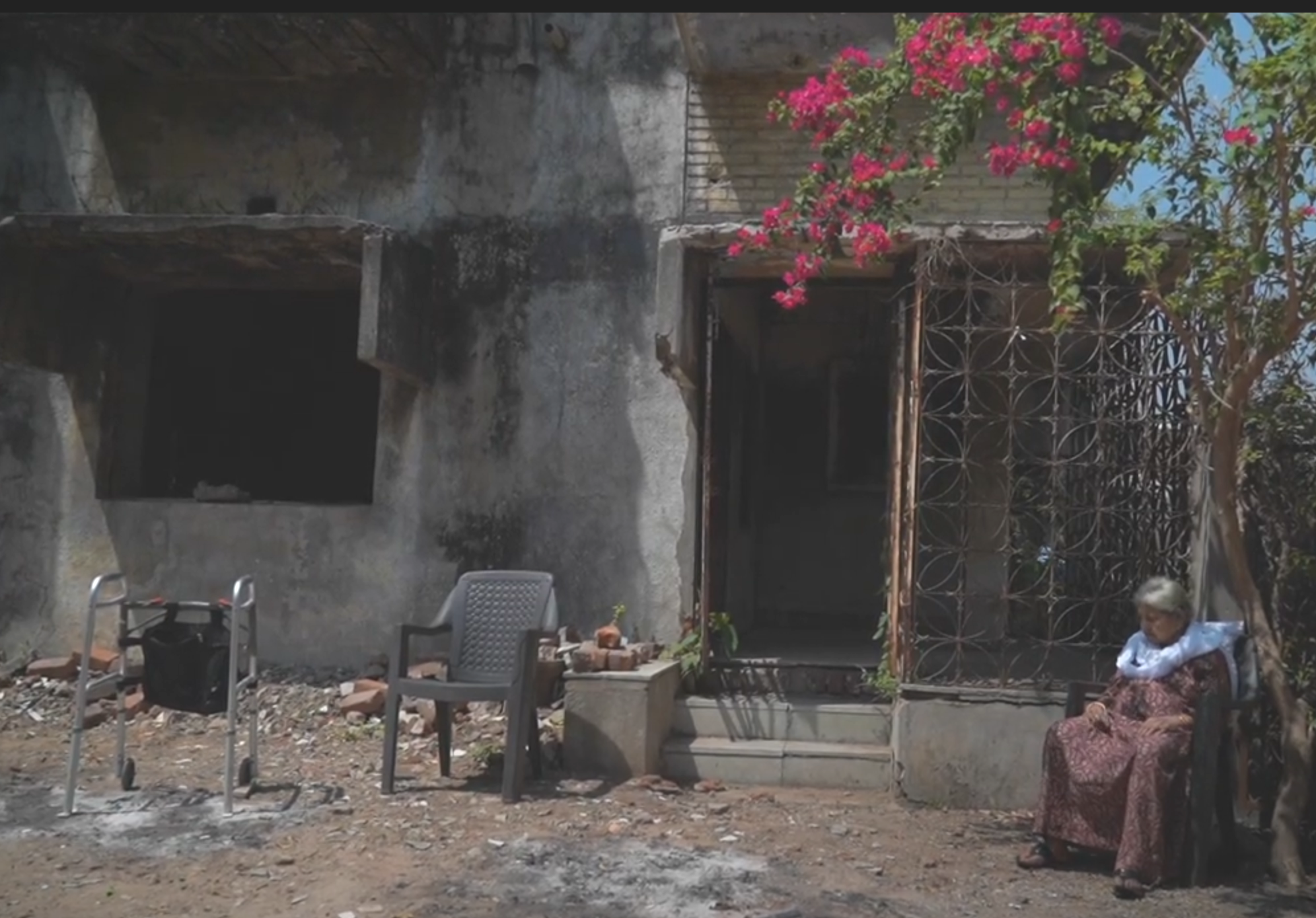
still from a French TV report “Two decades on, India still haunted by Gujarat religious riots” in 2024
Justice without amnesia
Some convictions have happened over the years—but the long arc of Gujarat is also the story of survivors fighting, repeatedly, to keep the door to accountability from being shut.
Even in recent years, the legal and political afterlives of 2002 continue to shape what truth can be spoken in public. In a June 24, 2022 judgment, India’s Supreme Court dismissed Zakia Jafri’s complaint alleging incomplete and biased investigation into a larger conspiracy surrounding the 2002 violence—an outcome that underscored, again, how hard it can be to pursue justice when it threatens power.
So when we say Never Again, we have to mean never again to the violence, and never again to the forgetting.
Modi’s own political arc is one reason Gujarat remains a live question, not a sealed chapter. In 2005, the U.S. denied him a visa and revoked his existing travel visa—an extraordinary mark of international censure tied to the shadow of 2002. Yet less than a decade later, as he rose toward the prime ministership, the story shifted from isolation to embrace: Washington signaled it would welcome India’s new leader, and he arrived not as a pariah but as a partner—proof of how quickly geopolitics can anesthetize moral memory. And yet memory does not belong to governments or courts—it belongs to the people who refuse to let convenience become closure, and who keep the demand for truth alive in the present tense.
The living guardians of memory: Zara, Aakashi, and the Dawoods
This is where our work—our relationships—matter.
At Hindus for Human Rights, wehonor Swami Agnivesh because he modeled a fierce, expansive moral imagination: vasudhaiva kutumbakam—the world as one family—lived as solidarity with communities beyond his own.
In that spirit, we have over the years uplifted and honored people whose work keeps Gujarat’s memory alive—not as a museum piece, but as a contemporary call for justice:
Zara Chowdhary, whose memoir The Lucky Ones offers a deeply personal, poetic exploration of a multigenerational Muslim family navigating the aftermath of Partition and “modern-day pogroms.” We hosted Zara for multiple readings—because storytelling can be a form of protection, a refusal to let erased lives stay erased.
Aakashi Bhatt— now a surgeon and researcher in the UK—has spent years fighting for her father, former IPS officer Sanjiv Bhatt, whom many human-rights advocates view as unjustly imprisoned and politically persecuted; that a system meant to protect justice can be used to punish truth-telling is, for many, a stain on India’s judiciary, and Aakashi’s relentless public witness refuses to let that stain be scrubbed from public memory.
Yusuf and Imran Dawood, whose relentless decades-long fight for justice began after Imran survived a family tragedy during the 2002 Gujarat violence—and who have continued to challenge targeted anti-Muslim violence and official misinformation, reigniting public memory precisely when powerful forces would prefer closure without truth.
These are not “honorees” in a ceremonial sense. They are living guardians—people who refuse the comfortable ending. Their work insists that Gujarat is not over as long as survivors are still fighting for recognition, restitution, and dignity.
A Hindu ethical response: dharma without domination
We do not accept a version of Hindu identity that requires another community’s fear.
If our spirituality is real, it should show up as restraint, responsibility, and courage: ahimsa as discipline; satya as the refusal to launder violence into euphemism; karuna as the insistence that no one is disposable.
On this anniversary, we recommit to:
naming anti-Muslim mass violence clearly, without euphemism;
opposing hate and dehumanization in our communities and our politics;
standing with survivors and truth-tellers—artists, advocates, families, organizers—who keep memory alive;
building interfaith solidarity that is concrete: showing up, intervening against misinformation, protecting one another in public life.
Memory is not only grief. It is a boundary we draw together: this far, and no further.
Learn more about the Swami Agnivesh Memorial Awards honorees we’re referencing here:
https://www.hindusforhumanrights.org/swami-agnivesh-awards
Further Reading
Harsh Mander, “The communal, criminal injustice of the stories of Bilkis Bano and Maya Kodnani” (Feb 16, 2026) — a sharp, contemporary lens on how Gujarat 2002 continues to shape impunity and “course-corrections” in public life.
“Remembering Gujarat 2002: How an Unjust Past Shapes India’s Present” (HfHR, Feb 26, 2025). Last year’s HfHR framing of the anniverssary
https://www.hindusforhumanrights.org/en/blog/remembering-gujarat-2002-how-an-unjust-past-shapes-indias-present
“Remembering Zakia Jafri” (Feb 2, 2026) — a remembrance that re-threads Gulberg Society, state failure, and the ethics of not moving on.
Yusuf Dawood, “From Eid to Ash: 14 Years Since the Gujarat Pogrom” (Feb 27, 2026) — explicitly connects memory, diaspora dynamics, and the unfinished work of justice (with the Dawood family’s voice at the center).
“From Unnao to Bilkis Bano: Is the judiciary becoming reactive to public pressure?” (Jan 25, 2026) — a mainstream-but-useful read for how “public outrage → institutional correction” gets narrated (and what that misses).
“The Stories and Scars of the 2002 Gujarat Pogrom” (Feb 14, 2026) featuring Zara Chowdhary — survivor-centered conversation that treats storytelling as a living archive (and a political practice).