
A Prayer for Resistance: Hindus for Human Rights at ICNY’s “Religious Resistance to Authoritarianism” Conference
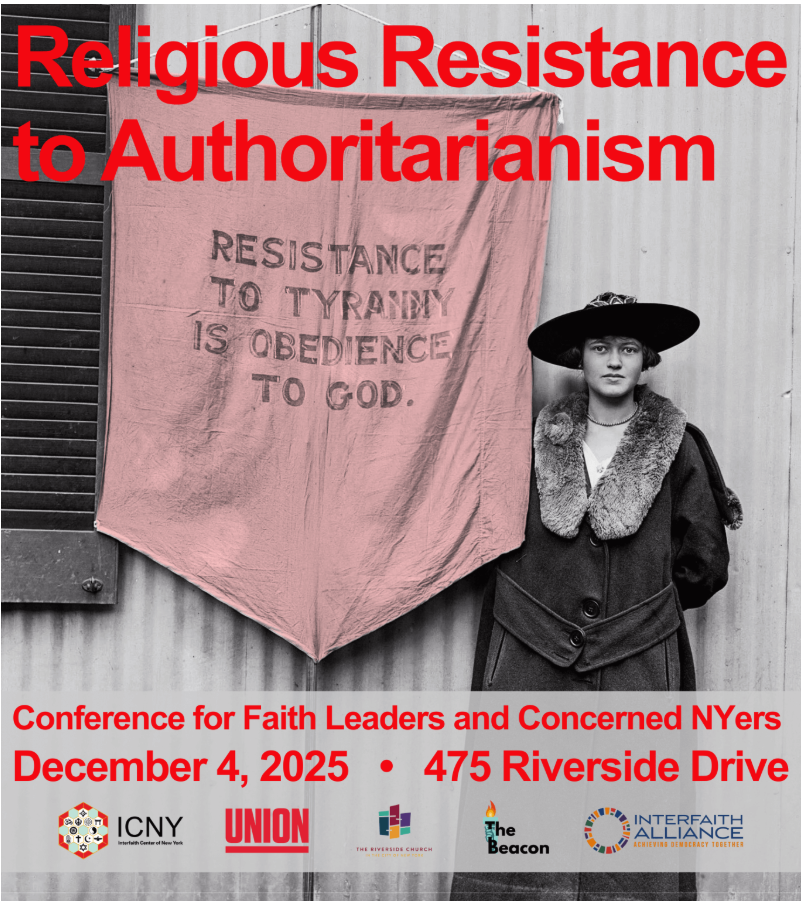
On December 4, the Interfaith Center of New York held its 43rd Social Justice Conference, Religious Resistance to Authoritarianism. Co-sponsored by Union Theological Seminary, The Riverside Church, The Beacon, and the Interfaith Alliance, the gathering brought together religious leaders, scholars, activists, and neighbors committed to confronting the deepening currents of authoritarianism in the United States and around the world. Hindus for Human Rights was represented by our NYC Organizer Vrinda Jagota, and our Executive Director, Sunita Viswanath, was invited to offer the conference prayer.
It was a call to remember the vastness within each human being at a time when political forces seek to flatten our identities and divide our communities. She began by recalling the beloved story of Krishna’s childhood — when Yashoda, suspicious that her son was eating dirt, asks him to open his mouth. Instead of dirt, she sees the universe: galaxies, suns, moons, her village, her life, her past and future held inside the small body of her child.
In this story, Sunita reminded the room, lies a truth that authoritarian movements cannot abide: every human being contains worlds. Every person carries within them a constellation of histories, stories, inheritances, and possibilities that cannot be confined to a single identity or political category.
Sunita shared that she had become a grandmother only days before. Her grandson — with Hindu, Christian, Jewish, immigrant, and American lineages bound together — embodied this vastness in the most intimate way. “This little boy contains worlds,” she prayed. “How will we put him in a box labeled Hindu, Christian, Jewish, brown, white, religious, secular, immigrant, Indian, American? Where is the box that has all those labels and more — or no labels at all?”
The prayer then widened, naming the many forms of religious nationalism and supremacist movements currently shaping global politics: Hindu nationalism in India, the forces sustaining occupation and genocide in Israel/Palestine, and the emboldened authoritarian currents in the United States that target immigrants, Muslims, dissenters, and marginalized communities. What these movements share, Sunita offered, is the attempt to erase the fullness of the human spirit.
Against this erasure, Sunita invoked a different path — one grounded in tenderness, courage, and refusal. “The best way for us to resist,” she prayed, “is to hold our little ones tight and honor them in their entirety, honor the worlds within them. And refuse, utterly refuse, to be divided from each other.”
Her prayer closed with a quiet interfaith benediction drawing from both Hindu and Sufi traditions — reminders that all prayers return to the same source, all rivers move toward the same ocean, and the Divine refuses none.
Throughout the conference this invocation echoed through the conference’s conversations. As speakers discussed the histories of faith-rooted resistance to authoritarianism — from Turkey to Latin America, from Jim Crow to Japanese incarceration — the struggle is not only political, but spiritual. Authoritarianism works by collapsing complexity; resistance begins with reclaiming it.