
Narasimha Jayanti: A Story of Courage, Protection, and Justice
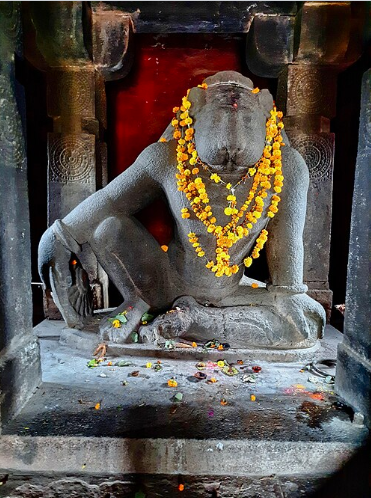
Narasimha, Ramtek Kevala Narasimha temple.
Narasimha Jayanti celebrates the appearance of Lord Narasimha, one of the ten major avatars of Vishnu. Narasimha is often described as the “Man-Lion” form of Vishnu: neither fully human nor fully animal, fierce and protective, terrifying to the tyrant but compassionate toward the vulnerable.
The story at the heart of Narasimha Jayanti is one of the most dramatic in the Hindu tradition. Hiranyakashipu, a powerful asura king, receives a boon from Brahma that seems to make him impossible to kill. He cannot be killed by human or animal, inside or outside, by day or night, on earth or in the sky, or by any weapon. Protected by this technical invincibility, he becomes arrogant and tyrannical, troubling heaven and earth and demanding worship for himself.
But inside Hiranyakashipu’s own house is Prahlada, his young son, who refuses to treat power as God. Prahlada remains devoted to Vishnu despite his father’s threats. In many tellings, Hiranyakashipu tries again and again to break Prahlada’s faith, but Prahlada will not surrender his conscience. The Bhagavata Purana presents Prahlada as calm, modest, and self-controlled even when his father rages against him. When Hiranyakashipu asks where Vishnu is, Prahlada’s answer is radical: divine power is not owned by kings. It is the source of power in all beings.
The climax comes when Hiranyakashipu points to a pillar and demands to know whether Vishnu is present there too. When the pillar is struck, Vishnu appears as Narasimha: half-human, half-lion. Narasimha destroys Hiranyakashipu at twilight, on a threshold, with his claws, placing him on his lap. Each detail matters. Twilight is neither day nor night. The threshold is neither indoors nor outdoors. Narasimha is neither human nor animal. The claws are not conventional weapons. The lap is neither earth nor sky. The tyrant’s loopholes collapse around him.
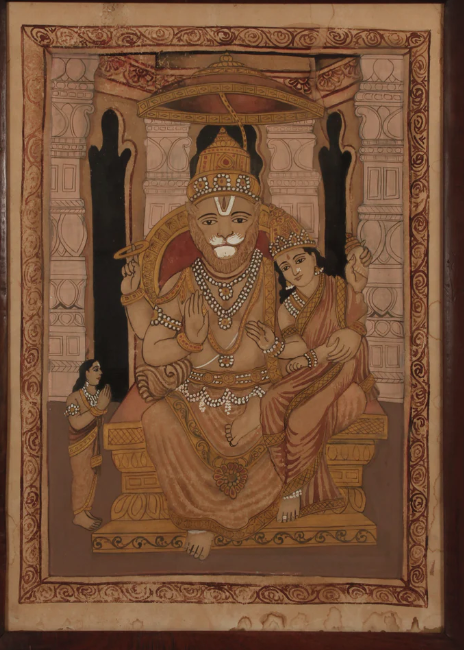
rare monochrome Mysore School painting of ‘Lakshmi Narasimha’.
This is what makes Narasimha Jayanti such a powerful holiday for our time. The story is not simply about divine violence or supernatural victory. It is about the failure of authoritarian cleverness. Hiranyakashipu tries to build a world where power is untouchable because it has mastered the rules. Narasimha appears in a form that breaks the categories themselves, showing that no system of legalism, ritual status, or technical immunity can protect cruelty forever.
From a Hindus for Human Rights perspective, Narasimha Jayanti is a festival about protection — but not protection as domination, revenge, or fear. It is protection as dharma: the defense of the vulnerable against unchecked power. Prahlada is a child facing the full force of a ruler’s rage. Narasimha’s ferocity is not random anger. It is the force that intervenes when power turns against the innocent.
There is also a deeply anti-hierarchical lesson in Prahlada’s own prayer. In the Bhagavata Purana, Prahlada says that wealth, high birth, beauty, austerity, education, influence, strength, and intelligence are not what satisfy the divine; devotion does. The text goes even further, placing sincere devotion above the pride of caste status. For those of us committed to an anti-caste and human rights-centered Hinduism, this is a crucial part of the Narasimha story: spiritual worth cannot be measured by birth, social rank, ritual prestige, or proximity to power.
This is why Prahlada has long been remembered not merely as a devotee, but as a figure of moral courage. One useful Gandhian source, the educational resource “Prahlad and Harishchandra” on the M.K. Gandhi website, says that from childhood Gandhi loved the stories of Prahlad and Harishchandra as “truth-loving people.” That source places Prahlada alongside Harishchandra in a moral universe shaped by truth, suffering, and steadfastness. Gandhi’s own autobiography, The Story of My Experiments with Truth, speaks most directly and personally about Harishchandra, whose example of truthfulness “haunted” him and helped shape his lifelong devotion to satya, or truth. Taken together, these sources let us make a careful but meaningful connection: Prahlada belongs to the same ethical imagination in which truth is not merely something one believes, but something one is willing to suffer for.
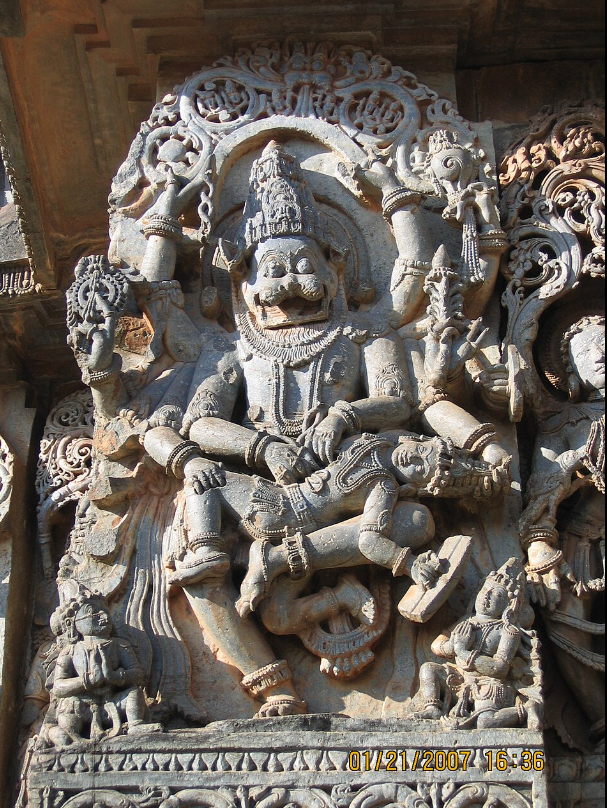
Narasimha kills Hiranyakashipu, Halebidu, Karnataka
Narasimha Jayanti asks us to reflect on what courage looks like when the world is ruled by fear. It asks what it means to protect children, dissenters, minorities, and all those who are punished for refusing to worship power. It reminds us that dharma is not passive. Dharma does not flatter tyrants. Dharma does not sanctify cruelty. Dharma stands between the vulnerable and the violence of those who believe they are untouchable.
To honor Narasimha is to remember that the divine is not confined to temples, palaces, or systems of status. The divine can emerge from the pillar, from the threshold, from the place no one expects. And when it does, it comes not to protect hierarchy, but to protect life.
FAQ: Narasimha Jayanti
What is Narasimha Jayanti?
Narasimha Jayanti is a Hindu festival that celebrates the appearance of Lord Narasimha, the fierce half-human, half-lion avatar of Vishnu. It is observed on Vaishakha Shukla Chaturdashi, the fourteenth day of the bright half of the Hindu lunar month of Vaishakha.
At its heart, Narasimha Jayanti is a festival about divine protection, moral courage, and the defeat of tyranny. But in a deeper Hindu ethical reading, it is also a story about what happens when power becomes arrogant, when rulers demand worship, and when the vulnerable are punished for refusing to surrender their conscience.
Who is Narasimha?
Narasimha is one of the major avatars of Vishnu, often included among the Dashavatara, or ten principal incarnations of Vishnu. His name combines nara, meaning human, and simha, meaning lion. Narasimha appears in a form that is neither fully human nor fully animal in order to defeat the tyrant Hiranyakashipu, who believed he had made himself impossible to kill.
Narasimha is often depicted as fierce, powerful, and terrifying. But his ferocity is not random violence. In the story, Narasimha’s anger is directed toward the protection of Prahlada, a child devotee persecuted by his own father. This makes Narasimha a complex figure: frightening to the oppressor, but compassionate toward the vulnerable.
What is the story of Narasimha Jayanti?
The story of Narasimha Jayanti centers on Hiranyakashipu, a powerful asura king, and his son Prahlada. Hiranyakashipu receives a boon from Brahma that seems to protect him from death. He cannot be killed by human or animal, indoors or outdoors, during the day or night, on the earth or in the sky, or by any weapon.
Empowered by this boon, Hiranyakashipu becomes tyrannical. He demands that everyone worship him and treat his power as supreme. But his son Prahlada remains devoted to Vishnu. Prahlada refuses to accept that any king, father, ruler, caste order, or empire can take the place of the divine.
When Hiranyakashipu demands to know whether Vishnu is present even in a pillar, Vishnu appears from the pillar as Narasimha. At twilight, on a threshold, Narasimha places Hiranyakashipu on his lap and kills him with his claws. Each detail matters: twilight is neither day nor night; the threshold is neither indoors nor outdoors; Narasimha is neither human nor animal; his claws are not conventional weapons; his lap is neither earth nor sky. The tyrant’s protections collapse because they were built on technicalities rather than truth.
What is the meaning of Narasimha Jayanti?
The meaning of Narasimha Jayanti is often summarized as the victory of good over evil. But the story is more specific and more intellectually rich than that. Narasimha Jayanti is about the defeat of authoritarian power that believes it can manipulate law, language, and ritual to make itself untouchable.
Hiranyakashipu does not simply represent “evil” in a general sense. He represents the ruler who confuses power with divinity. He represents the arrogance of those who believe that legal loopholes, social hierarchy, violence, and fear can protect them from moral accountability. Narasimha’s appearance shows that dharma cannot be trapped inside the categories created by oppressive power.
For Hindus for Human Rights, Narasimha Jayanti is a reminder that Hindu dharma must not be used to sanctify domination. Dharma must protect life, conscience, dignity, and the vulnerable.
Why is Narasimha half-human and half-lion?
Narasimha appears as half-human and half-lion because Hiranyakashipu’s boon says he cannot be killed by either human or animal. Vishnu appears in a form that breaks this binary. Narasimha is both and neither.
This is one of the most powerful symbolic features of the story. Narasimha does not simply overpower Hiranyakashipu; he exposes the limits of Hiranyakashipu’s imagination. The tyrant believes he has mastered reality by controlling categories. Narasimha arrives as a form that exceeds those categories.
In a progressive Hindu interpretation, Narasimha’s form can remind us that justice often comes from the margins, the thresholds, and the places that rigid systems cannot understand. The divine is not confined to neat social, political, or ritual classifications.
Who is Prahlada, and why is he important?
Prahlada is the young son of Hiranyakashipu and one of the most beloved child devotees in Hindu tradition. He is important because his courage is not military, royal, or violent. Prahlada’s courage is the courage of conscience.
He is a child facing the rage of a king who is also his father. That means his resistance is political, spiritual, and familial all at once. Prahlada is pressured to obey power, accept domination, and deny what he knows to be true. He refuses.
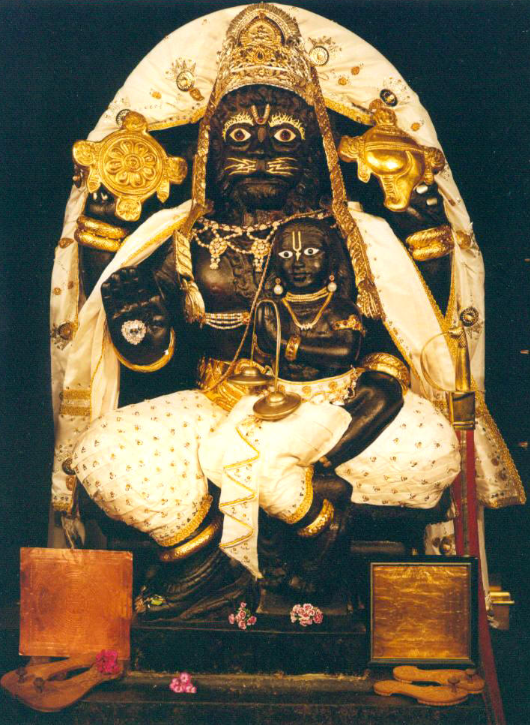
Narasimha and Prahlada
This is why Prahlada is remembered not only as a devotee, but as a figure of moral resistance. He shows that truth does not depend on age, status, caste, wealth, or institutional authority. His power lies in his refusal to let fear decide what is sacred.
What does Hiranyakashipu represent?
What does Hiranyakashipu represent?
Hiranyakashipu is often described as an asura king, but a careful reading should not treat “asura” as a simple moral category meaning “evil.” Hindu stories are more complicated than that. Devas are not always morally pure, and asuras are not always spiritually corrupt. In fact, Prahlada himself is born into Hiranyakashipu’s asura lineage, yet he becomes one of the great exemplars of devotion, courage, and moral clarity.
This matters because too-simple readings of Hindu mythology can turn symbolic categories into social prejudice. When “asura” is flattened into “demon,” the story can become a tale about one kind of being being inherently evil. But the Narasimha story resists that. The moral contrast is not between a “good species” and a “bad species.” It is between domination and conscience, arrogance and humility, cruelty and protection.
Hiranyakashipu represents the arrogance of unchecked power. He is not dangerous simply because he is an asura; he is dangerous because he uses power to place himself above moral accountability. He receives a divine boon and uses it not for humility, service, or protection, but to construct a system of domination. He demands worship not because he is worthy of reverence, but because he has the power to punish those who refuse.
His violence toward Prahlada reveals a deeper spiritual danger: the temptation to confuse authority with truth. Hiranyakashipu tries to control his child’s education, speech, devotion, and conscience. He cannot tolerate the idea that truth might live outside his command. In that sense, he represents authoritarian power in its most intimate form: the ruler, father, teacher, and state all collapsing into one demand for obedience.
For a human rights-centered Hindu reading, Hiranyakashipu is therefore not a warning against “asuras” as a people or category. He is a warning against every structure of power — religious, political, familial, caste-based, or national — that demands obedience while denying dignity. The presence of Prahlada within the same lineage makes the lesson even sharper: no community is inherently righteous or inherently corrupt. Dharma is revealed through action, humility, justice, and the protection of the vulnerable.
Is Narasimha Jayanti a story about violence?
Narasimha Jayanti includes a violent mythic climax, but reducing the story to violence misses its ethical meaning. Narasimha’s ferocity is not cruelty for its own sake. It is a response to a ruler whose power has become abusive, absolute, and directed against the vulnerable.
A progressive Hindu reading should not romanticize violence. Instead, it can ask why the story imagines divine intervention at the point where ordinary systems have failed. Hiranyakashipu has manipulated the rules so thoroughly that justice must appear in a form outside those rules.
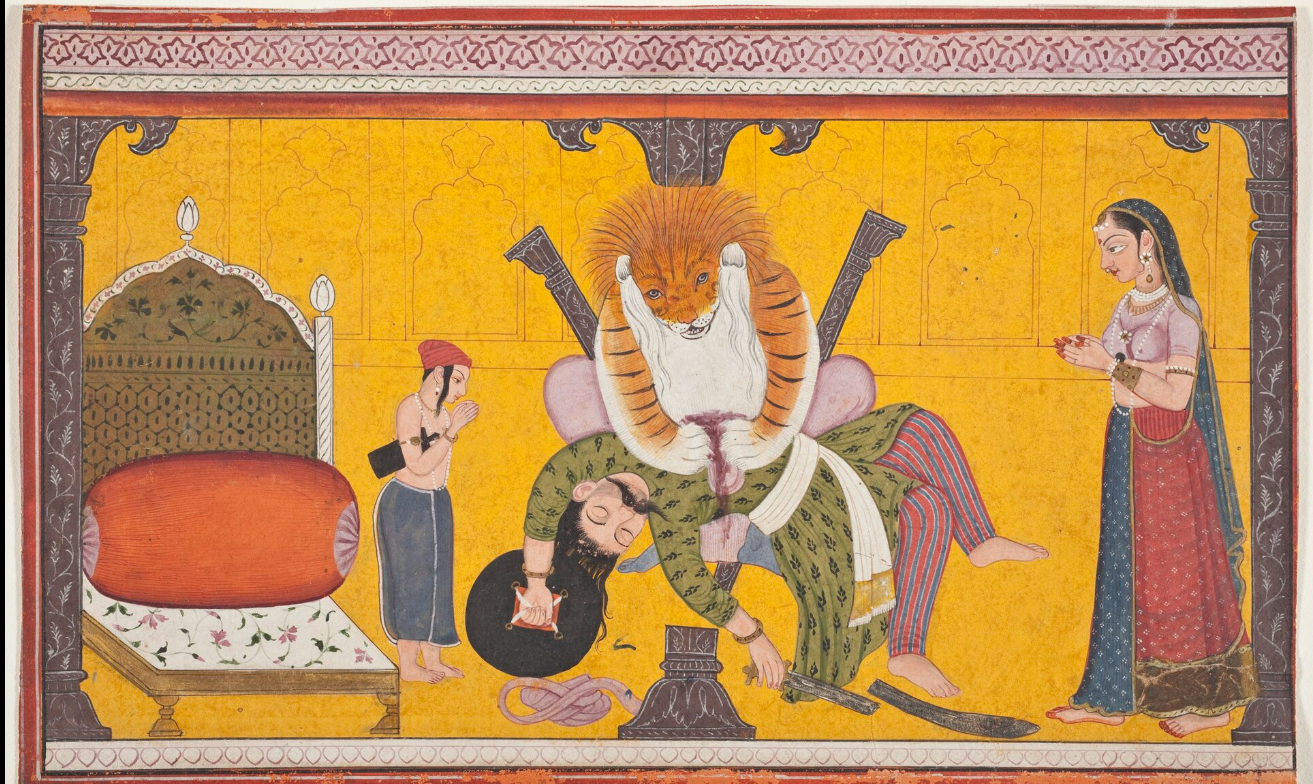
manuscript folio from Bhagavata Purana 1700s
The deeper question of Narasimha Jayanti is not whether violence is sacred. The deeper question is: What happens when power becomes so protected by law, status, and fear that the vulnerable have nowhere left to appeal? Narasimha represents the refusal of dharma to abandon them.
What is the progressive Hindu meaning of Narasimha Jayanti?
A progressive Hindu interpretation of Narasimha Jayanti sees the festival as a call to defend the vulnerable against authoritarianism, caste hierarchy, religious domination, and the abuse of power.
In this reading, Prahlada represents conscience. Hiranyakashipu represents domination. Narasimha represents dharma as protection. The story insists that no ruler, no family structure, no social hierarchy, and no religious authority can demand obedience to cruelty.
For Hindus for Human Rights, Narasimha Jayanti is a reminder that Hinduism contains powerful resources for resisting tyranny. It teaches that devotion is not submission to power. Devotion is fidelity to truth, dignity, and the sacred presence that cannot be owned by kings.
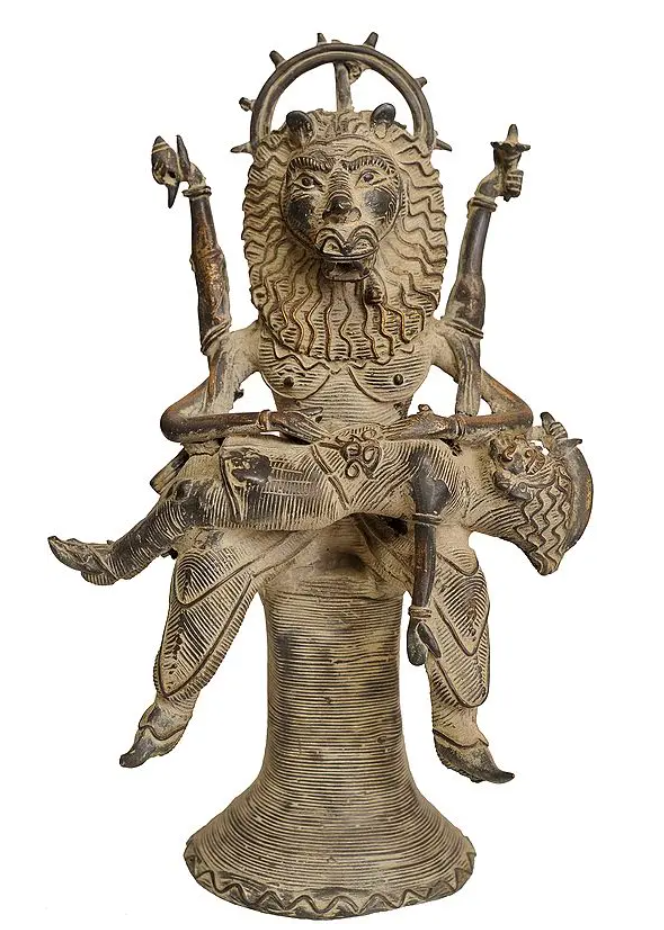
Narasimha statue from Bastar
What does Narasimha Jayanti teach about dharma?
Narasimha Jayanti teaches that dharma is not passive. Dharma is not merely personal piety, ritual correctness, or obedience to social order. In the Narasimha story, dharma appears as the protection of a child whose conscience is under attack.
This matters because the language of dharma has often been used to defend hierarchy, caste duty, gender control, and social obedience. Narasimha Jayanti challenges that misuse. It reminds us that dharma cannot mean loyalty to injustice. Dharma must mean accountability, protection, truth, and care for those made vulnerable by power.
A Hinduism worthy of Narasimha’s story must stand with Prahlada, not Hiranyakashipu.
Why does Narasimha appear from a pillar?
Narasimha appears from a pillar after Hiranyakashipu mocks Prahlada’s claim that Vishnu is present everywhere. The pillar becomes a symbol of the divine presence in the place power least expects.
This detail is spiritually important. It tells us that the sacred is not confined to temples, palaces, scriptures, or priestly authority. The divine can emerge from the ordinary, the overlooked, and the in-between. It can appear from the very structure that the tyrant assumes is empty.
For a human rights-centered reading, the pillar reminds us that hope often comes from places dismissed by power: children, dissenters, workers, oppressed communities, religious minorities, caste-oppressed communities, and people told they do not matter.
What does Prahlada teach us about conscience?
Prahlada teaches that conscience is not the same as stubbornness or private belief. Conscience is the disciplined refusal to call falsehood truth simply because power demands it.
His story is especially striking because he is a child. He has no army, no wealth, no throne, no institution, and no physical advantage. Yet he refuses to let fear redefine reality. His courage comes from remaining rooted in truth even when every authority around him insists on obedience.
This is why Prahlada remains so relevant today. In every society, people are pressured to accept injustice as tradition, cruelty as order, and domination as loyalty. Prahlada’s story says that conscience is sacred precisely because it cannot be owned by power.
How is Narasimha Jayanti relevant today?
Narasimha Jayanti’s contemporary relevance really registers because we continue to live in a world where power often tries to make itself untouchable. Governments, religious authorities, caste elites, corporations, and social majorities can all use law, culture, and fear to protect themselves from accountability.
The Narasimha story speaks to any moment when vulnerable people are told to remain silent for the sake of order. It speaks to children facing abuse, minorities facing persecution, caste-oppressed communities facing humiliation, dissenters facing repression, and religious communities facing the demand to worship power rather than truth.
Narasimha Jayanti reminds us that Hindu stories can be resources for justice. They can help us imagine a dharma that protects the vulnerable rather than defending the powerful.
How do people observe Narasimha Jayanti?
Many Hindus observe Narasimha Jayanti through fasting, prayer, temple visits, recitation of stories from the Puranas, and worship of Vishnu in the form of Narasimha. Devotees often remember Prahlada’s devotion and Narasimha’s role as protector.
But observance can also include ethical reflection. For those approaching the festival through a progressive Hindu lens, Narasimha Jayanti can be a day to ask: Who is vulnerable in our society? Who is being punished for conscience? Where is power demanding worship? What would it mean to practice dharma as protection?
In that sense, Narasimha Jayanti is not only a ritual date. It is an annual invitation to align devotion with justice.
What should Hindus for Human Rights emphasize on Narasimha Jayanti?
Hindus for Human Rights can emphasize Narasimha Jayanti as a festival of protection, conscience, and resistance to tyranny. The holiday offers a powerful Hindu framework for rejecting authoritarianism, caste hierarchy, religious nationalism, and every form of domination that demands obedience at the expense of dignity.
The central message is clear: dharma does not belong to the powerful simply because they claim it. Dharma is revealed in the protection of the vulnerable, the courage of conscience, and the refusal to confuse fear with faith.
To honor Narasimha is to stand with Prahlada. To honor Prahlada is to defend truth even when power calls it disobedience. To honor Narasimha Jayanti is to remember that devotion without justice is incomplete.