
New York Must Outlaw Caste Discrimination
No one in New York should be denied a job, a home, credit, an internship, or access to a public space because of caste.
That is the simple moral truth behind A6920/S6531, a bill now before the New York State Legislature that would explicitly prohibit discrimination based on caste under New York law. The Assembly bill, sponsored by Assemblymember Steven Raga, and its Senate counterpart, sponsored by Senator James Sanders Jr., would amend the state’s Executive Law to name caste discrimination in employment, housing, public accommodations, real estate transactions, credit, and internships.
Caste is often treated as invisible in the United States. But invisibility does not mean absence. Caste can travel through surnames, family networks, marriage expectations, food practices, religious and cultural spaces, professional referrals, housing arrangements, jokes, silences, and exclusions. For Dalit, Bahujan, Adivasi, and other caste-oppressed communities, caste discrimination is not an abstract issue. It can mean being humiliated at work, pushed out of housing, denied opportunity, or forced to navigate coded forms of social exclusion.
The bill defines caste as a class within a graded social hierarchy that assigns social status, roles, privileges, and disadvantages based on birth, often enforcing hereditary status, endogamy, occupational restrictions, and limits on social and economic mobility. This definition matters because caste is not always captured clearly by existing categories like race, religion, ethnicity, or national origin. The Senate sponsor memo notes that because caste is not tied to one religion or race, current state law can fail to protect people who experience caste-based discrimination.
For Hindus for Human Rights, this is also a question of moral clarity. A liberatory Hinduism must stand against hierarchy disguised as tradition. The dignity of every person is not negotiable. Any system that ranks human beings by birth, assigns purity or pollution, and turns inherited status into social power must be confronted directly.
Supporting caste protections is not anti-Hindu. It is anti-discrimination. It is pro-dignity. It is a way for Hindu, South Asian, interfaith, and civil rights communities to say clearly: our traditions, cultures, and communities are strongest when they reject inherited humiliation and stand with those most harmed by it.
New York’s Human Rights Law already names many protected categories in employment and public life, including race, creed, color, national origin, citizenship or immigration status, sexual orientation, gender identity or expression, disability, sex, age, marital status, and others. Caste is not currently named in those protections. A6920/S6531 would help close that gap.
This bill is not about policing identity, ancestry, religion, or private belief. It is about what happens when caste becomes discrimination: when someone is harassed at work, excluded from housing, denied professional opportunity, demeaned in school or community spaces, or treated as lesser because of the caste they were born into or perceived to belong to.
New York has an opportunity to lead. At a time when caste-oppressed communities are speaking with courage, lawmakers must listen. Civil rights protections are strongest when they name the harms people actually face.
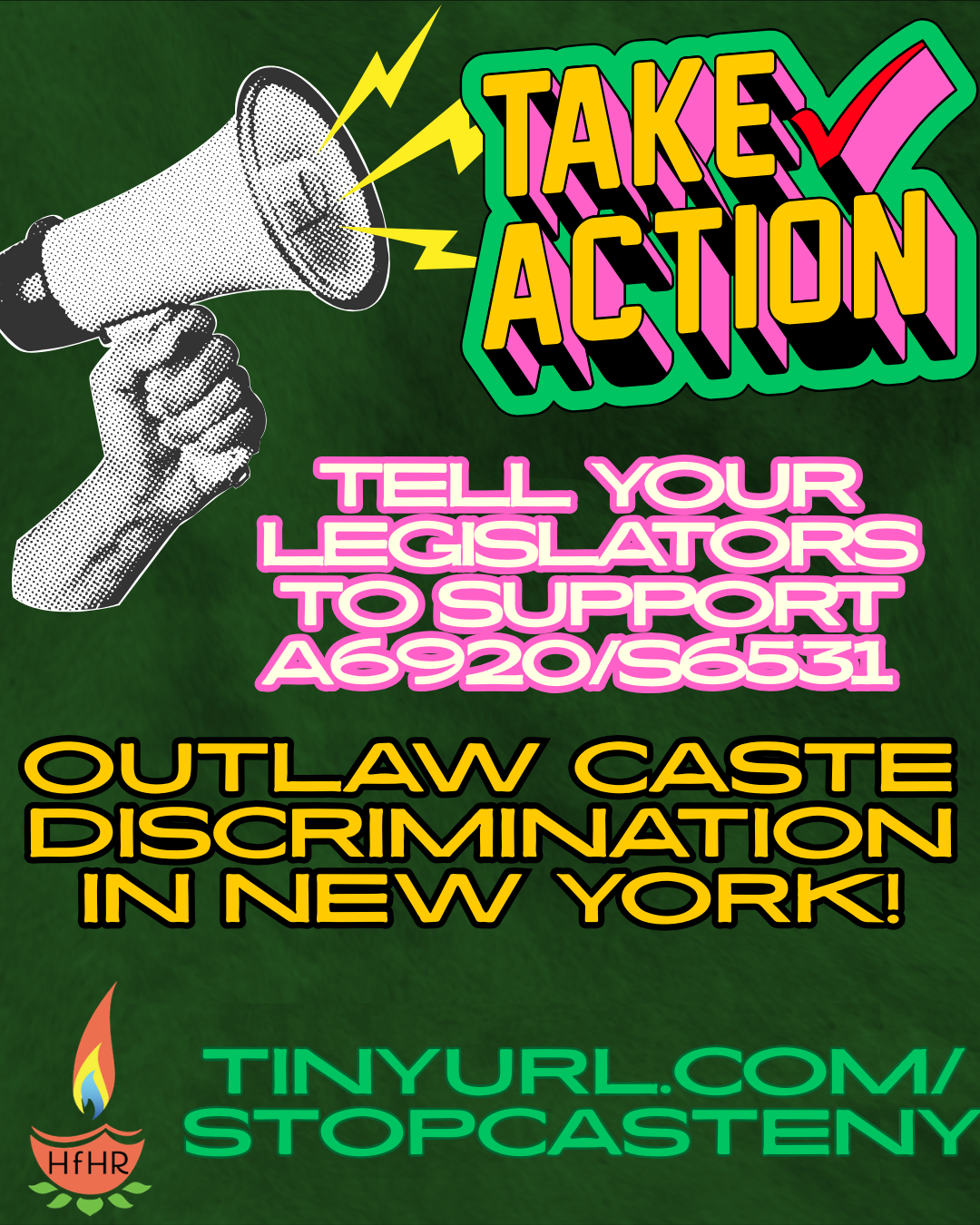
Take action today. Tell your New York legislators to support A6920/S6531 and outlaw caste discrimination in New York.
Use this link: tinyurl.com/stopcasteny
If you live in New York, contact your State Senator and Assemblymember. If you live outside New York, share this with friends, family, faith communities, student groups, labor allies, and civil rights organizations across the state.
Caste discrimination survives when it is hidden. Justice begins when we name it.