
A New Approach to Interfaith Dialogue Begins at Riverside Church
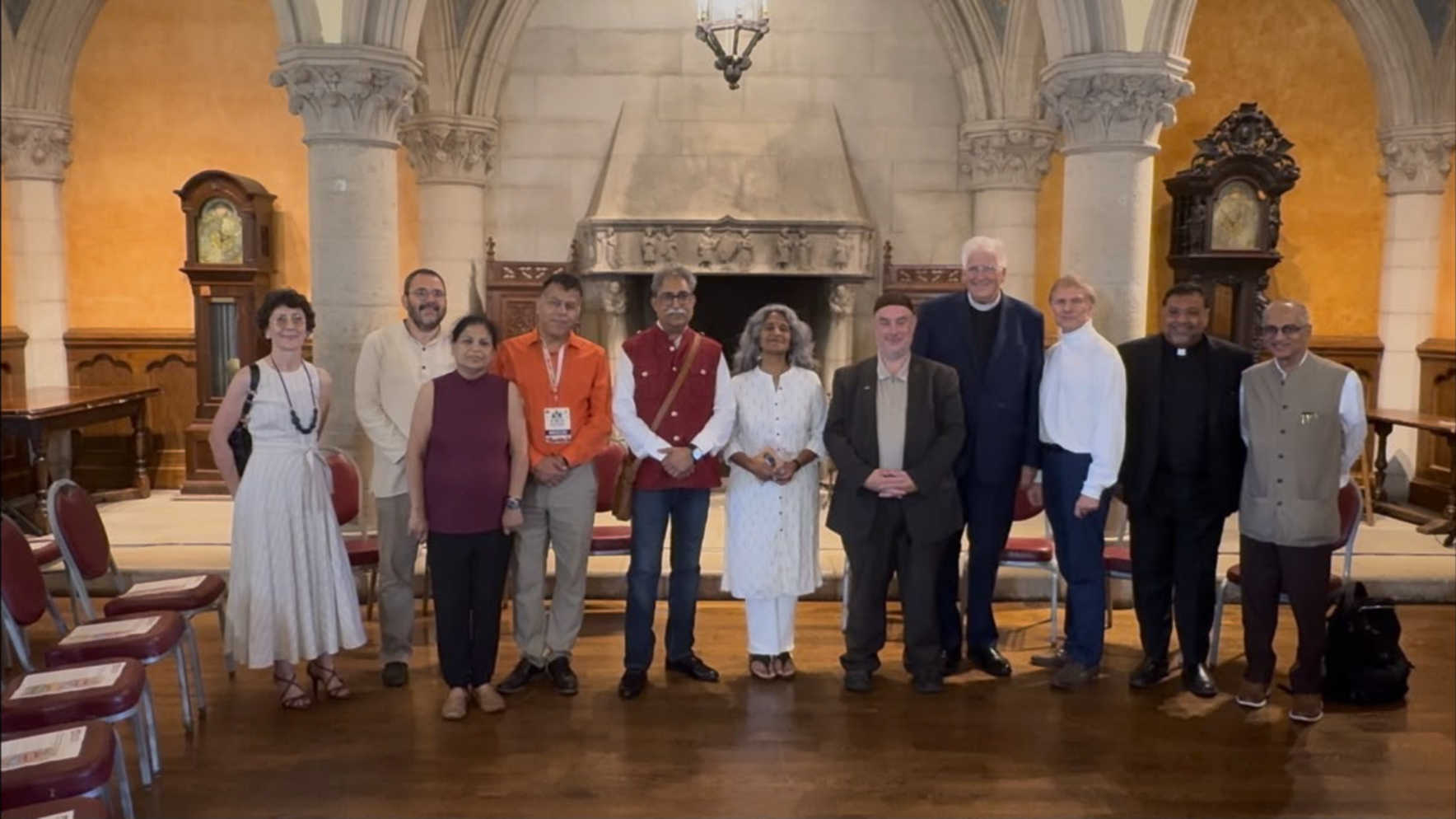
On October 1, faith leaders, scholars, activists, and community members gathered at The Riverside Church in New York City for the inaugural Faith Beyond Religious Nationalism conversation, an effort to develop a deeper and more self-reflective model of interfaith dialogue.
The gathering grew in part from a difficult experience earlier this year. Faith leaders including Imam Shamsi Ali and the Rev. Adriene Thorne had attended an interfaith gathering connected to RSS chief Mohan Bhagwat’s visit to New York and afterward felt they had not been given the context they needed to understand the politics surrounding the event.
What followed was a larger conversation among faith leaders about a weakness in many interfaith spaces: we may know one another as Hindus, Muslims, Christians, Jews, Sikhs, Buddhists, or members of other traditions without necessarily understanding the debates and struggles taking place within those communities.
For Thorne, that experience raised a particularly concrete question: what might have been different if she had been given a fuller understanding of Hinduism, Hindutva, and the distinction between a religious tradition and a political movement claiming to represent it?
That question helped shape the October gathering. At the same time, the Rev. Peter Cook and the Rev. Neal Christie were developing Faith Beyond Religious Nationalism as a broader effort to create interfaith spaces grounded not simply in goodwill, but in truth-telling, listening, self-examination, and a willingness to confront the ways religion can be used to justify nationalism and exclusion.
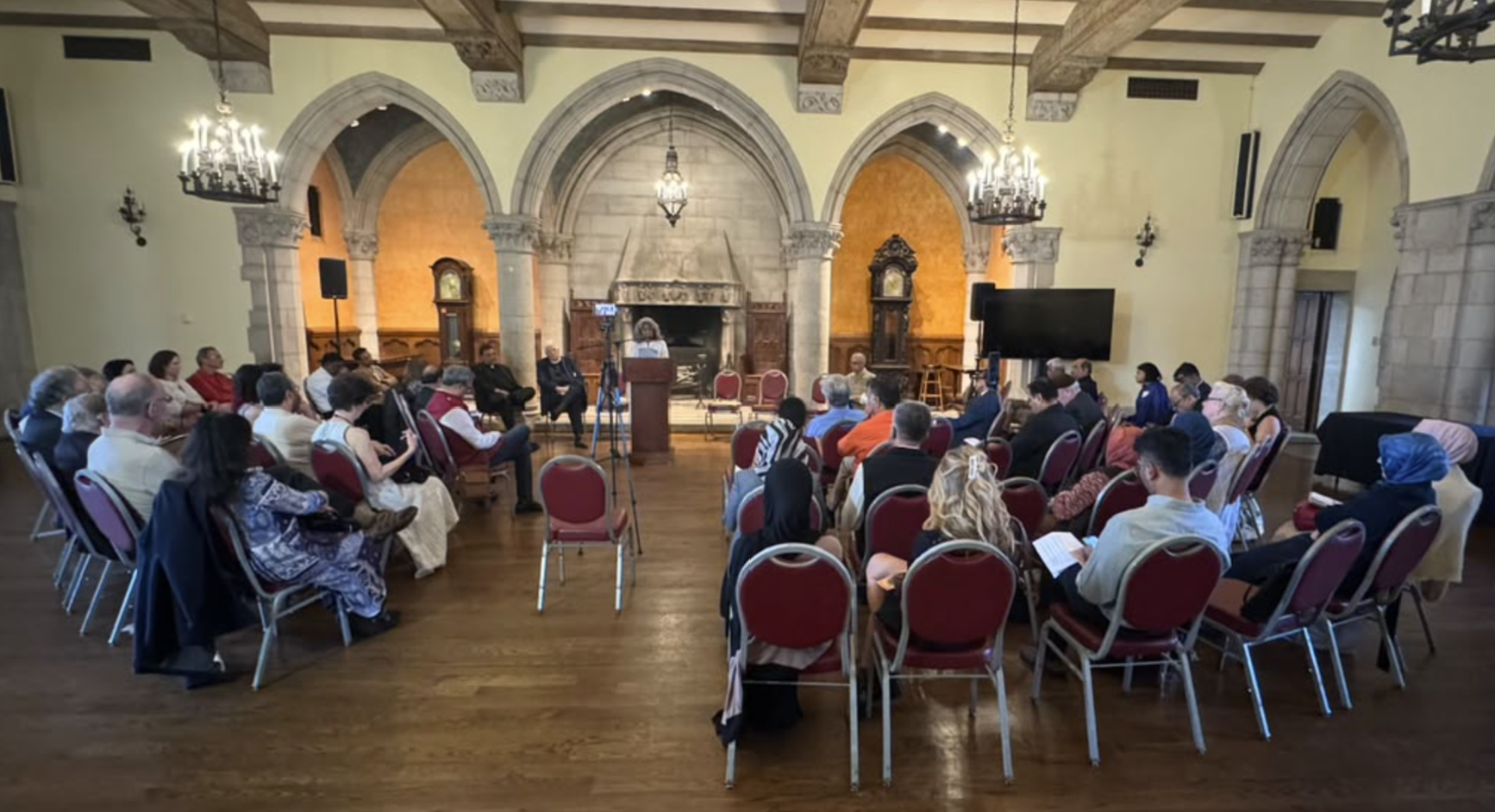
The Riverside gathering brought those strands together.
The evening opened with Imam Shamsi Ali, Imam of the Jamaica Muslim Center, and the Rev. Adriene Thorne, Senior Minister of The Riverside Church, reflecting on why religious communities need spaces for a more informed and substantive kind of interfaith dialogue. Their remarks focused on the importance of curiosity about one another’s traditions, but also on understanding how those traditions can be politically distorted.
The Rev. Neal Christie and the Rev. Peter Cook then helped frame the broader question of religious nationalism itself: how religious identity can become fused with political power, national belonging, and ideas about who properly belongs within a society.
From there, the evening moved into Hinduism as the first tradition to undergo this more searching examination.
Sunita Viswanath, co-founder of Hindus for Human Rights, addressed the question “What is Hinduism?”, speaking from within the tradition about its devotional life, philosophical diversity, contradictions, and liberatory possibilities.
The Rev. John J. Thatamanil, Professor of Theology and World Religions at Union Theological Seminary, then explored Hinduism and its distortion through Hindu nationalism, examining what happens when the complexity of a religious tradition is narrowed into a political ideology.
The conversation then broadened through Peter Beinart, journalist, professor, and author of Being Jewish After the Destruction of Gaza: A Reckoning, who reflected on faith, political power, and the ways religious traditions can be transformed by nationalism. His contribution also pointed toward the larger ambition of the series: Hinduism and Hindutva would be the first case, but not the last.
The organizers envision future gatherings moving among mosques, synagogues, churches, temples, meditation centers, and other sacred spaces, with different communities undertaking the same kind of examination of their own traditions and the political movements that claim their authority. A future gathering might, for example, examine Judaism and Zionism; another might consider Christianity and Christian nationalism.
The purpose is not to create a sequence in which religious communities take turns criticizing one another. It is to develop a more reciprocal practice of interfaith dialogue: learning enough about other traditions to understand the struggles taking place within them, while becoming willing to examine our own traditions with the same seriousness.
The gathering was conceived as the beginning of a broader series rather than a one-time event. Future Faith Beyond Religious Nationalism conversations are intended to take this same self-reflective approach into synagogues, temples, mosques, churches, meditation centers, and other sacred spaces, with different traditions taking their turn at examining the relationship between faith, nationalism, prejudice, democracy, and public life.
For Hindus for Human Rights, the evening also pointed toward a larger vision of progressive Hindu practice. Near the conclusion of her remarks, Viswanath turned to the long history of anti-caste Hindu reformers and poets, including Kabir, Basavanna, Andal, Mirabai, and Ramdas. Asked what religious lineage or sampradaya she belongs to, she offered a striking answer: “My sampradaya connects me to any Hindu throughout history who has rejected caste.”
That idea captured much of what the evening was trying to make possible: an interfaith dialogue in which religious commitment does not require defensiveness, and self-examination does not require abandoning faith. Instead, faith can become the ground from which communities examine inherited structures, listen seriously to one another, and imagine more equal and liberatory traditions.
-
I was born into an upper caste Hindu family in South India. From early childhood I rejected caste, and casteist practices, but embraced so many of the traditions practiced by my family. I pray to Lord Ganesha because he never says no to the innocent prayers of children. I pray to Maa Shakti, the divine Goddess, because in her gentle form she protects and embraces us, and in her fierce form, she destroys the evil all around. I love the sounds of Hindu chanting, the smells of camphor and other incense used in puja, and the sight of the dancing flame, Lord Agni, who presides over most Hindu rituals. I was taught that God is absolutely everywhere, and most importantly, God is within me. My relationship with God is one of delightful intimacy. For Hindus, God is your baby, your parents, your best friend, your lover. Hindu Gods make mistakes, have flaws. Through their stories we learn to be better people ourselves.
Some of your Hindu friends might say: Hinduism is not a religion. It is a way of life. It is sanatana dharma, an eternal dharma or ethical and values-based path.
While there are many strands and schools and lineages of worship and practice, from perhaps 2500 BC which is when the Indus Valley Civilization is thought to have existed, which share roots and similarities, the concept of a religion called Hinduism is a modern one. The term was coined by the British to name the collection of diverse beliefs and practices they encountered when they colonized the subcontinent. Over the centuries, it is also true that village and tribal deities which were not necessarily Hindu were folded into mainstream Hinduism. The Hindu world suffers a deep wound of separation into unequal castes, and these local deities were often worshipped by so-called lower castes. The system that appropriated these deities and practices over time was a Brahminical system that supports and perpetuates caste hierarchy.
The vast diversity of Hindu belief and practice makes Hinduism hard to define, and yet, to those who say there is no such thing as Hinduism, I would ask them to rethink. Even if there is a vast diversity of practice and belief, and though there has been an ongoing homogenization and appropriation of local practices, there exists today something that is readily recognized as Hindu practice. Hinduism is considered a religion alongside the other world religions. We speak of Hindus, the Hindu diaspora, Hindu texts, Hindu beliefs, Hindu temples. And in my country of birth India, the most populous nation on the planet, religious nationalists are well on their way to creating a Hindu rashtra, a religious and authoritarian state.
All this to say: Hinduism exists. Hindus exist. And I am a Hindu.
—
I am not a priestess, theologian, or a renunciant. I am a human rights activist that insists on connecting her faith to work in the world. Hindu texts offers four yogas or paths to the truth: action (karma yoga), devotion (bhakti yoga), meditation (raja yoga) and knowledge (gyana yoga). I am a karma yogi.
I will share with you about the Hinduism that I practice, some of which I learned from my parents, some which I have learned myself, and a lot of which I have learned from my Guru and mentor Pandit and Dr Anantanand Rambachan.
The most central Hindu concept in my life is the notion of dharma, as taught by Lord Krishna in the Bhagawat Gita. You decide what you must do at any given time, given the context and your own nature and obligations, and you take that action with all your heart and focus, and without worrying about the results of your action. I have been taught to live this way since I was a very young child. No guilt, no regrets, no perseverating. Just act.
In fact Lord Krishna says in the Gita, inaction is not an option, because even inaction is an action. I grew up to see the Gita as a call to action.
Another formative teaching was from my mother. There is no one and nothing that is pure evil or pure good. My mother’s example was from the Ramayana, the Hindu epic that features a war between Lord Rama and the demon King Ravana. Every Diwali, when every other child was taught that Diwali is the festival of the victory of good over evil, this is what I was taught: If Lord Rama were pure good, he would not have treated Sita so cruelly, and made her prove her chastity by walking through fire, and banishing her to the forest even though she emerged from the fire unscathed. And if Lord Ravana were pure evil, he would have brutalized her while she was his captive. Even though we talk of good and evil, the fight between good and evil isn’t out in the world – it is within each of us.
Swami Medhananda is a Hindu monk based in California who writes and lectures on modern themes in Hinduism.
He has listed these “noble truths” of hinduism:1–There is one infinite divine reality called by various names and manifests in various forms.
Ekam sat vipra bahudha vadanti.
Truth is one, sages call it by different names.
2–Each of us is intimately connected to the infinite divine.
I am one with God as a non-dual divinity. Or I am part of god, and god is the whole.3--The Ultimate goal of life is moksha, liberation from the cycle of life, death and rebirth. That is, to realize the divine reality. (Moksha)
Dharma, Artha, Kama, Moksha are the four goals of life
Dharma: ethical living
Artha: material acquisition, a valid value
Kama: fulfillment of worldly desires, pleasure
Moksha: liberation, the ultimate goal.
Other three are means to the end of attaining moksha
4– There are many paths to the infinite divine.
Because God is infinite, there are infinite paths to God.
5–Karma and rebirth: there are good consequences of good actions, our rebirth is determined by our actions in this life.After listing these defining aspects of Hinduism, Swami Medhananda offers the disclaimer: Most Hindus adhere to at least some of these truths. But you can also be a hindu if you don’t believe in any of them.
There are probably as many answers to the question, “what is hinduism” as there are Hindus. This to me is one of the most liberating aspects of Hindu practice – a seeker, a devotee can chart their own path. There isn’t one book or one prophet or one God.
You can worship the deity of your family, and participate in rituals in the prescribed way.
Or you can choose your own Ishtadevata, the deity of your choice, the one you adore.
Or do both.
If ritual and prayer aren’t for you, you can be a philosophical Hindu, and search for the truth through knowledge.
While you worship the many Gods and Goddesses and celebrate their holy days, you also remember that all the deities are but aspects of the same changeless, timeless, formless, genderless eternal consciousness that is Brahman.
You are to consider your parents, and your teacher as God. However, your greatest guru is within you. If you obey authority blindly, you are betraying the most important guru, your own conscience.
The oldest Hindu text is the Rig Veda, and it contains these radical and liberatory teachings:
The truth is one, sages call it by different names. (we heard this before)
Let noble truths come from all directions.
Both these teachings tell us to keep an open mind, and realize that different ways of seeing and thinking are equally valid.
The Sama veda tells us:
Tat Tvam Asi
This is one of the Maha vakyas (or great sayings) which means you are that, or that is you.
Each of us isn’t simply connected to each other, and to the divine. We are each other. The divine is in us.
If the divine is in you and me, and you and I are not just connected but are one, then where is there room for hate, where is there room for “other?”
The Taittiriya Upanishad teaches: Atithi Devo Bhava
Be one for whom stranger is God.
It doesn’t say the Hindu stranger, the stranger with the same politics, the same views, the same faith, race, ethnicity, gender. It asks us to see the divine in anyone and everyone we encounter.These teachings and sayings from the Vedas and Upanishads are the ones that motivate me as a Hindu. Anantji, my guru, calls this path the Hindu Theology of Liberation.
A project we have co-created, Samadarshini, aspires to articulate a way forward, in our present times, to be born, live, and die, as Hindus rooted in love. Union Theological Seminary and Garret Theological Seminary in Chicago are partners in our endeavor. Samadarshini can be translated as “Seeing Equally.” It comes from a line in the Hindu text, the Bhagavad Gita, in which Lord Krishna says that a true devotee regards all people, all creatures, the whole world, equally, and does not discriminate. Yesterday saw the book launch in Delhi of our anthology, Seeing Equally. Every chapter is the story of a contemporary liberatory and anti caste Hindu religious leader. Beacon Press will publish the book in the US next fall.The Bhagavad Gita contains another teaching from Lord Krishna: it is better to do your own dharma imperfectly than the dharma of another perfectly. Rather than obey those who are in authority, we must follow our own path, and do so courageously, taking risks and knowing we might make mistakes. We are encouraged to follow our sva-dharma: our own individual ethical path in the world.
Several Hindu texts teach that rather than follow religious texts blindly, one must use our reason and consider what evidence lies before us. Our experience trumps a religious text. Sage Vashishta, the teacher of Rama and his brothers in the Hindu epic, the Ramayana, says during one of the princes’ lessons: “A reasonable statement, even if spoken by a young boy, should be accepted. But a statement lacking reason should be rejected as worthless, even if it is uttered by the creator Brahma himself or found in a sacred scripture."
The Rig Veda which teaches the oneness of us all, and the validity of all paths and perspectives, also contains the Purusha Shukta. This is probably the original source of the caste system. And I and so many of my fellow progressive Hindus reject this entire chapter, and the whole notion of caste.
Purusha or Brahma is the cosmic creator, and the Brahmins (or priestly caste) emerged from his mouth, the kshatriyas (or princely caste) from his arms, the Vaishyas (or trading caste) from his legs, and the Shudras (the laboring caste) from his feet. Some argue that this was simply division of labor rather than a social hierarchy. I cannot agree. The Brahmins from the mouth of the Almighty and the manual laborers from the feet, to me are an undeniable hierarchy. And whatever the original intent, there is absolutely no denying that what has existed throughout history, and exists today, is a brutal social hierarchy. Not only are Brahmins the highest caste, and the shudras the lowest. But there are also many groups that are below the shudras, who don’t fit this four caste framework. These groups have been called by many names. Outcastes. Untouchables. Chamars, Mahars, and so many more. The term that these communities chose for themselves, a name of resistance, is Dalit, a word that means broken or oppressed.Many Hindu families throughout India practice untouchability and unseeability – my own family raised me with this vile practice. When I was a child in India, if I ever touched or even laid eyes on a Dalit person, I had been polluted and had to purify myself with a bath. Gandhi called Dalits Harijans, people of God. But many Dalits felt this was a patronizing name, because rather than be people of God, they wanted to be equal citizens enjoying equal rights.
Bhimrao Ambedkar was India’s most famous Dalit rights advocate. As a Dalit, he endured unspeakable cruelty and discrimination throughout his life, and rose to be one of India’s greatest thinkers and social reformers. He was the architect of India’s constitution. Ambedkar recognized that annihilating caste would require profound religious reform since caste is enshrined in the oldest Hindu texts, and throughout Hindu worship practice. He studied Hindu texts closely, searching for resources that would serve the cause of liberation. He ended up abandoning Hinduism and becoming a Buddhist at the end of his life. However, in his Riddles in Hinduism, he argues that Brahmaism (essentially the teachings of Vedanta) teaches us that the divine is equally present in all of us, and this directly contradicts the caste system. In other words, Hindus do not need to look beyond our own Hindu teachings to find the resources we need for anti-caste reform.I have known since I was a little girl that I am entirely opposed to not only caste discrimination, but caste itself. I and every justice-oriented Hindu must take up Ambedkar’s challenge, and find the teachings within our traditions that lead us to collective liberation, and boldly disavow those that teach supremacy, hierarchy, inequality.
The oldest Hindu texts are called Shruti texts. Shruti means what is heard, and these texts are considered to be teachings from God, that were heard by ancient sages. These include the vedas and many Upanishads. All other texts including the popular Hindu epics the Ramayana and Mahabharata, are called Smriti texts. Smriti means what is remembered; these texts have human authors. Tulsidas’s Ramcharitmanas was written just 450 years ago. It is not audacious to think that some of the brave anti-caste religious leaders we are bringing together through Samadarshini might write texts that will be considered scripture in the future.There have been anti-caste Hindu reformers and revolutionaries throughout history. Bhakti saints like Kabir, Basavanna, Andal, Mirabai, Ramdas, and so many more, sang songs and wrote poetry railing against caste and for all humans to be treated with dignity. The word sampradaya means religious lineage or tradition; an established school of Hindu thought, or way of practicing Hinduism, passed down from teacher to student over generations. When I am asked what is my sampradaya, my answer is clear. My sampradaya connects me to any Hindu throughout history who has rejected caste.