
Last March, a Hindus for Human Rights delegation traveled to Selma, Alabama for the commemoration of the 60th Anniversary of Bloody Sunday. In our reflection, we remembered Viola Liuzzo, a 40 year old white mother of three who drove from Detroit to Selma to answer Dr. King’s call. Viola was shot dead by the Ku Klux Klan as she was helping marchers get home.
Sixty one years later, a 37 year old white mother of three in Minneapolis, Renee Good, was shot dead by ICE. By deciding to protect her immigrant neighbors from ICE brutality, she too was answering Dr. King’s call, and she too paid that highest price.
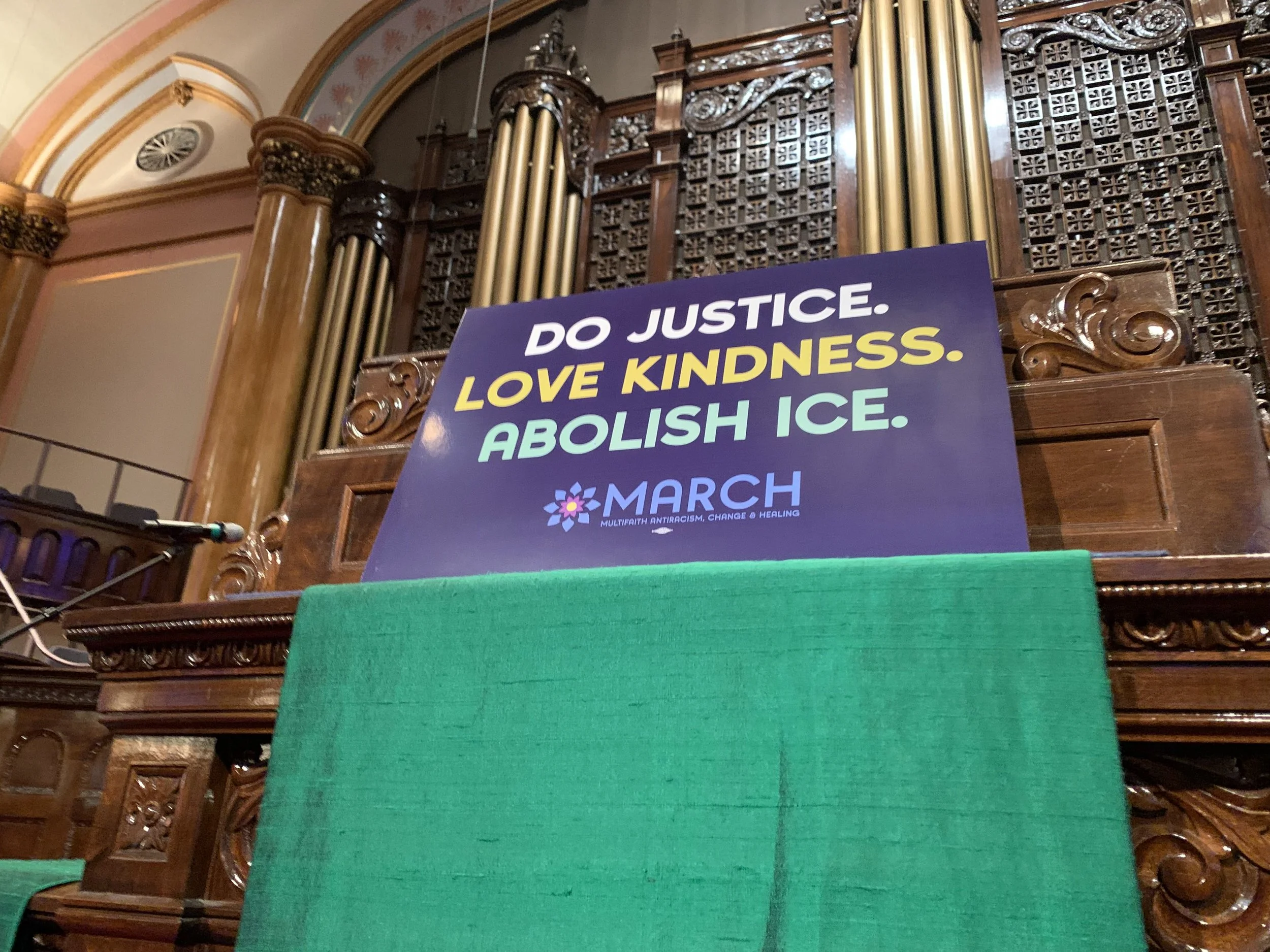
So it made complete sense that when a Minneapolis interfaith organization MARCH (Multifaith Anti-Racism Change and Healing) put out a call to faith leaders across the land to converge in Minneapolis, they invoked Dr. King’s call to all Americans of conscience to come to Selma.
As a cofounder of Hindus for Human Rights and as a mother of three myself, I knew I had to answer the call and travel to Minneapolis.
But who would I travel with? Who was my crew?
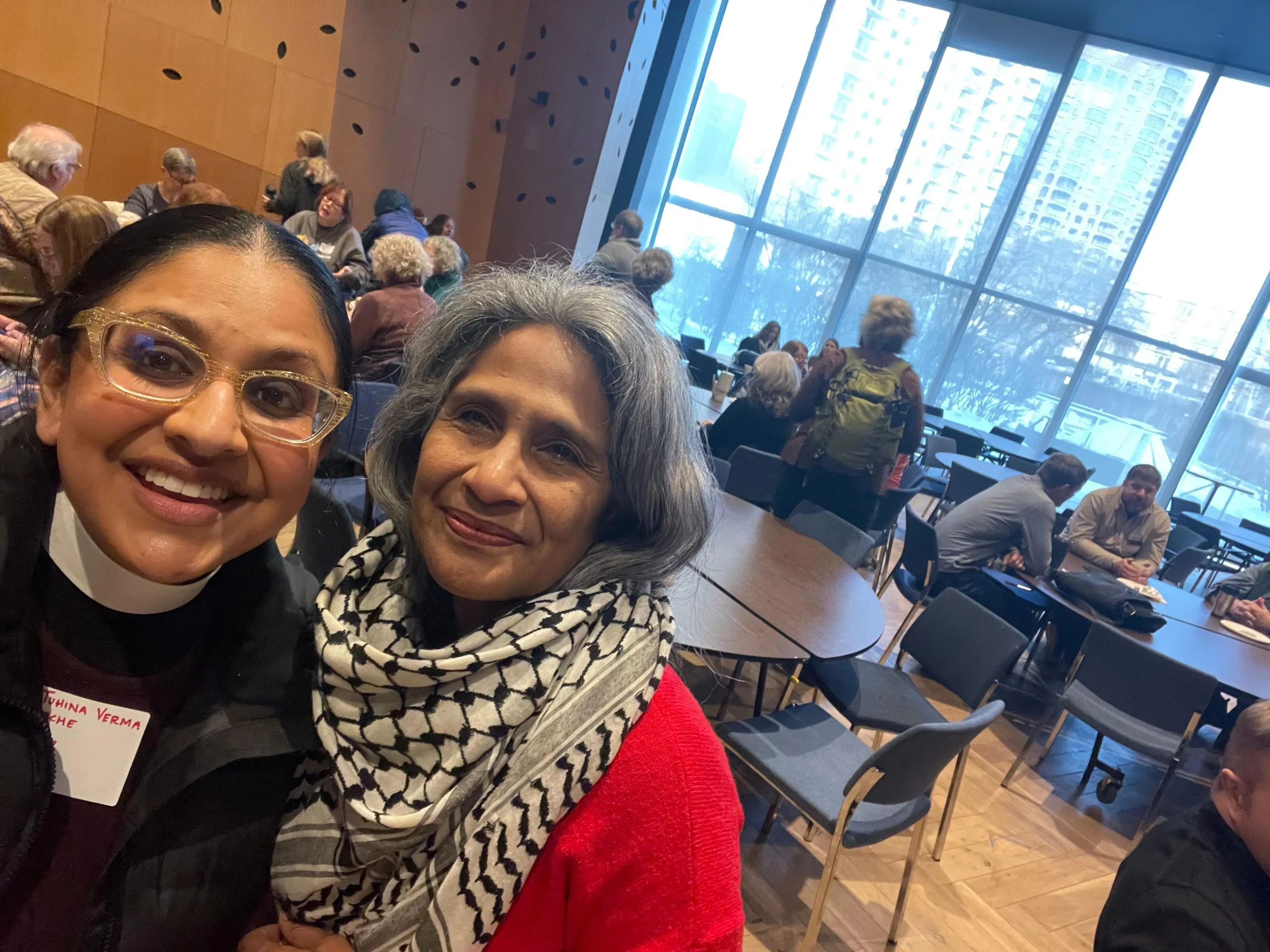
Sunita with HfHR memberTuhina
There wasn’t an Indian or Hindu delegation. Indians are the third largest undocumented group in America, and understandably afraid. When we have organized Know Your Rights trainings in Hindu temples in Queens, NY, devotees have been too afraid to attend.
The mainstream interfaith community is a space I call home, but in the past few years I have been disappointed and disillusioned by people and groups I love and trust failing to connect their commitment to justice at home, to a similar commitment abroad, particularly in the Middle East.
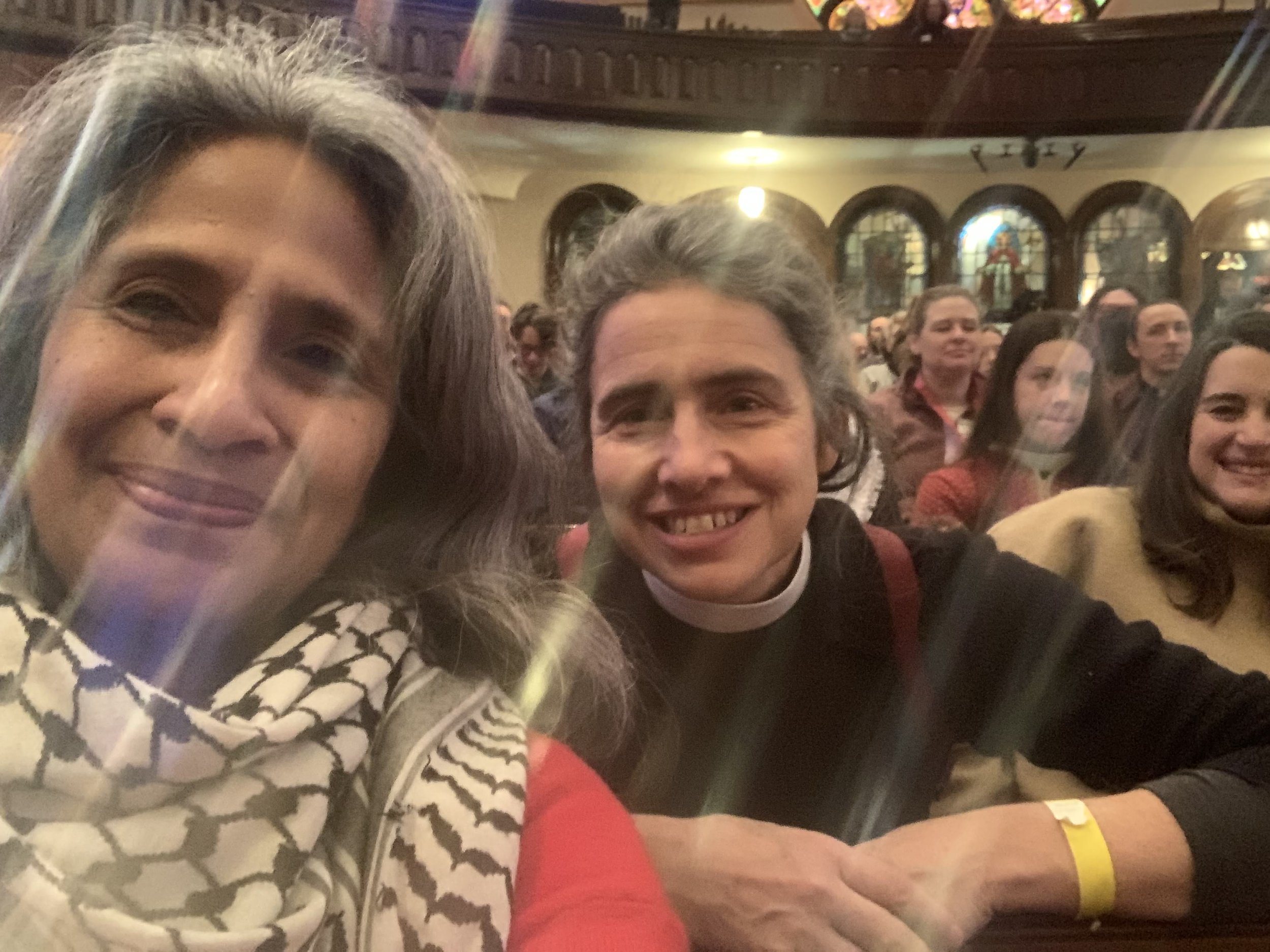
I reached out to Rabbis for Ceasefire, with whom I had traveled to the West Bank in August 2024, and they immediately welcomed me along.
Dr. King has been much on my mind since we just celebrated the national holiday to commemorate his life and legacy. Many speakers at MLK Day events remind us that Dr. King was reviled in his time. And yet, I always wonder if it would be any different were he alive today.
Two of the most important teachings of Dr. King, at least in my opinion, are either entirely forgotten or only given lip service.
One is the importance of connecting across race. It is significant that Viola Liuzzo and Renee Good were both white women who sacrificed their lives for the cause of racial justice. Dr. King didn’t launch the Poor Black People’s Campaign, but a Poor People’s Campaign that would unite and mobilize all the poor in the land. Rev William Barber, whom Dr. Cornel West has called “the closest person we have to Martin Luther King, Jr. in our midst," never fails to remind us that if we care about racial justice in America, we must make room in our hearts for the white poor.
This teaching is very close to my heart because for Hindus, the divine is present in all of us, the poor and rich, black and white, oppressed and oppressor; and it is our dharma (religious duty) to see God in every stranger we encounter. It is only when we see the world with such a radically inclusive vision that we can achieve Dr. King’s Beloved Kingdom.
The other oft-overlooked teaching of Dr. King is the importance of connecting our struggles at home with global struggles, particularly when we ourselves are complicit in the pain of others. Dr. King was pillaried by not only white Americans and the mainstream press, but also by the NAACP for insisting on connecting his fight for civil rights in America to the urgency of ending the war in Vietnam. There is no doubt in my mind that were Dr. King with us today, he would don a keffiyeh and march for a Free Palestine.
It is true that Dr. King believed that Israel was the bastion of true democracy, and he made many speeches and statements in support of Israel. However, his heart also ached for the Palestinians. In June 1967, just one week after the Six Day War in which Israel launched a pre-emptive strike against Egypt, Syria and Jordan–supported by the United States–and captured and occupied the West Bank, the Gaza Strip and the Sinai Peninsula, Dr. King told ABC Sunday’s Issues and Answers, “I think for the ultimate peace and security of the situation it will probably be necessary for Israel to give up this conquered territory because to hold on to it will only exacerbate the tensions and deepen the bitterness of the Arabs.”
If Dr. King had learned the harsh truth about the Nakba of 1948 which forcefully displaced one million Palestinians; if he had lived to see the continued occupation of Gaza and the West Bank, the slow and ongoing torture and erasure of the people of Palestine, and the most recent genocide in Gaza which has taken more than 100,000 lives, I believe his heart would have burst, and he would have spoken thunderous words of compassion and solidarity to the Palestinian people.
While we cannot possibly know what Dr. King would have done had he lived, we can and must
understand that the only way to truly honor this great man–to answer his call–is to join hands and hearts across every difference that divides us: race, class, religion, nation and beyond.
It is with that unconditionally inclusive spirit that I join this multifaith convergence in Minneapolis, along with a radical group of Rabbis for Ceasefire, who wish for an end to the fires that are ravaging the lives of children and families in Minneapolis and Gaza alike.
We have journeyed here from all across the country to bear witness, and to pray with our feet, just like the 25,000 people who answered Dr. King’s call sixty one years ago, and marched from Selma to Montgomery, winning the Voting Rights Act for all Americans.