
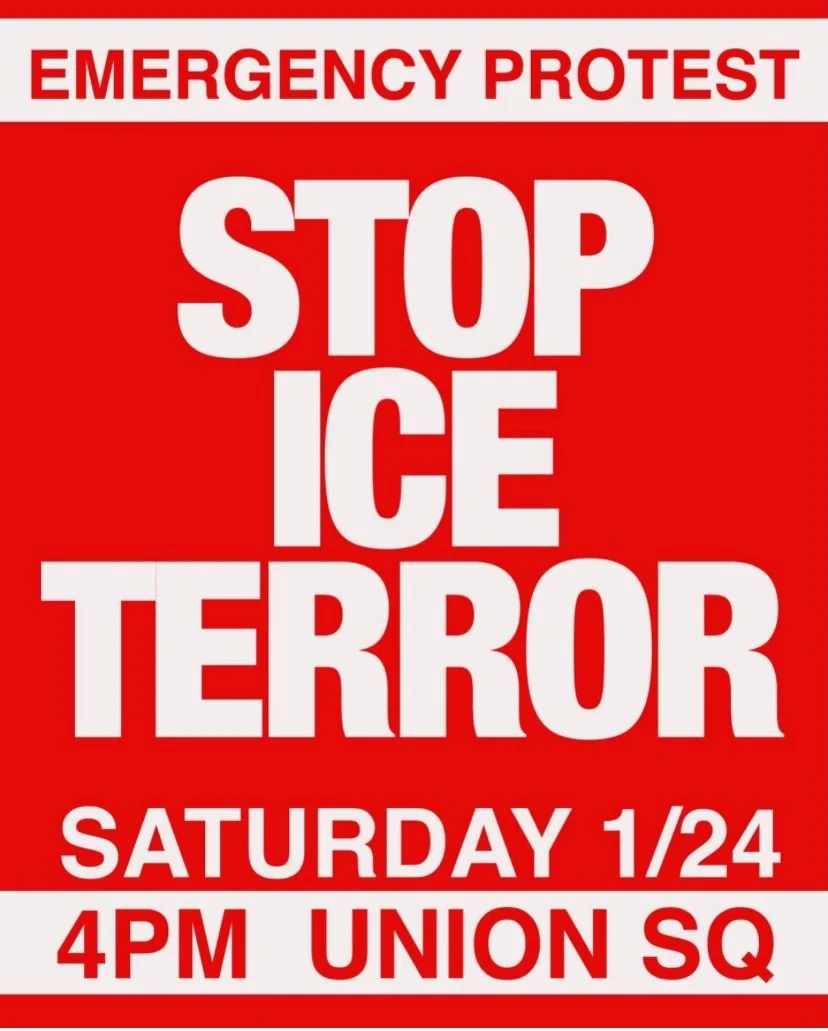
This Sunday in NYC many of us planned to gather at Union Square for an emergency vigil and protest—an urgent public act of grief, solidarity, and moral clarity in the face of escalating ICE activity and the climate of fear it creates.
Our Executive Director, Sunita Viswanath, was scheduled to speak. Because so many people needed space to share, the program ran tight and Sunita wasn’t able to deliver these remarks. We’re sharing the speech here instead—because the message doesn’t belong to just a microphone. It belongs to the moment we’re in.
Sunita’s words come after three days in Minneapolis, answering a call to faith leaders that deliberately echoed Dr. Martin Luther King Jr.’s call to Selma in 1965: a call not for commentary from a distance, but for presence—what Rabbi Abraham Joshua Heschel famously described as “praying with our feet.”
We share these prepared remarks in full below.
I’m Sunita Vishwanath, Executive Director of Hindus for Human Rights. I’ve just come back from three days in Minneapolis, and I went because there had been a call to faith leaders around the country from Minneapolis. The call felt weighty enough, and even invoked Martin Luther King Jr.’s call to Selma in 1965.
In these times—which have been catastrophic here, there, and everywhere—I have been saying that our prayers need to leave the temples, and our temples need to become the places where the crisis is happening. I have been saying, echoing Rabbi Abraham Joshua Heschel, that we need to be praying with our feet. So with those thoughts of prayer and houses of worship and pilgrimage in my heart, of course I had to respond to the call to go to Minneapolis.
And it turns out I was just one among 1,000 religious leaders that answered that call.
It was an incredibly difficult, challenging few days. The organization that invited all of us was called March. It was a multiracial, pro-queer, anti-racist organization that had been around since the 90s, and they put so much thought and effort into welcoming us—spending a whole day grounding us in the context, making sure that we really understood what was happening in Minneapolis, and really heard deeply from impacted communities, as well as people who were stepping up to this moment.
Incredibly brave residents of Minneapolis told us about all the things they’re doing every single day to take care of each other.
So with that deep, deep, deep context—and also with a training in nonviolent cooperation, nonviolent resistance in an actual, live emergency—we went out on Friday into the streets of Minneapolis. Some of us went to the airport to participate in an action. 106 local clergy from Minneapolis took arrest at that action, and 600 people, including many of the faith leaders that had come from out of town, stood witness.
And I was part of a group that went to the Whipple Building. The Whipple Building is Minneapolis ICE headquarters—this huge, sprawling, ugly, scary place. My multifaith group sang and protested there in minus 20 degree temperature. I will add: I have never been so cold in my life.
Then we did something that many Minneapolis residents do whenever they have spare time—when they’re not working or dropping their kids off at school. What they do is patrol.
Patrol means driving around in your car and getting on dispatch, which is something that’s on Signal. It’s basically continuously going on from 5am in the morning till midnight, and you sign in with a handle. I heard handles like “Precious Granny”—just a name that you use for this purpose that keeps your identity safe.
And then you patrol, and you report ICE activity. You report license plates of ICE vehicles, and they get added to a fast-being-built database of ICE vehicles. You report. You record. And you warn.
Those are the things you do when you’re on patrol.
And while I was on patrol, I saw so much ICE activity all across that city. It is an occupied city. When you go to Minneapolis, you will feel you are in a city that has been occupied by ICE. The ICE agents are everywhere. And also, everywhere there is an ICE agent or an ICE vehicle, there are local people videoing them. They have eyes on them all the time.
And these are just ordinary people like you or me—like Reneé Good, and like Alex Pretti. They were people who were legal observers, doing patrol, having their eyes on ICE, and keeping each other safe.
They were being kind and brave when they were killed.
And those people who died could have been any one of us.
And this is the main message that I need to convey to everybody who is listening, wherever you are in the country: what is happening in Minneapolis might be happening where you are already, and it certainly is very likely to come to wherever you are in this country.
The people of Minnesota had this message for all of us. They appreciated the solidarity and the love of everybody who came from out of town, but they also offered back that solidarity, because they are in nothing short of a battleground, and they are rising up to this moment—putting themselves in harm’s way, and giving and sharing and stepping up and taking care of each other.
If somebody has time, they give time. If somebody has money, they give money. If somebody has a couch or an extra bed, they give that. And that is what they are doing for each other.
It is an unhesitating giving that is going on. And that is what is going to get us through when ICE comes to our door, because what I saw in Minneapolis is that nobody is safe.
And this is a wave of cruelty and brutality that—it might be stoppable in that moment of love that you extend to another human being. In that moment you have put a pause on a wave of hate. But in a larger sense, until we change the political reality of this country, this wave is going to be a tidal wave, and it’s going to take this country.
And there is nothing that is an option except rising up together.
And the together means all of us—everybody who agrees that this madness isn’t okay and we have to stop it. Everybody who agrees that ICE has to be abolished has to put aside ideological differences between us, hold hands, and resist together.
And that resistance is going to be scary, but we have to let that fear propel us rather than paralyze us.
So I invite all of you to join me—and all of us in Hindus for Human Rights—to make your prayers fill the streets. Take pilgrimages to sites of crisis. Make those sites your temples. And let us pray together with our feet.
Namaste.