
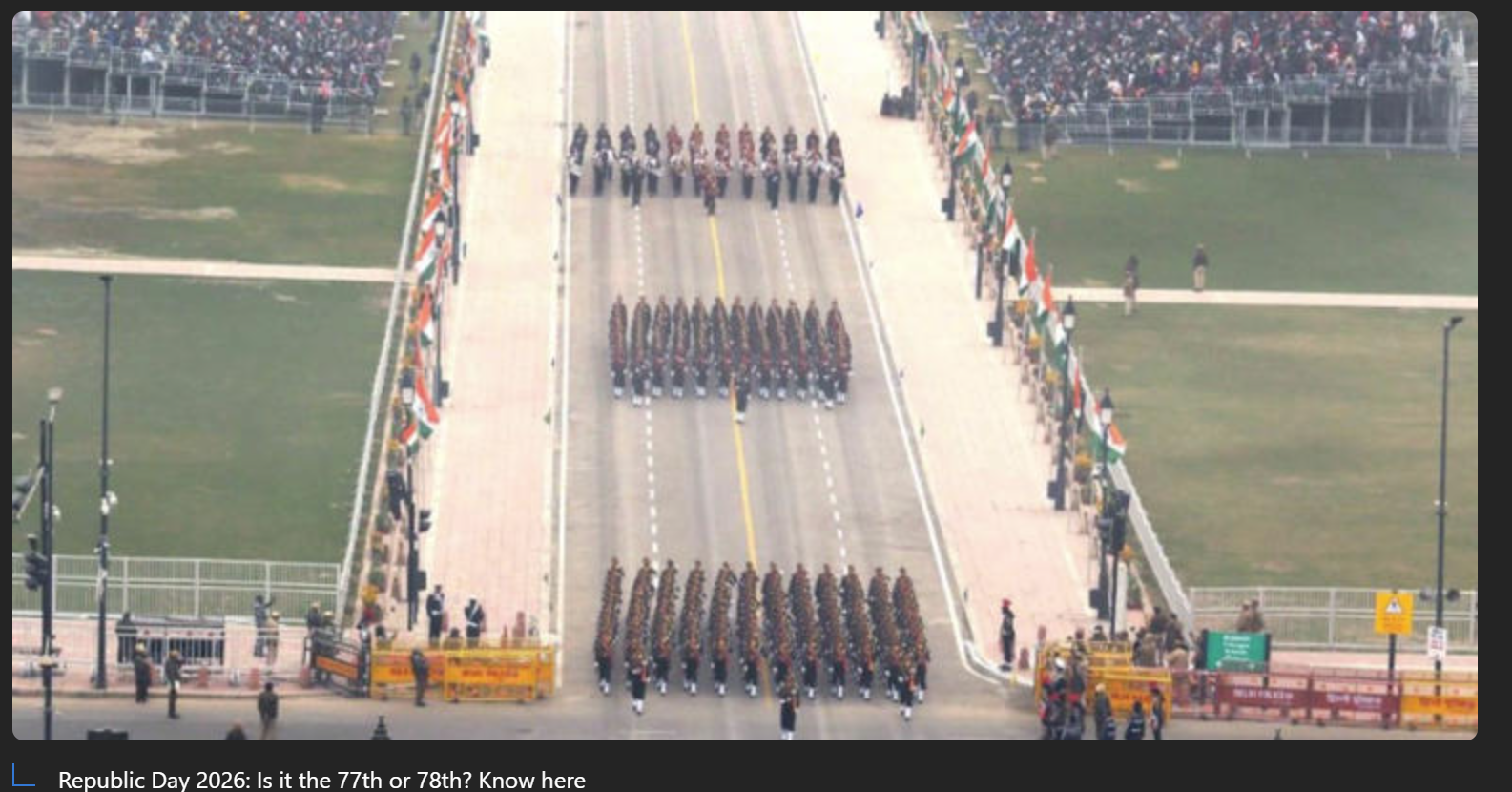
Republic Day, observed every January 26, is often described as a celebration of India’s Constitution. In 2026, it’s more useful—and more honest—to treat it as something slightly harder: a yearly appointment with a promise that has to be kept on purpose. The Constitution did not arrive as a decorative artifact at the end of independence. It arrived as a plan for governing life after catastrophe: the aftermath of colonial rule, the violence and displacement of Partition, and the brutal clarity that a new nation would either build equal citizenship or reproduce old hierarchies with fresh uniforms.
That framing matters because 2026 is not a year of calm anywhere. Across regions, wars grind on, displacement grows, and humanitarian systems face funding crises. The UN refugee agency reports that at the end of 2024 there were 123.2 million forcibly displaced people worldwide, a number that has nearly doubled over the last decade. At the same time, the world is living inside a long decline in political rights and civil liberties; Freedom House describes 2024 as the nineteenth consecutive year of global freedom’s decline. Climate change intensifies these stresses, and the IPCC continues to warn that impacts and risks are widespread and escalating, with compounding harms to security, health, and livelihoods.
In this atmosphere, constitutions matter not because they are sacred, but because they are practical tools for keeping power answerable—especially when fear, grievance, and propaganda try to make unaccountable power feel natural. That is the deeper Republic Day question for 2026: can the Constitution still function as the country’s shared vocabulary of dignity and equal citizenship, even when politics tries to shrink citizenship into a reward for loyalty?
The Indian Constitution is, famously, long. That length is not bureaucratic vanity; it is an attempt to write down what should not be left to “tradition,” discretion, or the mood of the day. It is also a document that expects conflict. You can see this expectation in how it pairs enforceable rights with social goals, and in how it anticipates moments when the state will claim extraordinary powers. The text is not naïve about power. It tries to cage it.
To understand how deliberately the Constitution was built, it helps to read it alongside the Constituent Assembly Debates, which preserve the arguments, anxieties, and visions that shaped the final text. The debates show a founding generation trying to design a republic for a society marked by deep difference and deep inequality—not only difference of language and religion, but also caste, gender, class, and region. The debates are also where you can watch the Preamble being born out of moral and political argument, including the Objectives Resolution moved by Jawaharlal Nehru and contested, refined, and carried forward.
The Constitution’s most durable achievements sit in the tension between protection and transformation. Fundamental Rights are meant to restrain the state and protect individuals and communities from arbitrary power. Directive Principles of State Policy are meant to push the state toward social welfare and economic justice, even when those goals are politically inconvenient. This pairing is part of what makes the Constitution feel less like a narrow rulebook and more like an argument about what a decent society owes its people.
A central feature of that argument is that democracy is hollow without social equality. The Constitution does not pretend that social hierarchy will dissolve on its own. It tries to interrupt the reproduction of inherited status through guarantees, prohibitions, and affirmative measures. That insistence—especially against caste oppression—remains one of the Constitution’s most radical commitments, because it asks the republic to be more than a counting exercise at election time. It asks the republic to be a practice of equal dignity.
That is also why the Constitution becomes a target whenever politics turns toward majoritarian rule. The pressures most often show up as slow alterations to the conditions of citizenship and dissent: whose belonging is presumed, whose speech is treated as suspect, whose protest is framed as dangerous, whose pain is ignored until it becomes “security.” Human Rights Watch’s World Report 2025 describes patterns that include discrimination and violence against minorities, restrictions on civil society, and pressure on independent media and dissent. International democracy indices echo the direction of travel: Freedom House rates India “Partly Free” in its 2025 report, with a score of 63/100. V-Dem’s Democracy Report 2025 classifies India as an “electoral autocracy” by 2019, describing a longer arc of autocratization.
Press freedom is an especially sharp diagnostic because it reflects whether the public can know what power is doing. Reporters Without Borders’ materials on the 2025 World Press Freedom Index place India at 151/180 with a score of 32.96, and describe a harsh environment for independent journalism.
Naming these trends is not the same thing as declaring the Constitution dead. What matters in 2026 is that the constitutional system still contains contestation—court challenges, investigative reporting, grassroots organizing, and public solidarity that insists the Constitution belongs to everyone, not just the state. Even within grim contexts, there are moments of pushback and correction, and the public record of rights claims continues to matter because it keeps the language of legality from collapsing into mere power.
It also matters that the world’s attention is split in ways that can make rights violations easier to normalize. Geopolitics rewards “stability,” markets reward “certainty,” and major powers often learn to look away from abuses if alliances require it. That is why constitutional culture at home—ordinary people treating rights as real—is so important. A constitution can survive hostile politics if enough people keep treating it as a common standard rather than a partisan instrument.
So, if Republic Day 2026 is a moment to read the Constitution, it’s worth reading it in a way that is both reverent and unsentimental. Read it not as a symbol, but as an instruction manual for shared life. Read it as a set of constraints on what the state may do, and a set of obligations the state must try to fulfill. Read it with today’s questions in mind: how do we protect equal citizenship in an era of disinformation and polarization? How do we defend free expression while resisting targeted hatred? How do we hold the line on due process when punishment-by-spectacle becomes politically useful? How do we protect pluralism while refusing the false comfort of enforced sameness?
The Constitution will not answer those questions by itself. But it gives citizens the words—and the legal architecture—to demand answers that are bigger than fear.
For anyone looking to go deeper, the most reliable place to begin is the official text, and then the debates that show how and why its parts were built. From there, it helps to read credible annual assessments of rights and democracy not as final verdicts, but as weather reports: imperfect, contested, and still useful for understanding pressure systems before they become storms.
FAQ: Indian Constitution Resource Guide for Republic Day 2026
What is Republic Day in India, and why does Republic Day 2026 matter right now?
Republic Day (January 26) marks the day the Constitution of India came into force in 1950, turning a newly independent nation into a constitutional republic. But Republic Day 2026 matters for more than its anniversary energy. It lands in a moment when democracy worldwide is being re-tested by polarization, disinformation, and the temptation to treat “majority will” as a substitute for rights.
A progressive reading of Republic Day treats the Constitution less like a ceremonial relic and more like a public commitment that must be renewed—especially when people are encouraged to trade rights for a sense of “order,” or to treat dissent as disloyalty. In that sense, Republic Day becomes a civic practice: returning to the text, returning to the idea that the state is not a family patriarch and citizens are not children, and returning to the hard promise that India belongs equally to all who live in it.
What is the Indian Constitution, in simple terms, and what makes it different from a “national culture” or “majority tradition”?
The Indian Constitution is the highest legal framework governing how power can be exercised and how people are protected from that power. It is not a mirror of “national culture,” and it is not a certificate for whichever tradition has the loudest megaphone. It is closer to a shared agreement that says: even if we disagree about gods, languages, food, and history, we will still treat each other as equals under law.
That distinction is essential in 2026 because majoritarian politics often tries to blur “culture” into “citizenship,” and “faith” into “state power.” The Constitution refuses that merger. It insists that belonging is not earned by conformity. This is where constitutional democracy becomes a moral idea, not just a procedural one: it is the practice of equal dignity even when the crowd is impatient.
Who wrote the Indian Constitution, and why does Ambedkar matter for Republic Day 2026?
The Constitution was drafted by the Constituent Assembly, with Dr. B.R. Ambedkar chairing the Drafting Committee and shaping the architecture with extraordinary rigor. Ambedkar matters not only because he was a drafter, but because he understood something foundational: political freedom without social equality is an unfinished liberation.
In 2026, Ambedkar’s relevance sharpens because the fiercest threats to constitutional democracy often arrive through “social common sense”—the inherited habits of caste, patriarchy, and communal hierarchy that people learn to treat as normal. Ambedkar’s constitutional vision asks society to unlearn what it romanticizes. A progressive Hindu ethics approach can sit here honestly: if faith is to mean anything beyond identity, it must reject the humiliation of human beings, not sanctify it.
What does the Preamble of the Indian Constitution mean, and why do people call it a “moral compass”?
The Preamble is the Constitution’s opening declaration of purpose: justice, liberty, equality, and fraternity. People call it a moral compass because it tells you how to read the rest of the document. It’s not just a poetic introduction; it’s a statement of direction.
In a polarized era, the Preamble also functions like a diagnostic. When politics pushes citizens to fear each other, the Preamble’s insistence on fraternity becomes a radical demand. When inequality is treated as inevitable, justice becomes a refusal. When speech is controlled through intimidation rather than argument, liberty becomes a lived struggle. If Republic Day 2026 is a “Preamble day,” it’s because the Preamble reminds us that the republic’s goal is not dominance—it is dignity.
What are Fundamental Rights in the Indian Constitution, and why are they central to protecting minorities and dissent?
Fundamental Rights are the Constitution’s enforceable protections for individuals and communities, including equality before law, freedoms of speech and association, protections of life and liberty, freedom of religion, and protections against discrimination. They matter because they are the mechanism by which citizens can tell the state: you may govern, but you may not violate.
In practice, Fundamental Rights are especially important for minorities and dissenters because majoritarian power often tries to treat them as exceptions—people whose rights can be trimmed “for security,” “for harmony,” or “for national pride.” A progressive constitutional view rejects that logic. Rights are not a gift for obedience; they are the minimum conditions of equal citizenship. When dissent is painted as betrayal, Fundamental Rights remind us that disagreement is not an attack on the nation. It is often the nation trying to save itself from power without restraint.
What are the Directive Principles of State Policy, and how do they connect to economic justice and dignity?
Directive Principles of State Policy are constitutional commitments that guide governance toward a welfare-oriented society—things like reducing inequality, ensuring fair working conditions, improving public health, and promoting social justice. They are not always directly enforceable like Fundamental Rights, but they are essential because they express what the republic is for, not only what it forbids.
In a progressive reading, the Directive Principles tell us that constitutional democracy is not just about preventing state abuse; it is also about building conditions where people can live with dignity. A republic that holds elections but tolerates hunger, humiliation, caste-based exclusion, and extractive labor as “normal” is not fully honoring its constitutional promise. In 2026, this is where constitutionalism meets daily life: schools, hospitals, wages, housing, and the right to exist without degradation.
What does “secularism” mean in the Indian Constitution, and how is it different from being “anti-religion”?
Constitutional secularism in India is not a demand that people abandon faith. It is a demand that the state not convert one faith identity into a governing hierarchy. In other words, secularism protects religion by preventing the state from weaponizing religion.
This is especially important for progressive Hindu work because Hinduism should not need state power to feel secure. When religion is fused with state dominance, the result is not spiritual flourishing; it is moral corrosion. Constitutional secularism creates space for many kinds of religious life—including devotional, skeptical, reformist, and nonreligious—without turning citizenship into a religious test. That is not anti-faith. It is anti-theocracy, anti-supremacy, and anti-humiliation.
How does the Indian Constitution address caste discrimination, and why is Article 17 still urgent in 2026?
The Constitution explicitly abolishes “untouchability” (Article 17) and prohibits discrimination, while also enabling affirmative measures to address historic injustice. This is not symbolic. It is an admission that caste oppression is not a private prejudice; it is a public system with economic, social, and physical consequences.
In 2026, Article 17 remains urgent because caste does not survive by calling itself “caste” all the time. It survives through coded practices of purity, hierarchy, exclusion, and violence—sometimes openly, sometimes quietly. A progressive constitutional lens insists that caste justice is not a niche issue; it is foundational to democracy. A progressive Hindu ethics lens adds a sharper edge: any religious identity that defends caste hierarchy as “culture” is defending the degradation of human beings, which should be unacceptable within any serious moral tradition.
What is “constitutional morality,” and why does it matter when majoritarian politics claims to speak for the nation?
“Constitutional morality” is the idea that public life should be guided by constitutional values—dignity, equality, liberty—rather than by raw social prejudice or the mood of the majority. It matters because majoritarian politics often argues that electoral victories automatically justify everything. Constitutional morality says: no. Democracy is more than counting heads; it is protecting rights, especially when it’s unpopular to do so.
In 2026, constitutional morality is a practical concept. It helps citizens evaluate whether an action is merely legalistic, merely popular, or actually aligned with the republic’s ethical foundations. It also speaks directly to faith and community life: if community norms conflict with dignity and equality, the Constitution asks society to evolve. That is not an insult to tradition; it is the republic’s insistence that tradition cannot be used as a license to harm.
What are the biggest constitutional challenges India faces today, and how should a reader approach them without cynicism?
Major challenges include pressure on civil liberties, the narrowing of civic space for activists and journalists, communal polarization, and the temptation to treat state power as a tool for cultural enforcement rather than equal governance. There are also recurring concerns about due process and the normalization of punishment-by-allegation, where the process itself becomes the penalty.
A progressive approach tries to avoid two traps: denial and despair. Denial says the Constitution is fine because institutions exist on paper. Despair says the Constitution is meaningless because violations happen. The truer posture is constitutional realism: the text is powerful, the struggle is ongoing, and institutions respond to pressure—sometimes in the right direction, sometimes not. The point of reading the Constitution on Republic Day 2026 is to remember that the republic is not a mood; it is a discipline.
How can ordinary people “use” the Indian Constitution in daily life, beyond courts and lawyers?
Most people will never file a constitutional petition. But the Constitution still shapes daily life when people use its language to clarify what is acceptable and what is not. It teaches citizens to name harms precisely: discrimination, arbitrary detention, unlawful violence, censorship, exclusion, humiliation, denial of equal access, and state overreach.
In community life, constitutional thinking changes the questions people ask. Instead of asking, “Who belongs here?” it asks, “How do we guarantee belonging without forcing sameness?” Instead of asking, “Who is pure?” it asks, “Who is being degraded, excluded, or punished?” This is one reason progressive movements return to the Constitution: it doesn’t just give rights; it gives vocabulary—words strong enough to challenge power without becoming power.
What is the best way to learn the Indian Constitution for students, educators, and diaspora readers in 2026?
Start with the official text so you are not learning the Constitution through rumors or partisan summaries. Then read the Constituent Assembly Debates to understand intention, context, and disagreement at the founding moment. For contemporary understanding, pair constitutional reading with credible civic education sources and careful journalism, especially on how laws impact marginalized communities.
If you want a clean learning pathway, read the Preamble, then Fundamental Rights, then Directive Principles, then the sections on federalism and emergency powers. The goal is not memorization; it is comprehension. In 2026, the most important learning outcome is not reciting articles—it is recognizing when power is trying to move the goalposts on citizenship, equality, or free expression.
Where can I read the Constitution of India online and find reliable constitutional resources?
For the official Constitution text, use: https://legislative.gov.in/constitution-of-india
For debates and learning tools, use: https://www.constitutionofindia.net/
For legislative explainers and bill tracking, use: https://prsindia.org/
For the Supreme Court’s official portal, use: https://www.sci.gov.in/