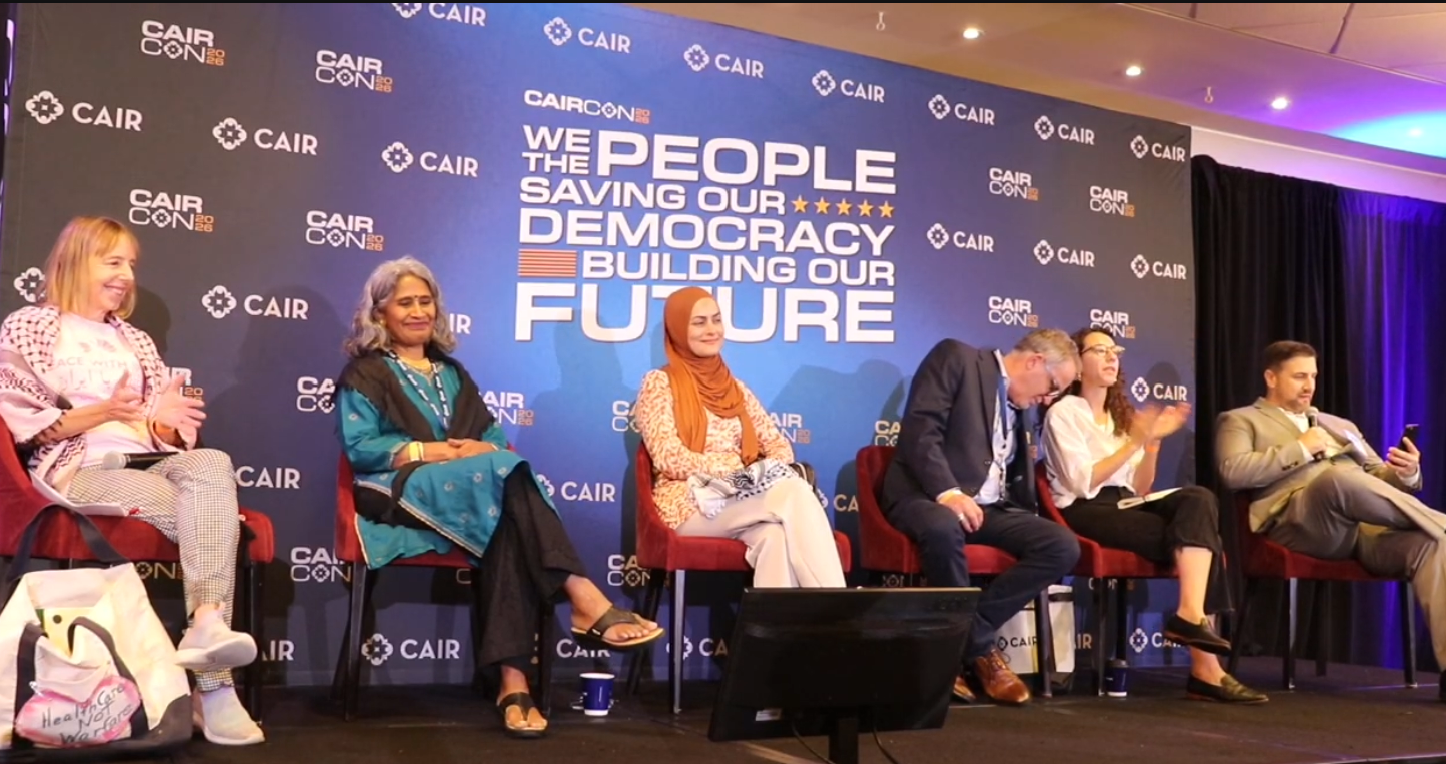
At CAIRCon, Sunita Viswanath Calls for Solidarity Across Faiths, Movements and Borders
At a CAIRCon panel on defending democracy, Hindus for Human Rights co-founder Sunita Viswanath joined leaders from Muslim, Jewish, Palestinian, and antiwar movements to discuss what meaningful solidarity requires in a time of rising authoritarianism.
Sunita talking about Radical Solidarity
On September 13, Hindus for Human Rights co-founder Sunita Viswanath participated in “Coalitions That Win: Cross-Movement Defense of Democracy” at CAIRCon.
Moderated by Zahra Billoo of CAIR-SFBA, the panel featured Medea Benjamin of CODEPINK, Beth Miller of Jewish Voice for Peace, author and activist Miko Peled, author and journalist Laila El-Haddad, and Sunita Viswanath. Together, they explored what movements can learn from one another as they confront Islamophobia, attacks on Palestinian rights, religious nationalism, militarism and the erosion of democratic freedoms.
Panelists considered a question with urgent consequences for every movement: What happens when a threat treated as belonging to one community is allowed to become a broader tool of repression?
Sunita marks the sixth anniversary of Umar Khalid’s incarceration and calls for him to be freed
The panel offered an opportunity to consider how threats often treated as belonging to a single community can weaken democratic rights more broadly. Islamophobia, caste oppression, Hindu nationalism, and attacks on Palestinian rights emerge from distinct histories, but the surveillance, exclusion, silencing, and collective punishment directed at one group can establish methods that are later used against others. This makes solidarity a particular responsibility for communities in whose name harm is carried out. For Hindu organizations, that includes confronting caste, anti-Muslim hatred, and Hindu nationalism without leaving targeted communities to carry that burden alone. It also requires recognizing that authoritarian movements cross borders through funding, propaganda, religious and cultural institutions, professional networks, and political relationships, often adapting their language to different audiences.
The recent campaign responding to RSS chief Mohan Bhagwat’s international appearances demonstrated the importance of Hindu, Muslim, Sikh, Christian, interfaith, and secular groups working together to make these connections visible. Such solidarity must extend beyond public statements. It depends on organizations examining their own constituencies, speaking before a position becomes safe or popular, and building coalitions with clear approaches to leadership, decision-making, safety, accountability, and disagreement. These relationships must be established before a crisis, so that communities already understand one another’s vulnerabilities and can respond together when one is targeted. This work is part of our dharma and our responsibility for the society we help create. Our faith traditions should enlarge the circle of people for whom we feel responsible, rather than teach us only to defend our own.