
The Hindu Marriage Validity Act: Marriage, Caste, and the State’s Power Over Intimate Life
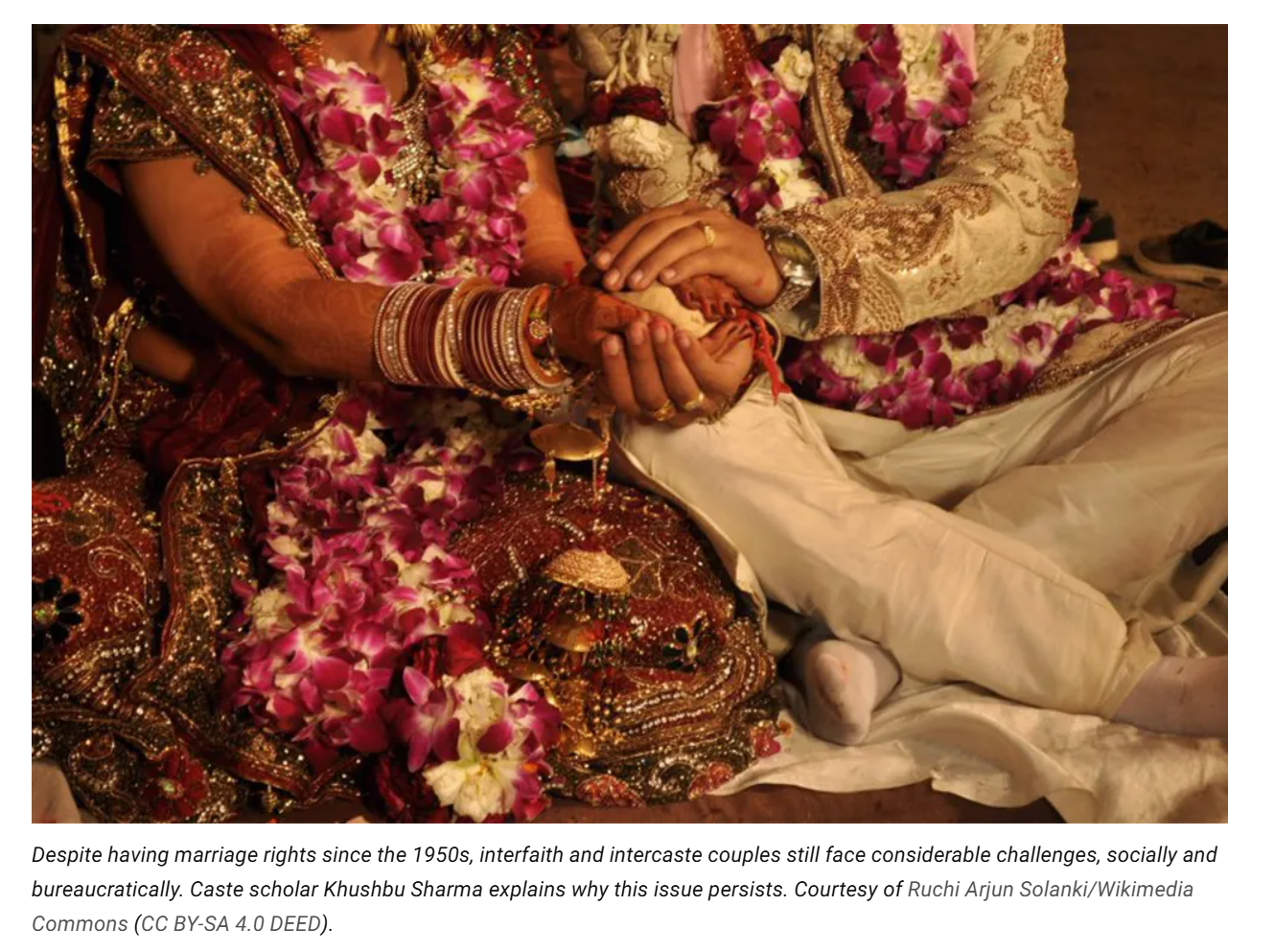
In the long struggle against caste hierarchy, marriage has always been one of the clearest battlegrounds. That is because caste is not only a matter of belief or ritual. It is reproduced through control: over kinship, over inheritance, over sexuality, over who may belong to whom. As B.R. Ambedkar argued in Castes in India, caste survives through endogamy, through the policing of marriage itself. In that sense, laws about marriage are never only about ceremony. They are about power over bodies, family, and the social future.
That is what makes the Arya Marriage Validation Act, 1937 and the Hindu Marriage Validity Act, 1949 so important. Both laws mattered because they pushed back, at least in part, against older structures that treated inter-caste and certain inter-sect marriages as suspect or invalid. But both laws were also limited. They did not establish an expansive right to marry based on dignity, equality, and personal liberty. Instead, they carved out carefully managed exceptions within a larger legal order still invested in classifying people by religion, caste, and community.
The 1937 Act: a narrow opening through Arya Samaj
The Arya Marriage Validation Act, 1937 was enacted on April 14, 1937. Its stated purpose was to “recognise and remove doubts” about inter-marriages among “a class of Hindus known as Arya Samajists.” Its operative provision said that a marriage between two people who were Arya Samajists at the time of marriage would not be invalid merely because they had previously belonged to different castes or sub-castes, or because one or both had previously belonged to a religion other than Hinduism.
That was significant. It meant the law could no longer so easily be used to erase marriages simply because caste boundaries had been crossed. It also reflected the reformist role Arya Samaj played in challenging some orthodox practices and making room, however imperfectly, for marriages that dominant custom would stigmatize. But the law’s structure is revealing. It did not say that every adult person has an inherent right to marry another consenting adult regardless of caste. It said, instead, that such marriages were protected if the parties could be recognized as Arya Samajists. Freedom was not universalized. It was routed through a sanctioned identity.
That limitation matters. The law loosened caste control, but only by placing couples into another recognizable religious-legal category. It challenged one orthodoxy while preserving the larger assumption that the state and personal law systems get to decide which identities are legible enough to receive protection. In that sense, the 1937 law was progressive, but conditional. It alleviated harm without fully surrendering the state’s power to sort, certify, and contain intimate life. This is an inference from the statute’s narrow coverage and wording.
The 1949 Act: a broader reform, but still a bounded one
Twelve years later, the Hindu Marriage Validity Act, 1949 widened that opening. Passed by the Dominion Legislature, the Act provided that no marriage between “Hindus” would be invalid merely because the parties belonged to different religions, castes, sub-castes, or sects. The Act also specified that “Hindus” for its purposes included Sikhs and Jains.
This was a real shift. The 1949 law was broader than the 1937 Arya Samaj law because it did not require both parties to be Arya Samajists. It extended legal protection across a larger field of intra-Hindu, Sikh, and Jain difference, and it rejected invalidation based solely on caste or sectarian separation. In practical and symbolic terms, it marked a move away from the idea that caste-endogamous custom should determine whether a marriage exists in law.
And yet the limits remained stark. The 1949 Act did not articulate marriage as a general civil right. It did not abolish the architecture of personal law. It did not erase the state’s appetite for religious classification. Rather, it enlarged the protected circle while keeping the circle intact. The question was still: under what recognized community does this couple fall? The answer was not individual autonomy in the abstract, but membership in a state-legible religious framework. This is one reason the 1949 law can be read both as anti-caste reform and as evidence of how modern states manage freedom by defining its boundaries.
A useful contemporary contrast comes from Karnataka’s new Freedom of Choice in Marriage and Prevention and Prohibition of Crimes in the Name of Honour and Tradition (Eva Nammava Eva Nammava) Bill, 2026. Unlike the older marriage-validity laws, which mostly worked by declaring certain unions legally acceptable within existing religious frameworks, Karnataka’s bill speaks far more directly in the language of autonomy: it affirms that once two adults choose each other, the consent of parents, family, caste, or clan is not required, and it criminalizes intimidation, harassment, and violence carried out in the name of “honour.” It also proposes district-level support bodies and fast-track courts, recognizing that freedom in marriage means little if the state does not protect people from the social violence that often follows inter-caste relationships. The law does not abolish caste, but it is important because it shifts the emphasis from merely validating marriages after the fact to actively defending the dignity and decisional freedom of those who enter them.
What these laws reveal about control
For Hindus for Human Rights, the deepest lesson here is not that these laws were worthless. They were not. They mattered because caste oppression is sustained through the policing of intimacy, and any legal weakening of that policing has real consequence. Ambedkar’s analysis remains essential: caste is reproduced through enforced endogamy, through the making of social walls around who may marry whom. Laws that interrupted that logic did meaningful work.
But a rights-based critique must go further. These laws also show how deeply the state has been involved in the governance of bodies and relationships. Even when the law becomes more permissive, it often does so in a paternal mode. It says not, “your dignity is yours,” but “we will now validate this category of union.” That distinction matters. One approach recognizes freedom; the other administers it. One begins from autonomy; the other begins from official permission. This is an inference drawn from the structure of the 1937 and 1949 Acts.
The later Hindu Marriage Act, 1955 both expanded and consolidated this framework. It applied to Hindus broadly, explicitly including followers of Arya Samaj as well as Buddhists, Jains, and Sikhs, and provided that a Hindu marriage may be solemnized between “any two Hindus,” while also codifying conditions, ceremonies, registration rules, and other legal restrictions. That codification was historically important, but it also confirmed that intimate life would remain a heavily structured terrain of state oversight.
Is there a connection to the transgender rights struggle in India now?
There is a connection, but it should be made carefully. The Arya Marriage Validation Act and the Hindu Marriage Validity Act were partial moves against exclusion. The newly contested Transgender Persons (Protection of Rights) Amendment law, by contrast, is being criticized for moving in the opposite direction: away from self-identification and toward medical and bureaucratic control. PRS says the 2026 amendment removes the earlier self-perceived identity framework, narrows who counts as transgender, and requires a District Magistrate to rely on a designated medical board for identity certification. Amnesty and Human Rights Watch have both criticized the law as a serious step backward that deepens state intrusion into gender identity.
So the connection is not that these are the same kind of law. It is that they belong to the same larger history of the state deciding when personhood becomes legally intelligible. In 1937 and 1949, the state grudgingly loosened restrictions around caste-bound marriage but still did so through managed categories. In 2026, activists say the state is once again insisting that identity must be examined, certified, and approved from above. That is why protesters in places like Lucknow and Dehradun have denounced the new law as an attack on self-identification, dignity, and privacy, and why national protests have continued into early April 2026.
The principle at stake is larger than any one statute: no state committed to human rights should treat the body, identity, or intimate life of its citizens as raw material for suspicion and classification. The law has a role in preventing coercion, violence, and discrimination. It should not become the instrument through which caste society, patriarchal order, or gender policing are given new administrative language. Whether the issue is inter-caste marriage or trans self-identification, the moral question remains the same: does the law expand dignity, or does it demand that dignity first present its papers? This is a normative conclusion grounded in the statutes and current criticism of the 2026 amendment.
Popular Questions about this Issue
What was the Arya Marriage Validation Act, 1937?
The Arya Marriage Validation Act, 1937 was a pre-independence law enacted on April 14, 1937 to ensure that marriages between two Arya Samajists would not be treated as invalid merely because the parties had belonged to different castes, sub-castes, or, before marriage, different religions.
What did the Hindu Marriage Validity Act, 1949 do?
The Hindu Marriage Validity Act, 1949 declared that a marriage between Hindus would not be invalid solely because the parties belonged to different religions, castes, sub-castes, or sects. For the Act’s purposes, “Hindus” included Sikhs and Jains.
What is the relationship between the 1937 Arya Samaj law and the 1949 Hindu Marriage Validity Act?
The 1937 law was narrower and protected marriages only where both parties were Arya Samajists at the time of marriage. The 1949 law broadened the principle by protecting a wider range of marriages among Hindus, Sikhs, and Jains across caste, sect, and certain intra-Hindu religious differences.
Did these laws abolish caste in marriage?
No. They weakened one important mechanism of caste exclusion by preventing some marriages from being invalidated on caste grounds, but they did not abolish caste itself. Ambedkar’s analysis remains crucial here: caste is sustained through endogamy, and legal reform alone cannot dissolve the deeper social system that reproduces it.
Were these laws progressive?
Yes, in part. Both laws pushed back against caste- and sect-based invalidation of marriage. But they were also limited, because they did not create a universal right to marry based simply on consent and equality. They worked through state-recognized religious categories rather than a fully rights-based framework. This is an interpretation based on the scope and wording of the Acts.
How do these marriage laws connect to transgender rights in India today?
The connection is conceptual, not identical. Current critics of the 2026 Transgender Persons amendment argue that it removes self-identification, narrows the definition of who counts as transgender, and subjects identity recognition to medical boards and district officials. That raises a similar rights question: should the state certify personhood, or should the law protect selfhood and dignity?
Why are activists protesting India’s 2026 transgender law?
According to PRS, the amendment narrows the definition of transgender persons, removes categories such as trans men, trans women, and genderqueer from the earlier definition, and requires certification involving a medical board. Amnesty, Human Rights Watch, and protesters have said this undermines self-identification and privacy and conflicts with the spirit of the Supreme Court’s 2014 NALSA judgment.
What did the Supreme Court say in NALSA v. Union of India?
In 2014, the Supreme Court recognized gender identity as tied to dignity, autonomy, and constitutional rights, and the judgment is widely understood as affirming the right of transgender people to self-identify their gender without compulsory medical intervention.