
September 11, 2026
Twenty-five years after the attacks of September 11, 2001, we remember the 2,977 people killed that day, the families who continue to carry their loss, the survivors, and the first responders, recovery workers and others living with 9/11-related illness.
We also remember what followed: hate crimes against Muslim, Sikh, Arab, South Asian and other communities; detention, deportation and surveillance; wars and displacement; and the people who organized against collective blame. These histories belong together.
For Hindus for Human Rights, this is also the history of communities with whom we live, worship and organize. Some Hindus and other South Asians were targeted because racism ignored the differences among us. Others acted in solidarity because friendship, faith and conscience required it. This page gathers a selection of the testimony, archives, events and teaching materials through which our communities are remembering 9/11 today.
Events and commemorations
Given the large and diverse variety of events nationwide and globally no list could be comprehensive. These are a few commemorations connected to communities, partners and alliances with whom HfHR has a relationship.
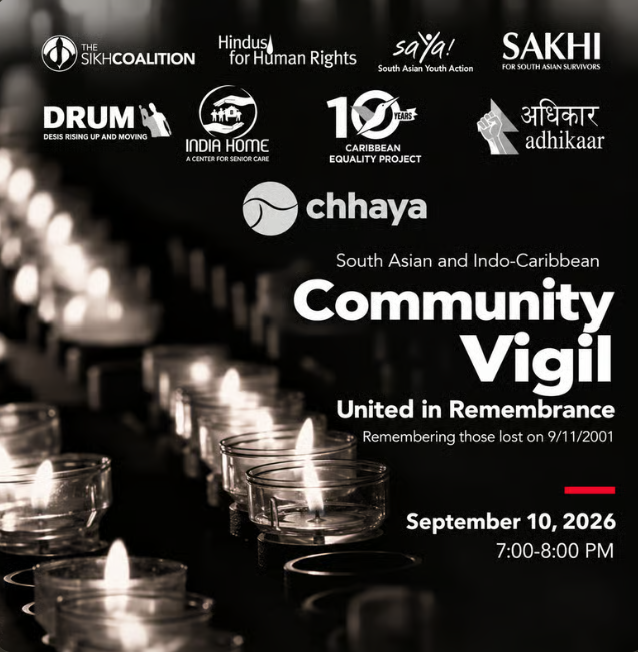
September 10: Strength Through Unity
On September 10, 2026, South Asian and Indo-Caribbean New Yorkers gathered at Diversity Plaza in Jackson Heights to remember those lost on September 11, 2001, and reflect on the twenty-five years since.
This montage brings together excerpts from speeches delivered during the community vigil, carrying a shared commitment to remembrance, solidarity and standing together against hate.
The vigil was organized by The Sikh Coalition, Hindus for Human Rights, South Asian Youth Action, Sakhi for South Asian Survivors, DRUM, India Home, Caribbean Equality Project, Adhikaar and Chhaya Community Development Corporation.
September 10: Standing Together

In NYC Join September 11th Families for Peaceful Tomorrows for a commemoration rooted in remembrance, peace and human rights. The evening begins at 5 p.m. in Union Square, followed by a 6 p.m. walk to Ground Zero and a 7:15 p.m. vigil at the 9/11 Memorial. Participants may join for any portion of the program.
September 11: National commemoration and learning programs
The National September 11 Memorial & Museum’s anniversary commemoration includes the reading of names and, for the first time, a seventh moment of silence for those lost to 9/11-related health effects.
Free Anniversary Digital Learning Experience, with a film and live educator chat from 9 a.m. to 3 p.m. ET
9/11 Tribute in Light: Live from Lower Manhattan, airing on ABC and Disney platforms at 8 p.m. ET

September 15: Balbir Singh Sodhi memorial
The Sodhi family, the Sikh Coalition and the Revolutionary Love Project will gather at the family’s gas station in Mesa, Arizona, to remember Balbir Singh Sodhi. HfHR’s Sapna Gupta will be among the participating faith leaders.
Register to attend in Mesa, beginning with ardaas at 6:30 p.m. local time
Register for the livestream, beginning at 7 p.m. PDT/10 p.m. EDT
IMAGE NOTE: Use the official memorial artwork from the Revolutionary Love Project hub.
Watch: Masuda Sultan reflects on 25 years since 9/11
Afghan New Yorker Masuda Sultan remembers the September 11 attacks and the 19 members of her family subsequently killed in a U.S. bombing near Kandahar. The interview also revisits her friendship with Rita Lasar, who lost her brother at the World Trade Center and joined Sultan in advocating for Afghan civilian families.
Community resources for the twenty-fifth anniversary

25 Years Later, the South Asian Coalition’s hub of testimony, educational resources, commentary and policy work
9/11 resources, advocacy and commemorative efforts, Sikh Coalition
9/11 25th Anniversary Hub, Revolutionary Love Project
Teaching 9/11 at 25, Islamic Networks Group
Early records of the backlash
Some of the most important records of the South Asian American response to 9/11 are now preserved by the South Asian American Digital Archive (SAADA). They include reports originally produced by South Asian American Leaders of Tomorrow, now South Asian Americans Leading Together (SAALT).

Within a week of the attacks, SAALT had documented 645 incidents of backlash against people of South Asian or Middle Eastern descent. A second report, published ten years later, recorded the hate crimes, profiling and discrimination experienced particularly by Sikh and Muslim communities, alongside the organizing and interfaith alliances that emerged in response.
American Backlash: Terrorists Bring War Home in More Ways than One, SAALT, 2001
Community Resilience: A South Asian American Perspective on the Ten-Year Anniversary of September 11th, SAALT, 2011
In Our Own Words: Narratives of South Asian New Yorkers Affected by Racial and Religious Profiling, SAALT
Muslim Americans look back
Twenty years after 9/11, Amna Nawaz led a powerful PBS NewsHour report in which Muslim Americans described how the attacks changed their lives and their place in the country. Their testimony addresses the growth of suspicion and hostility, major civil-rights violations, and what it meant for an ordinary religious identity to be treated suddenly as a threat. Placed beside the contemporary documents, the report allows personal memories to speak alongside the institutional record.
American Muslims Remember How 9/11 Changed America as They Knew It, PBS NewsHour, reported by Amna Nawaz
Classroom version, discussion questions and teaching resources, PBS NewsHour Classroom
Balbir Singh Sodhi and the inseparable histories of anti-Sikh and anti-Muslim hate
Balbir Singh Sodhi was murdered outside his Mesa gas station on September 15, 2001. His killer had mistaken him for a Muslim. The error was part of the racism, but there was no “correct” target for the hatred. Sodhi’s life and death remain central to understanding the overlapping experiences of Sikh, Muslim and other communities after 9/11.
Balbir Singh Sodhi and the 9/11 anniversary learning hub, Revolutionary Love Project
Divided We Fall: Americans in the Aftermath, a documentary about post-9/11 hate violence
A note from HfHR’s own history

Before HfHR existed, our Executive Director Sunita Viswanath, then Sunita Mehta of Sakhi for South Asian Women and Women for Afghan Women, was among the South Asian organizers speaking publicly about the aftermath of 9/11. These three Democracy Now! appearances record community responses to hate crimes, the organizing of a Muslim peace vigil in New York, and concern that Afghan women be heard in decisions about their country’s future. HfHR’s seeds were already planted: Sunita insists on fighting hate as a Hindu, and even sings the Gayatri Mantra. She insists on radical solidarity in the face of growing hate, violence and polarization, not to mention imminent war.
A Wave of Hate Crimes Against Aran and Asian Americans Sweeps the Country, September 18, 2001
Organizing for Peace: New York Police Revoke Permit for Muslim Peace Vigil, September 21, 2001
Afghan Factions Meet in Bonn: Are the Voices of Women Being Heard?, November 28, 2001
Our communities do not carry one memory of 9/11. We carry many. On this anniversary, we remember those killed, those harmed in the violence that followed, and those who chose to protect their neighbors, oppose collective blame and build peace.