
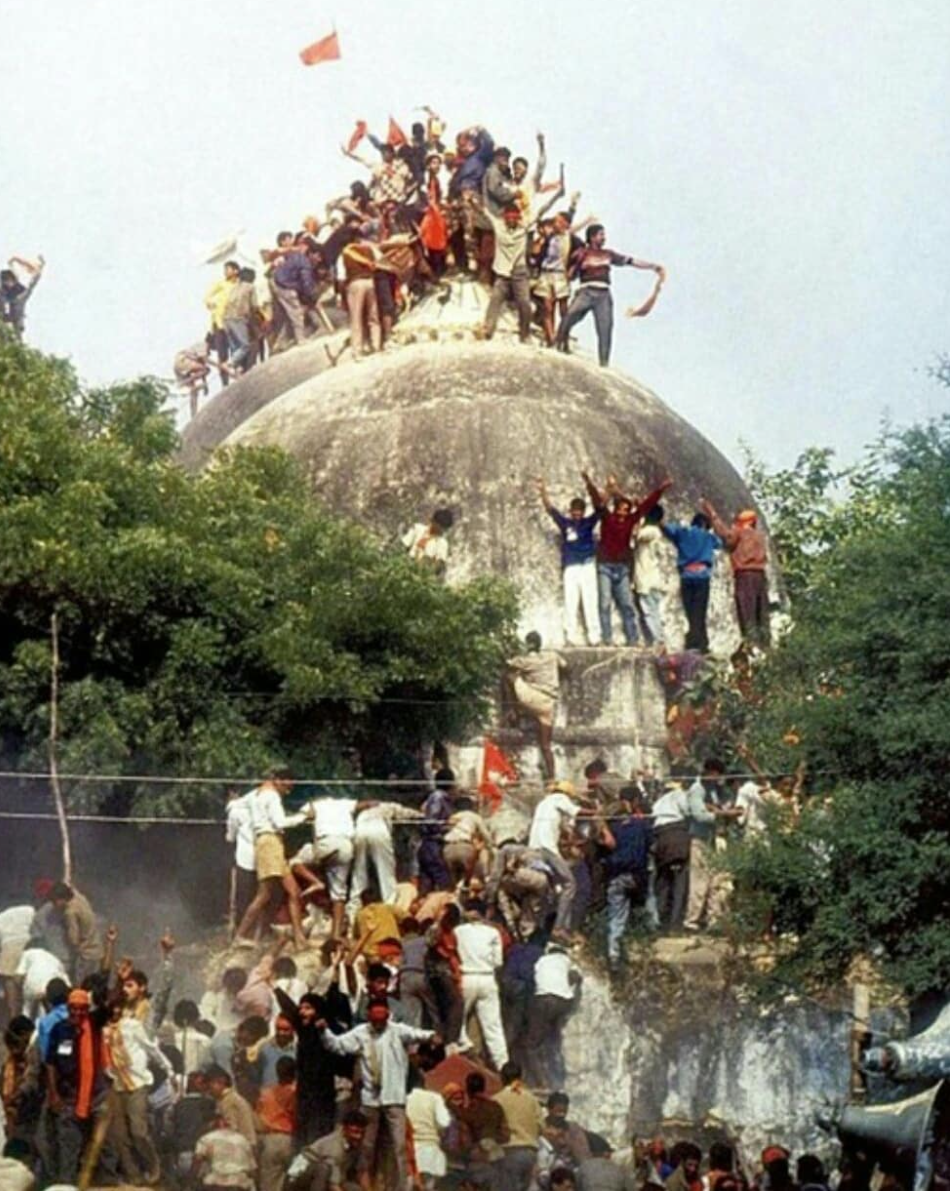
On 6 December 1992, the Babri Masjid in Ayodhya was reduced to rubble by a crowd of kar sevaks as senior leaders of the Hindu right looked on. In the weeks that followed, India burned; thousands were killed in riots across the country, most of them Muslims. The images from that day — men clambering over the domes, flags planted where prayers had once been said — are now part of the country’s visual memory.
This year, on the 33rd anniversary, those memories felt strangely distant.
Yes, there were news stories. Most focused on security arrangements: Ayodhya and Mathura on high alert, police checking vehicles, plainclothes officers in the crowd, hotels asked to keep detailed visitor logs. as in this article in the Hindustan Times
There were short pieces on how the day passed “peacefully,” with no major mobilizations in Ayodhya and a ban on both “Black Day” and “Victory Day” gatherings after the final court verdict.
But the deeper conversation that Babri once forced on India — about hate, impunity, and the future of the republic — was largely missing from mainstream public life.
For those of us at Hindus for Human Rights, that quiet is itself a symptom of what Babri unlocked.
Babri as a turning point
Babri was never just about a disputed structure. It was the culmination of years of organised mobilisation by the Sangh Parivar, a test case for whether a politics of religious grievance could overturn institutions and still claim democratic legitimacy. Long before the mosque was brought down, the Ram Janmabhoomi campaign had already changed the political map.
The demolition showed that the state would not — or could not — stop a determined majoritarian movement. Courts, police, and political leaders all failed in their basic duty to protect a place of worship and the lives that would inevitably be endangered in the violence that followed. The message was clear: if enough people could be mobilised in the name of “hurt religious sentiment,” even the most basic norms could be suspended.
From there, the road to today’s India is easy to trace:
The consolidation of the BJP as the central pole of national politics.
The rebranding of Hindu majoritarianism as “cultural nationalism” and “Ram Rajya.”
The gradual erosion of secularism from constitutional principle to unfashionable slogan.
The normalisation of everyday hate: lynchings, open calls for violence, and the steady drumbeat of laws and policies that tell Muslims, Christians, Dalits, and others that they are permanently suspect.
Babri was not the beginning of Hindu supremacy, and it would be naïve to claim that without the demolition everything would have been fine. But December 6 was a crossroads. It announced, with chilling clarity, what a politics of impunity could do.
From front-page crisis to background noise
In the 1990s and 2000s, the Babri anniversary was a day of intense public argument. There were editorials, debates on television, and statements from political parties that still felt obliged to locate themselves on some spectrum of “secular” versus “communal.” Civil society groups marked the date with protests and interfaith events. Even the language of condemnation — however hypocritical — acknowledged that something unacceptable had occurred.
This year, the emphasis was different. Most of the coverage revolved around whether there would be trouble, rather than why Babri still hurts. Governments proudly reported that the day passed “peacefully,” as if the absence of protest were proof of justice done.
Meanwhile, the larger story has shifted from the destruction of a mosque to the rise of a temple. The Ram Mandir in Ayodhya is now promoted as a symbol of national pride, with corporate sponsorship, political pageantry, and a new kind of pilgrimage economy. In this narrative, Babri appears mainly as an unfortunate prelude to a triumphant Hindu future — something to be forgotten, or at best explained away.
Silence, here, is not neutral. It is the sound of a story being rewritten.
What the silence protects
When we stop talking about Babri as a moral and constitutional rupture, we also stop asking uncomfortable questions:
Who benefited politically from that day, and how have they shaped our institutions since?
What does it mean that those responsible for the demolition were acquitted, while students, human rights defenders, and ordinary citizens are imprisoned for peaceful protest? Learn More Listenting to Tut the Clutter on: Podbean
How does a state that allowed a mob to tear down a 16th-century mosque now claim to be the guardian of “law and order” against those who dissent?
The quieter the anniversary becomes, the easier it is to treat all of this as settled fact rather than an ongoing injustice. The silence also erases the people whose lives were permanently altered by the demolition and the violence that followed: families of those killed in riots, survivors of sexual violence, communities that never returned to their homes, and an entire generation of Indian Muslims who grew up learning to make themselves smaller in public spaces.
As Hindus committed to human rights, we believe we have a particular responsibility not to look away.
We refuse a Hinduism that is built on the ruins of someone else’s sacred space. We refuse a theology that blesses majoritarian revenge as divine justice. Our tradition offers us other resources: ahimsa (non-violence), satya (truth), and nyaya (justice), alongside centuries of devotional and philosophical work that insisted on seeing the divine in every being.
Remembering Babri through this lens is not about nostalgia for a lost status quo. The India of 1992 was already marked by caste violence, communal pogroms, and state repression. But acknowledging Babri as an inflection point allows us to see how a particular project — Hindutva — has used that day to push the country further away from the constitutional promise of equality and dignity for all.
Further reading
The Quint – personal/political reflection
“Debris of a Dream: A Muslim Growing Up in the Shadow of Babri Masjid Demolition”
https://www.thequint.com/news/politics/debris-of-a-dream-growing-up-in-the-shadow-of-babri-masjid-demolition TheQuintTimeline Daily – historical overview & impact
“December 6: A Look Back At The Babri Masjid Demolition And Its Lasting Wounds”
https://timelinedaily.com/india/december-6-a-look-back-at-the-babri-masjid-demolition-and-its-lasting-wounds TimelineDailyHindustan Times – security/“law and order” angle
“Security heightened across UP ahead of December 6 — the anniversary of the 1992 Babri mosque demolition”
https://www.hindustantimes.com/india-news/security-heightened-across-up-ahead-of-babri-masjid-demolition-anniversary-101764952623908.html Hindustan TimesFree Press Journal – Ayodhya/Varanasi security
“UP: Ayodhya, Varanasi Tighten Security On 33rd Babri Demolition Anniversary”
https://www.freepressjournal.in/india/up-ayodhya-varanasi-tighten-security-on-33rd-babri-demolition-anniversary Free Press JournalMathrubhumi (English) – Ayodhya on high alert
“Ayodhya on high alert: Tight security on 33rd anniversary of Babri Masjid demolition”
https://english.mathrubhumi.com/news/india/ayodhya-on-high-alert-tight-security-on-33rd-anniversary-of-babri-masjid-demolition-n5k807h8 @mathrubhumiRediff – commentary plus security snapshot
“Security tightened in Ayodhya on Babri demolition anniversary”
https://m.rediff.com/news/commentary/2025/dec/06/security-tightened-in-ayodhya-on-babri-demolition-anniversary/ca3a6f2aebbae6d9861e55541daad5af RediffPakistan’s The News – cross-border framing
“Pakistan marks Babri mosque demolition anniversary”
https://www.thenews.pk/story/1385124-babri-mosque-demolition-anniversary-pakistan-urges-global-action-to-protect-muslim-heritage The News Pakistan