
Baithak: When Protest Becomes Public Theology
In this interfaith conversation, Rabbi Margot Meitner, Rev. Mark A. Thompson, and Sunita Viswanath ask what religious traditions demand of us when injustice can no longer be confronted from a safe distance.
Protest is often discussed as a political tactic: a way to pressure institutions, change public opinion, or demand a particular policy. But religious traditions have also understood public resistance as a moral and spiritual practice.
In this Baithak, voices from Hindu, Black prophetic Christian, and Jewish traditions explore protest as a form of public theology. Their conversation moves beyond the question of whether faith communities should become political. It asks how religious commitments are made visible through what people are willing to risk, defend, and refuse.
Grounded in struggles ranging from the genocide in Gaza to ICE raids across the United States, the speakers consider what happens when people place their bodies between vulnerable communities and the machinery of state violence. They also confront the emotional and spiritual costs of resistance, and ask how movements can sustain courage without turning suffering into a measure of moral worth.
Watch the full conversation below.
DEEPER DIVE
What is public theology?
Public theology is the practice of bringing religious and moral ideas into conversation with the political life of a society. It is not simply a religious opinion about public affairs. At its most serious, public theology asks what faith requires when governments, institutions, and social norms violate the dignity of human beings. Public theology can appear in sermons and scholarship, but it also takes material form. It appears in sanctuary movements, civil disobedience, mutual aid, vigils, marches, boycotts, and the decision to stand beside people whom the state has rendered vulnerable. The central question is not whether religion enters politics. Religion is already part of political life. The more difficult question is what kind of political life a religious tradition helps make possible.
When does protest become a spiritual act?
Protest becomes spiritual when it expresses a disciplined commitment to truth, dignity, and collective liberation. That does not mean every protest is sacred or morally sound. Political action can reproduce domination, glorify suffering, or reduce people to symbols. A spiritual approach to protest therefore requires more than religious language. It requires accountability to those most affected by injustice. In this sense, protest can become a form of prayer enacted in public. It gives physical and communal expression to a belief that the world as it is should not be confused with the world as it ought to be.
What do Hindu traditions contribute to a theology of resistance?
Hindu traditions contain multiple and sometimes competing approaches to duty, nonviolence, justice, and political responsibility. Concepts such as dharma, ahimsa, and satyagraha have shaped movements that understand resistance not simply as opposition, but as a disciplined effort to live truthfully in the presence of injustice.
These traditions also raise difficult questions. What does nonviolence demand when violence is already embedded in the social order? Does spiritual discipline require patience, or can patience become an excuse for tolerating oppression? How should Hindus respond when Hindu symbols and identities are themselves used to legitimize majoritarian power? A liberatory Hindu politics must therefore be more than the celebration of an inherited tradition. It must ask how that tradition is interpreted, whom it protects, and whether it produces solidarity across caste, religious, racial, and national boundaries.
What is the Black prophetic tradition?
The Black prophetic tradition joins religious faith to a direct confrontation with political and economic injustice. It emerges from the experience of Black communities who drew on scripture, worship, organizing, journalism, and civil disobedience to resist slavery, segregation, racial capitalism, and state violence. Its prophetic quality does not come from predicting the future. It comes from telling the truth about the present, especially when institutions have normalized cruelty or inequality. The tradition insists that religious life cannot be separated from the conditions under which people live. Faith without a struggle for justice risks becoming an accommodation to power.
How does Jewish resistance respond to violence committed in the name of Jewish safety?
Jewish traditions carry deep histories of exile, persecution, survival, disagreement, and collective responsibility. Those histories can produce a powerful commitment to protecting life. They can also be used politically to place certain forms of state violence beyond moral scrutiny. Jewish movements for ceasefire and Palestinian freedom reject the claim that Jewish safety must be built through Palestinian dispossession or death. They insist that grief and historical trauma do not suspend ethical responsibility.
This position can carry profound personal and communal costs. Jewish activists opposing Israel’s assault on Gaza may face exclusion from institutions, ruptures within families, or accusations that their solidarity represents a betrayal of their own community. Their resistance raises a broader theological question: Is belonging demonstrated through loyalty to power, or through the willingness to challenge injustice carried out in one’s name?
What are the spiritual costs of resisting injustice?
Resistance can generate courage, intimacy, and collective purpose. It can also produce grief, fear, burnout, disillusionment, and moral injury. Activists may witness suffering they cannot stop. They may lose relationships, employment, institutional standing, or a sense of safety. Religious communities that once felt like sources of belonging may become sites of conflict.
A serious theology of resistance must therefore include care. Spiritual practice cannot exist only to make people more productive for a movement. It should help people mourn, remain human, repair relationships where possible, and recognize the limits of individual endurance. Rest is not necessarily a retreat from resistance. It can be part of preserving the capacity to continue.
How can interfaith solidarity avoid becoming symbolic?
Interfaith solidarity becomes meaningful when communities are willing to take risks for one another. Public statements and shared ceremonies can matter, but solidarity cannot stop at the language of harmony. It requires religious communities to confront the forms of power that operate within their own institutions and traditions. Hindu solidarity with Muslims must include opposition to Hindutva. Christian solidarity with immigrants must confront Christian nationalism. Jewish solidarity with Palestinians must challenge the political use of Jewish identity to defend occupation and war. The strength of interfaith work lies not in pretending that traditions are identical, but in allowing their differences to deepen a shared ethical commitment.
How do movements build lasting hope?
Hope is not the belief that justice is inevitable. It is a practice of remaining available to the possibility of change, even when victory is uncertain. It is built through relationships, memory, political education, spiritual discipline, and repeated acts of solidarity. Movements sustain hope when they celebrate partial victories without mistaking them for liberation, acknowledge failure without surrendering to cynicism, and create communities in which people are valued for more than what they can contribute. Sacred resistance is ultimately not only about what people oppose. It is about the forms of life they begin constructing together.
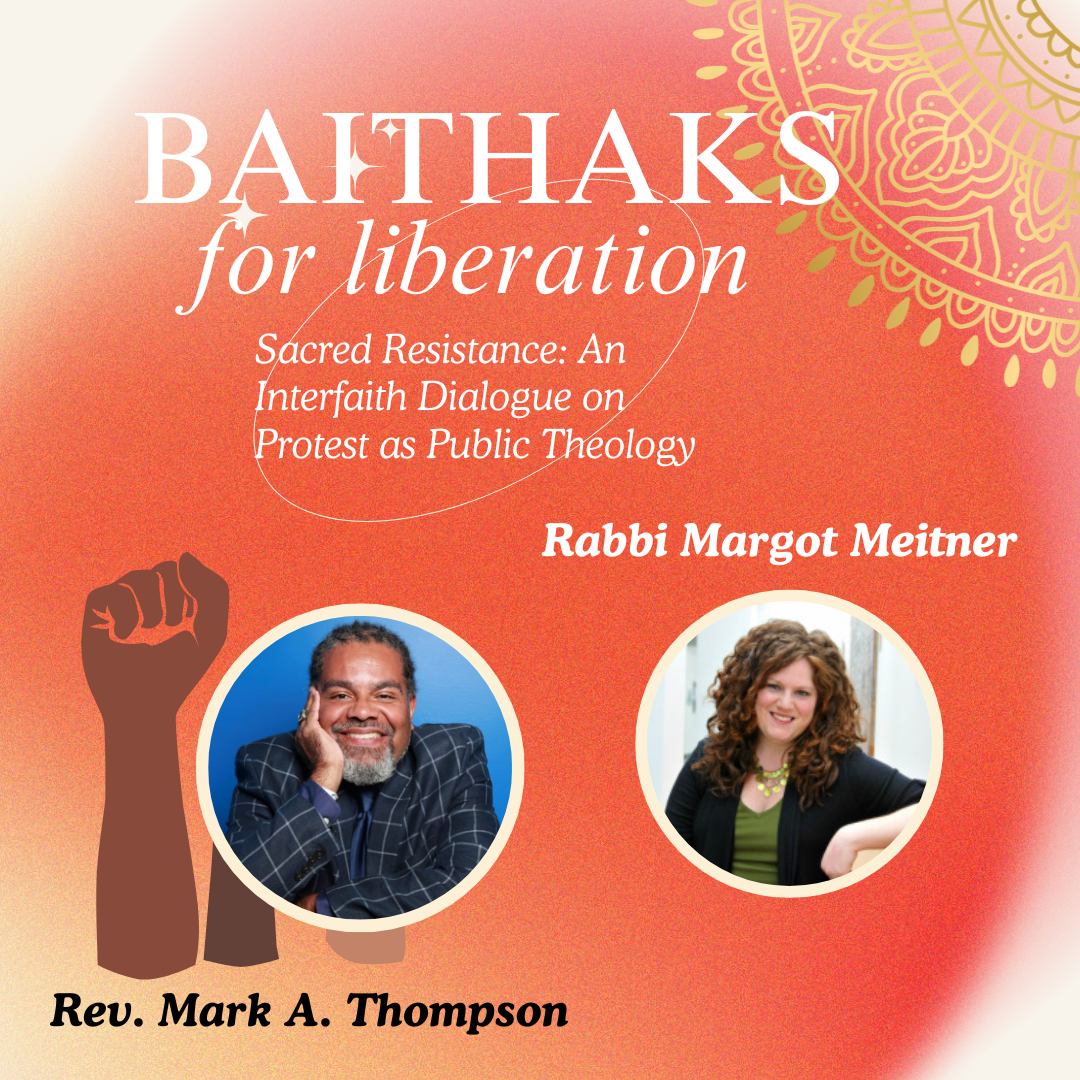
About the speakers
Rabbi Margot Meitner is a Boston-based psychotherapist, community rabbi, and leading member of Rabbis for Ceasefire. Her work brings together emotional and spiritual health, social change, trauma care, gender identity, and transgender inclusion. She also serves on the faculty of Hebrew College, where she trains future rabbis and cantors in spiritual care.
Rev. Mark A. Thompson is a minister, broadcaster, and longtime political and human rights activist. He hosts the award-winning podcast Make It Plain and has spent four decades working across movements for racial, economic, civil, and human rights. His activism has included the anti-apartheid movement, racial justice organizing, the Poor People’s Campaign, and the Black Church PAC.
Sunita Viswanath is the Executive Director and co-founder of Hindus for Human Rights. She has worked in women’s rights and human rights movements for more than three decades and previously co-founded Women for Afghan Women and Sadhana: Coalition of Progressive Hindus.
This conversation is part of Baithak, Hindus for Human Rights’ series bringing scholars, organizers, artists, and faith leaders together for serious conversations about Hindu traditions, democracy, justice, and belonging.