
Desh Videsh: How Hindutva Rewrites History and Turns Myth into Political Power
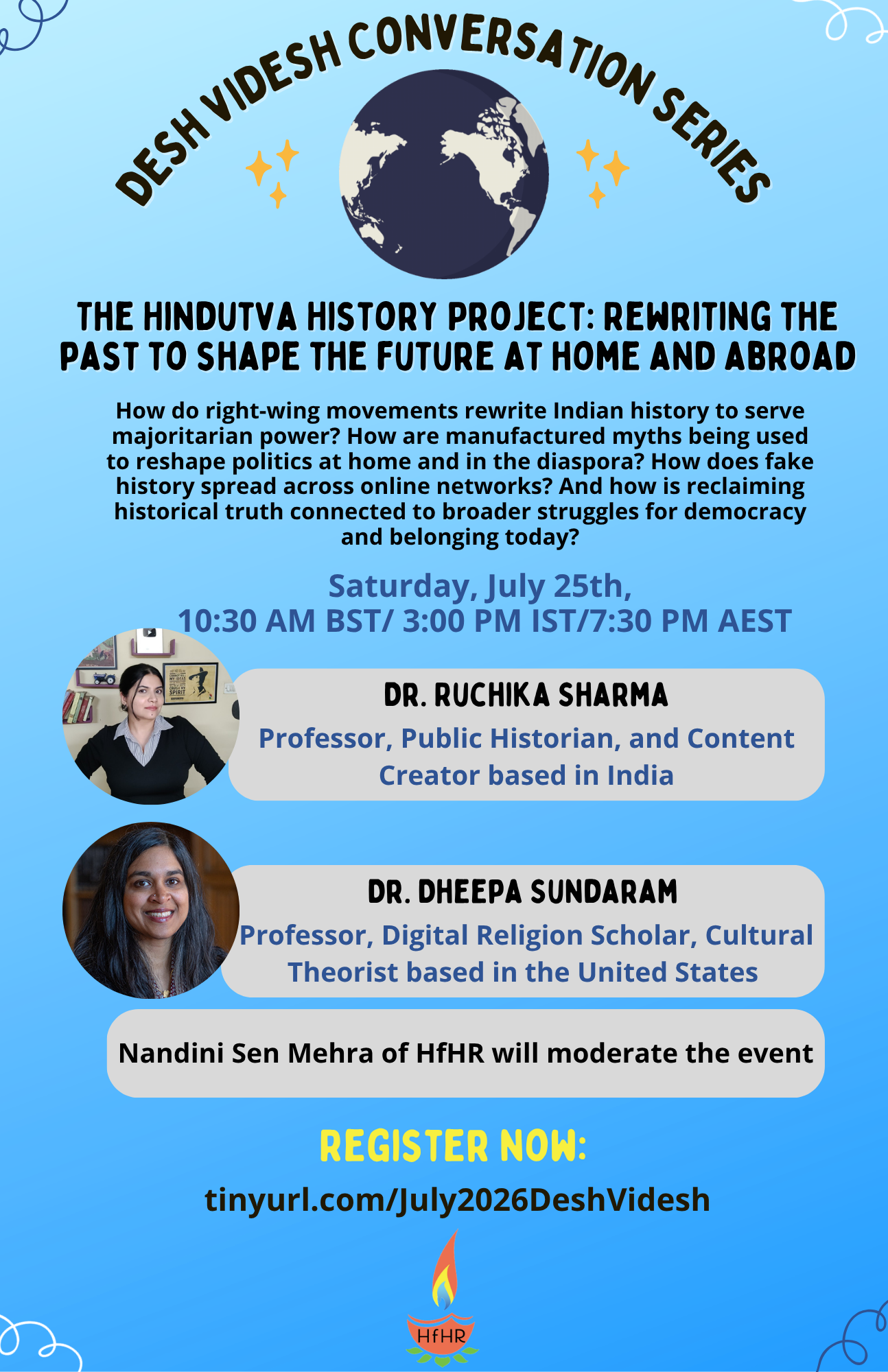
Dr. Ruchika Sharma and Dr. Dheepa Sundaram trace how Hindutva narratives move from textbooks and social media into minority persecution, mob violence and transnational repression.
History is never only about the past. The stories a society tells about conquest, faith, citizenship, and belonging help determine who is protected in the present, and who is placed in danger.
In this Desh-Videsh conversation, Dr. Ruchika Sharma and Dr. Dheepa Sundaram examine the Hindutva movement as a transnational disinformation pipeline. Historical myths are manufactured and popularized in India, circulated through memes, videos, textbooks, and digital platforms, and then repackaged for diaspora audiences as a polished account of Hindu identity and Indian history.
The consequences are not confined to academic debate. These narratives can be used to justify the “reclamation” of religious sites, the legal persecution of minorities, anti-Muslim mob violence, and the targeting of activists and government critics inside and outside India.
How do we close the widening gap between evidence-based history and politically useful mythology? What happens when algorithms reward the most inflammatory version of the past? And what will it take to build an honest, pluralistic public memory?
Watch the full conversation below.
DEEPER DIVE
What is “manufactured memory”?
Manufactured memory is a shared understanding of the past that has been deliberately simplified, distorted, or selectively assembled for political purposes. It does not always rely on completely invented events. More often, it takes fragments of history, removes their context, repeats them through emotionally powerful stories, and presents those stories as the natural memory of an entire community. Once such narratives become familiar, they can be difficult to challenge. Their power comes less from historical accuracy than from repetition, institutional support, and their ability to explain present-day anxieties through a story of past humiliation and promised restoration.
How does Hindutva turn history into political power?
Hindutva presents Indian history as an extended conflict between an authentic Hindu nation and a succession of foreign or hostile forces. This framework transforms a complex and plural past into a moral drama of victimhood, betrayal, and recovery. Contemporary Muslims, Christians, secularists, historians, and political critics can then be cast as inheritors or agents of an old civilizational threat.
Historical revisionism becomes politically useful because it changes how present-day actions are interpreted. Discrimination can be described as correction. The seizure of religious sites can be called reclamation. Violence can be presented as self-defense, even when it is directed at vulnerable minorities.
Why does rigorous history struggle to compete with political mythology?
Academic history is built through evidence, uncertainty, disagreement, and revision. Political mythology offers something more emotionally immediate: certainty, identity, heroes, enemies, and a clear explanation for why the world feels unjust. Digital platforms intensify this imbalance. A careful historical argument may require context and qualification. A misleading claim can be condensed into an image, a short video, or a viral message that rewards anger and belonging. The problem is therefore larger than correcting individual falsehoods. It concerns the institutions and technologies that determine which versions of the past become visible, memorable, and politically actionable.
What role do digital platforms and algorithms play?
Platforms do not merely transmit political narratives. Their design can shape which narratives succeed. Content that produces outrage, fear, or affirmation often travels further than content that asks audiences to tolerate ambiguity. Repetition can make fringe claims appear widely accepted, while coordinated networks can give propaganda the appearance of organic public opinion.
Algorithms also allow historical myths to travel between different audiences. A claim may be expressed through explicitly majoritarian language in India, then repackaged abroad as cultural pride, religious freedom, or the defense of Hindu identity. This process helps Hindutva operate simultaneously as a domestic political project and a transnational ideological network.
Why is the diaspora central to this conversation?
Diaspora communities do not simply reproduce Indian politics abroad. They reshape it through new institutions, funding networks, lobbying strategies, media ecosystems, and claims about minority identity. Hindutva organizations can present themselves in Western countries as representatives of a vulnerable religious minority while supporting a majoritarian political project in India. This apparent contradiction is central to understanding how the movement gains legitimacy internationally.
The diaspora can also challenge this machinery. Scholars, activists, faith leaders, journalists, and community organizations can expose how historical claims are translated across political contexts and insist that Hindu identity cannot be reduced to support for Hindu nationalism.
How does historical revisionism contribute to real-world violence?
Historical narratives influence who is viewed as innocent, threatening, native, foreign, or deserving of protection. When Muslims are portrayed as the living representatives of a centuries-old invasion, violence against them can be framed as historical redress. When activists are described as enemies of the nation, surveillance and repression can be presented as necessary defense. When religious sites are recast as evidence of collective humiliation, their destruction or seizure can be celebrated as justice.
The path from myth to violence is not automatic. It is built through political speeches, media coverage, institutional decisions, legal arguments, online networks, and repeated acts of dehumanization. Understanding that process allows us to see violence not as an isolated eruption, but as the outcome of sustained ideological work.
What would a more honest relationship with history require?
An honest history does not demand a flattering account of the past. It requires the ability to live with complexity. That means resisting the idea that nations must possess a single sacred narrative. It means protecting scholarship from political intimidation, teaching people how historical knowledge is produced, and making rigorous history accessible beyond universities.
It also requires a more plural understanding of belonging. India’s past cannot be reduced to the inheritance of one religious community, just as Hindu traditions cannot be reduced to the politics of Hindutva. The struggle over history is ultimately a struggle over the future. The question is not only which account of the past is true, but which kinds of political life our memories make possible.
About the speakers
Dr. Ruchika Sharma is a historian whose work examines the political uses of history, public memory, and the relationship between academic scholarship and popular historical narratives.
Dr. Dheepa Sundaram is a scholar of digital religion, Hindu nationalism, online political cultures, and the circulation of religious and ideological narratives across transnational networks.
This conversation is part of Desh Videsh, a Hindus for Human Rights’ series exploring the movement of politics, culture, and ideas between India and the diaspora, and what these transnational connections mean for democracy, pluralism, and human rights.