
On Foot at the Border: A Jerusalem Dispatch from Rev. Manish Mishra-Marzetti
Reverend Manish Mishra-Marzetti is a member, friend and advisor of Hindus for Human Rights and the senior minister of the First Unitarian Universalist Congregation of Ann Arbor, Michigan. — he is currently traveling with Unitarian Universalists for Justice in the Middle East’s clergy human rights delegation in Palestine/Israel and sharing his insights from his travels
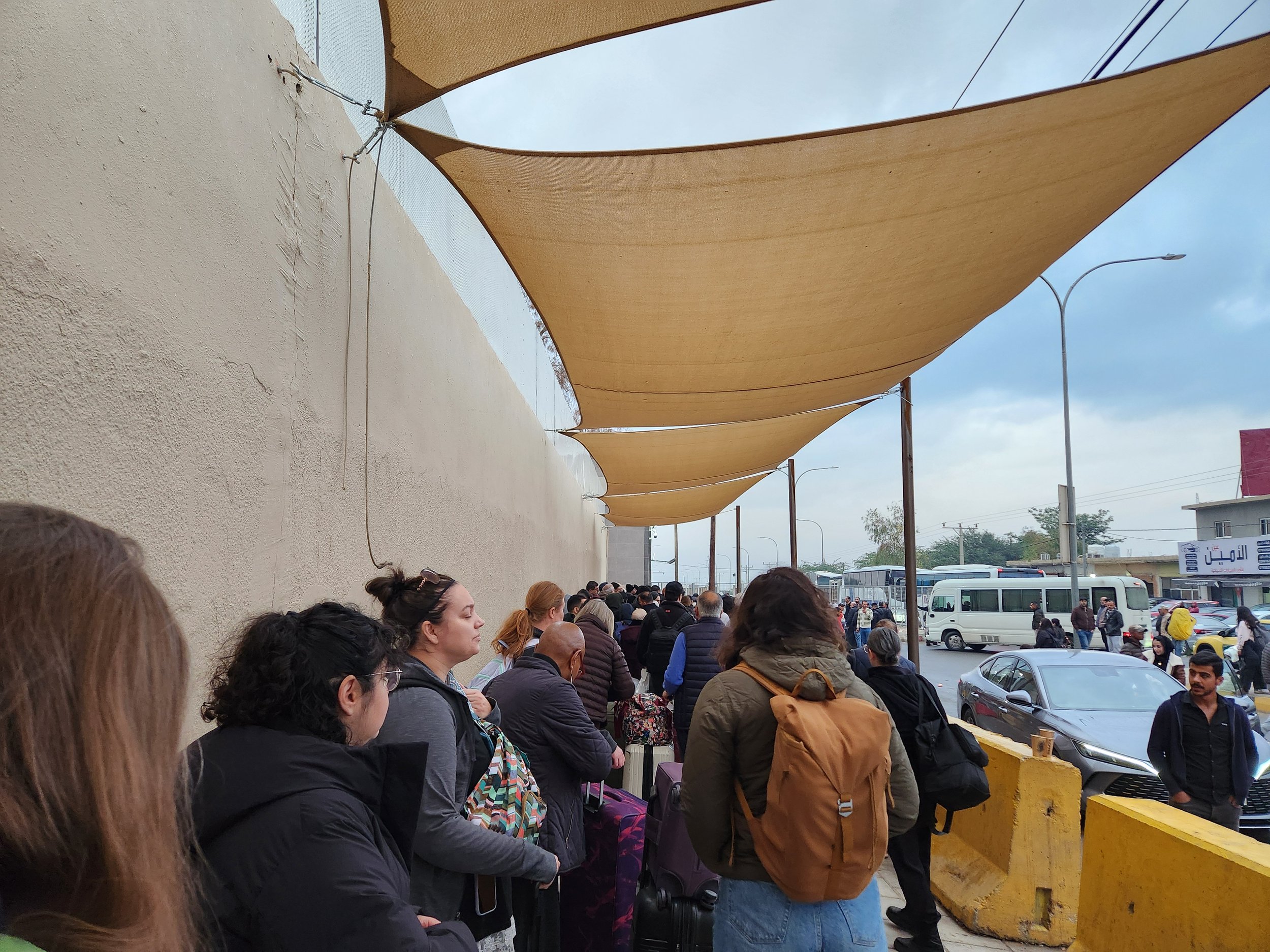
I am writing from Jerusalem, deeply jetlagged and also processing what I have been encountering and learning on this journey. The land crossing from Jordan into the West Bank and Israel was an experience that included traveling by foot and bus across the militarized border. It included multiple checks and re-checks by each government (the governments of Jordan and Israel). I have included an image of the crowds our delegation had to navigate as we began the border crossing by foot, carrying our luggage with us.
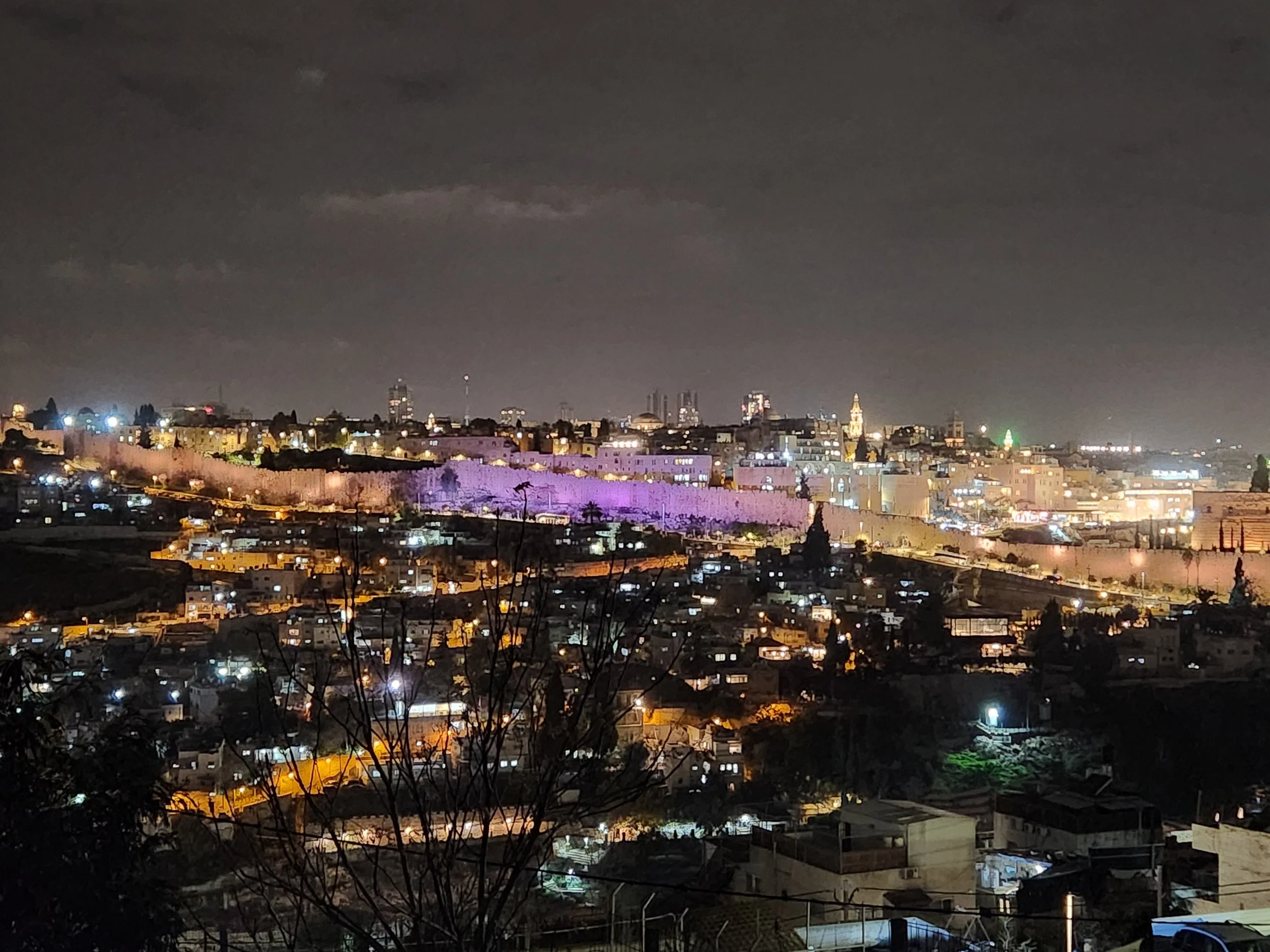
I learned about the language of “apartheid” being applied to the circumstances of the Palestinian people from our Quaker siblings, as we at UUAA considered signing the Quaker-led Apartheid-Free Communities Pledge, which UUAA signed onto as a part of the resolution we adopted in June 2025 in support of Palestinian human rights. While I could conceptually (theoretically) understand the reasoning of applying the term apartheid in the Palestinian context, I was not clear what this meant in terms of the day-to-day realities of the Palestinian people. I have only been in the region for two days, and apartheid is absolutely what the Palestinian people are experiencing – separate and unequal treatment (at every turn) by the government that dominates and militarily controls them. Palestinians drive with different colored license plates, and vehicles with Palestinian plates are subject to additional security checks and travel limitations. Most Palestinians need permits to travel within and to/from the Palestinian lands – and the granting of these permits by the government of Israel, and the restrictions that the permits may include, can feel arbitrary and capricious to Palestinians. The restrictions on movement are experienced as control, as intentionally limiting freedom of movement, and with that the ability of the Palestinian people to communicate with one another, be in relationship with one another, and/or organize.
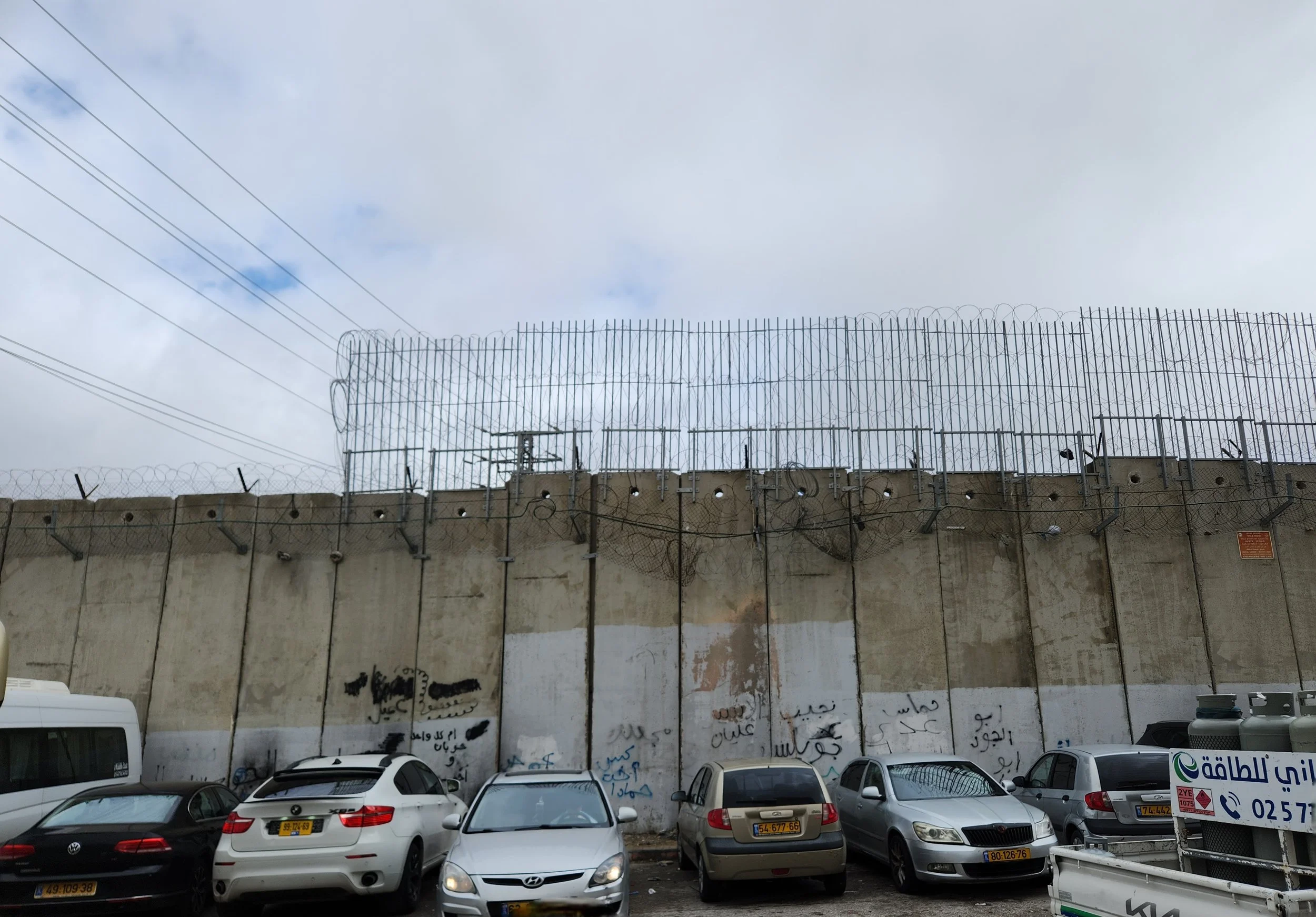
Heavily armed IDF military personnel routinely roam the streets of Jerusalem, and from my perspective as a first-time visitor, appear more menacing than helpful or friendly. Palestinians pay taxes to the government of Israel, on equal par with the rates that Israeli citizens pay, but at no turn receive similar government benefits or support. The government of Israel has even built a military wall around East Jerusalem, similar in style/feel to the border wall that exists along much of the US-Mexico border. This wall places the West Bank’s water supply under Israeli control and the government of Israel ensures that this water flows freely to Israeli settlements while charging Palestinian communities for access to their own water. (I am including an image of this military wall with this update.)
In sum, Palestinians live under Israeli military domination and are assumed to be a threat that must be controlled, managed, and subjugated. Apartheid (separate and unequal treatment) is the day-to-day lived reality of the Palestinian people.
While apartheid is the day-to-day reality of the Palestinian people, we have already met with local activists and organizers who have described Israel’s settler policies in great detail. I had assumed, to a degree, that Israeli settlements were partially or maybe even primarily being built in the desert – i.e., built on land that was unoccupied or had no prior development. This is not the case. The government of Israel actively appropriates the land and property of Palestinian people, typically providing no “imminent domain” style compensation. Land and buildings can be appropriated on any number of technicalities and pretexts, including mere absence from the property.
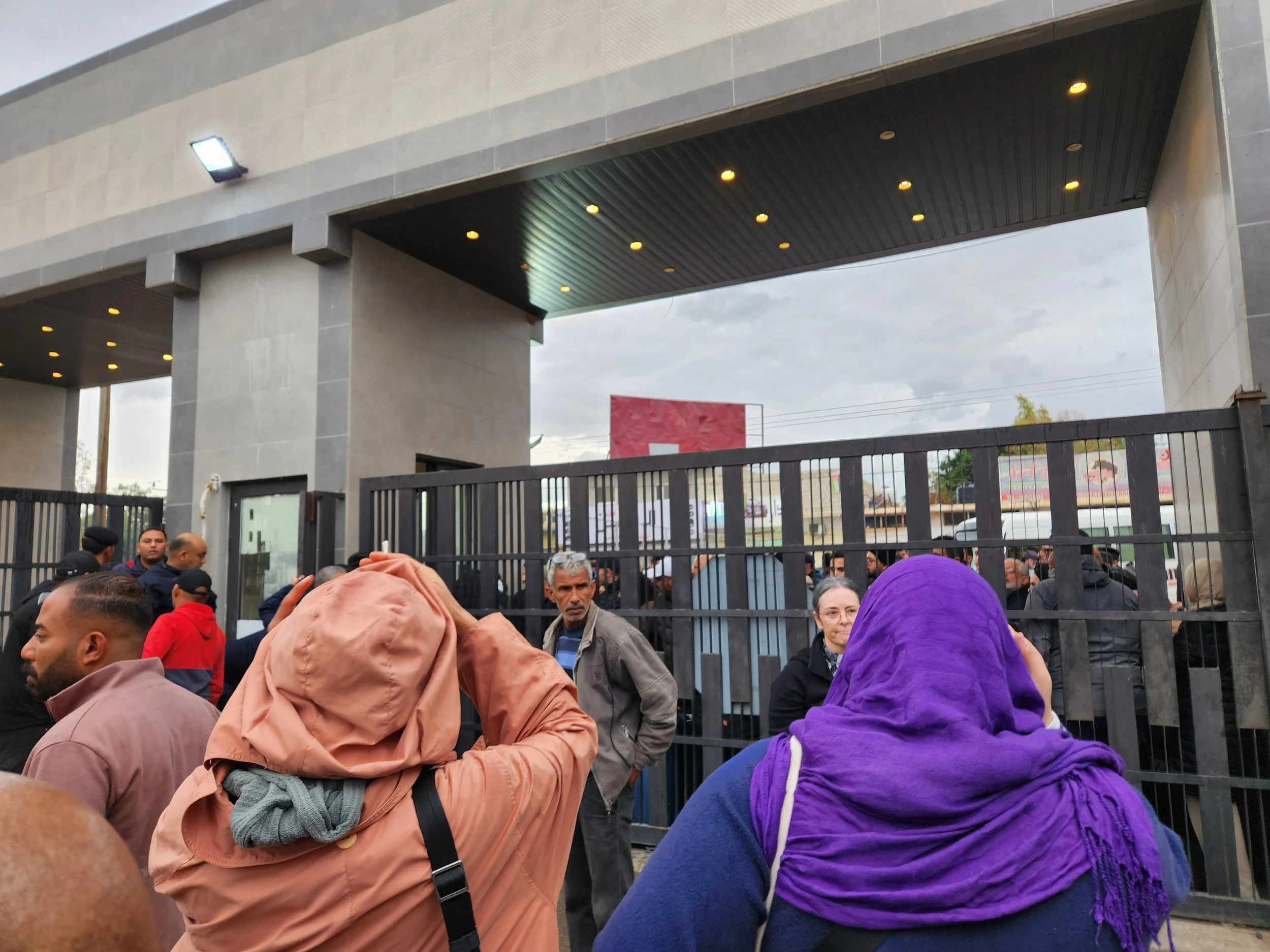
For example, if you fled your land or property because of war or conflict, the Israeli government can claim that you have abandoned that land/property and appropriate it for redistribution to Israeli settlers. We have heard from local community organizers who described this reality in despairing terms – if the government of Israel wants your land, they will have it. Often the best that Palestinians feel they can do is delay the appropriation of their land through court appeals, which they generally do not win. Activist after activist described this lived reality as one of population replacement – the intentional replacement of the Palestinian people with Jewish settlers, who are typically white, European and/or American immigrants to these lands. If the day-to-day lived reality of the Palestinian people is apartheid, the government of Israel’s goal – whether publicly stated or not, but demonstrated through the government’s actions – is ethnic cleansing and population replacement.
It is jarring to be encountering what I have described here so unambiguously and so early in this journey. Please continue to hold our delegation in your hearts and prayers, as we lend presence, witness, and love to those who are suffering these realities. I will share additional updates, as time and internet access permits.
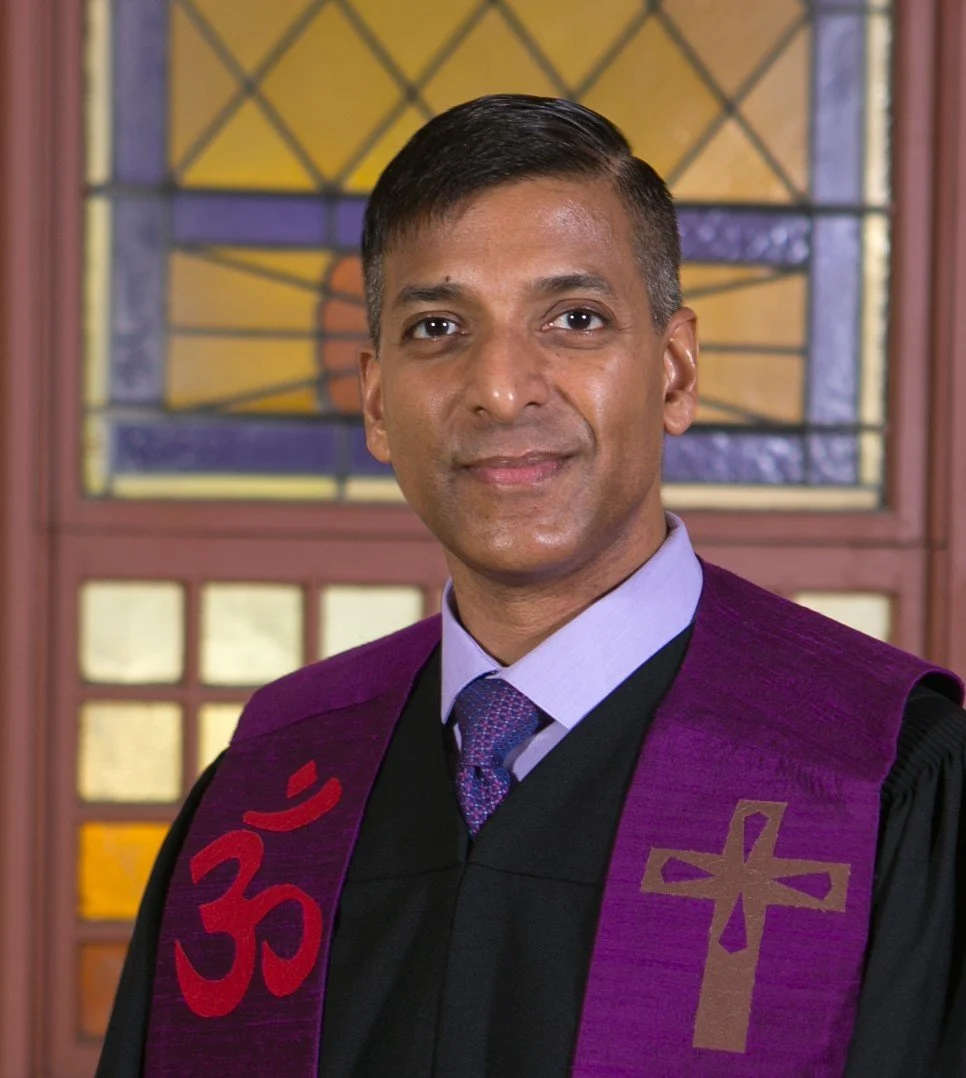
Rev. Manish Mishra-Marzetti (he/him) serves as senior minister of the First Unitarian Universalist Congregation of Ann Arbor, Michigan. He is the co-editor of Seeds of a New Way: Nurturing Authentic & Diverse Religious Leadership (2024), Conversations with the Sacred: A Collection of Prayers (2020), and the 2018-2019 UUA common read, Justice on Earth: People of Faith Working at the Intersections of Race, Class, and the Environment. He has served extensively in Unitarian Universalist leadership, including as co-chair of the Unitarian Universalist Service Committee (UUSC) Board of Trustees, a member of the UUA Board of Trustees, president of the Diverse and Revolutionary Unitarian Universalist Multicultural Ministries (DRUUMM), commissioner on the UUA Commission on Appraisal, secretary of the board of Starr King School for the Ministry, and as an author and advocate of the 2007 General Assembly resolution confronting gender identity-related discrimination. He brings to the ministry his multicultural experience serving as a U.S. diplomat during the Clinton administration.