
Reverend Manish Mishra-Marzetti is a member, friend and advisor of Hindus for Human Rights and the senior minister of the First Unitarian Universalist Congregation of Ann Arbor, Michigan. — he is currently traveling with Unitarian Universalists for Justice in the Middle East’s clergy human rights delegation in Palestine/Israel and sharing his insights from his travels
Having been a U.S. diplomat at the time of the Oslo Accords, in 1993, I assumed for decades that the Accords’ two-state solution was the holy grail of peace in the Middle East.

But then a local Palestinian leader shocked me. “Everyone in the West is obsessed with peace in the Middle East. And, every conversation about ‘peace’ devolves into a conversation about ‘piece’ – which side is going to get which pieces of land. What if a two-state solution is not possible? What if that isn’t the answer?” he asked.
I had never considered this. What if the two-state solution is a desert-like mirage? An illusory vision that the West continues to fervently chase after? History certainly demonstrates that there are mirage-like qualities to the notion of a two-state solution.
In the 1940s, as the British were crafting the possibility of a Jewish state and a Palestinian state in the Levant, the composition of historical Palestine was approximately 70% Palestinian and 30% Jewish. Despite those numbers, the partition plan that was eventually adopted by the UN General Assembly in 1947, at the behest of the British, disproportionately gave the Jewish minority 56% of the land, the Palestinians 43%, and designated 1% as an international zone (Jerusalem and its surrounding areas). The Jewish Zionist movement, which at that time had no land, thought this plan was great and readily agreed; the Palestinians objected and did not agree to a partition.
The UN plan, though never formally implemented, provided the first iteration of two potential states in Palestine. In the absence of UN implementation of the partition plan, Jewish Zionist militia began to forcibly implement the plan in 1948. Israelis call this conflict the War of Independence. Palestinians call it the Nakba, “the catastrophe,” the loss of life and homes, and the forcible removal of Palestinians from their own lands being the catastrophe. Between 1948 and 1949, under the pretext of “war,” Israel proceeded to take over even more land than the United Nations had disproportionately allocated in its partition plan. By 1949, Israel had taken over 78% of the land in historical Palestine. By the conclusion of the Six-Day War in 1967, the remaining Palestinian lands (including the West Bank, Gaza, and East Jerusalem) were occupied by Israel and subject to Israeli military control.
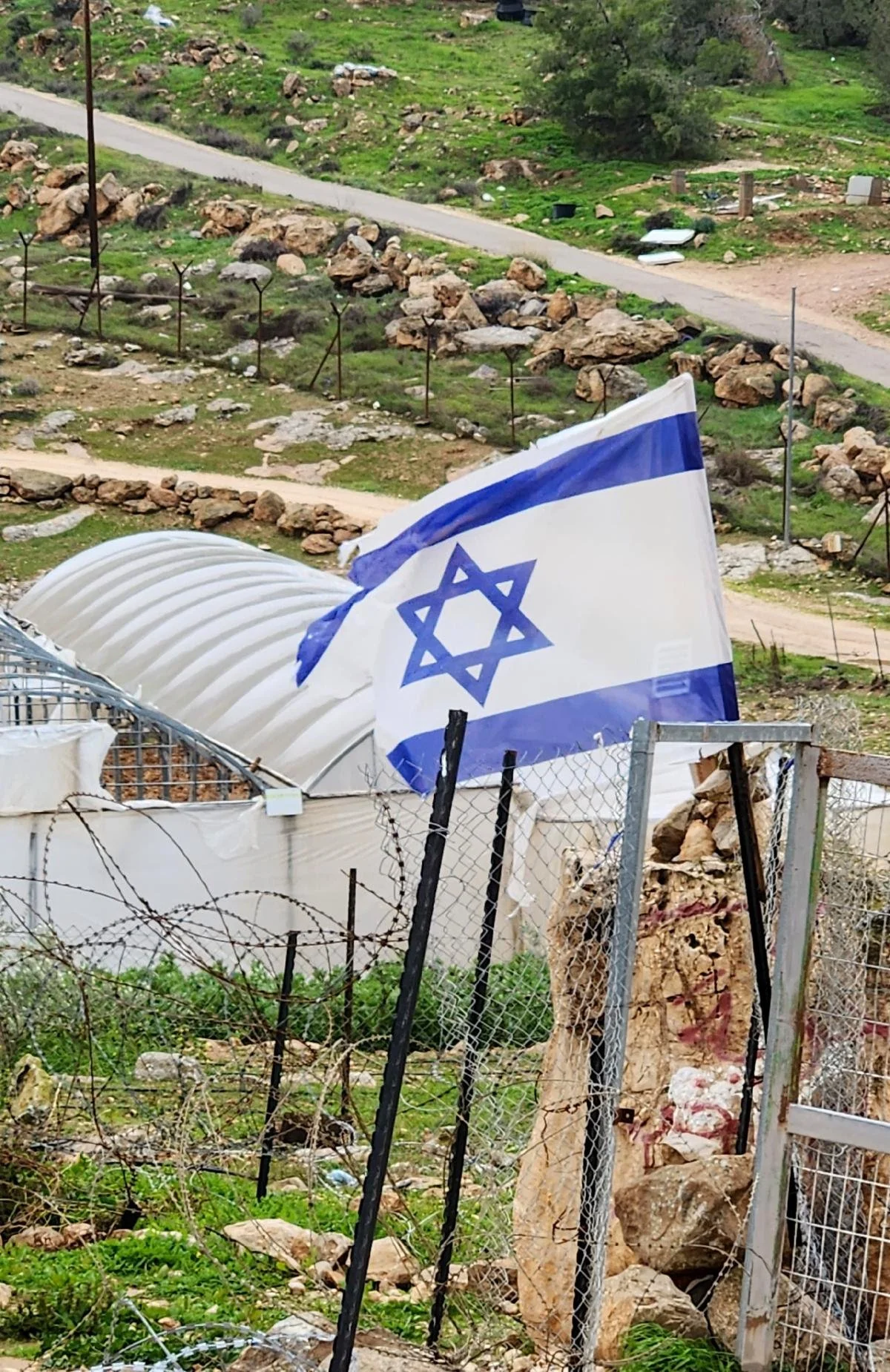
The subsequent 1993 Oslo Accords required Palestinians to accept that 78% of historical Palestine would forever be Israel, accepting permanently the outcomes of the Nakba. In turn, Israel would eventually withdraw its military forces from occupied Palestinian lands (the West Bank, Gaza, and East Jerusalem) and potentially remove Jewish settlers from those lands. These potential Oslo commitments got Israeli Prime Minister Yitzhak Rabin assassinated in 1995 by a Jewish settler who viewed Rabin as a traitor to the Jewish people due to his support of the Accords. The assassination is credited with having killed not just Rabin but also the Oslo process: a more conservative Israeli government followed Rabin’s death, one that was not committed to the Accords.
What resumed in earnest after Rabin’s death was Israel's settlement program. In 1993, the West Bank and East Jerusalem held about 250,000 Jewish settlers. By 2025, that number was 750,000. Today, a two-state solution would require either the forced removal of three-quarters of a million Jewish settlers from Palestinian lands or for those Jewish settlers to accept living in a Palestinian-run state. Both of those possibilities seem unlikely, and that very unlikelihood may have been the Israeli government’s implicit goal: to undermine the possibility of a two-state solution by robustly placing Jewish settlers in occupied Palestinian lands.
To my surprise, some Palestinian leaders openly wonder what it might be like for everybody to live together in a genuinely democratic state, one that embodies equality for all its citizens. Our delegation met a Palestinian former member of the Knesset, whose political party advocates exactly this: an Israeli state with genuine equality for all. He and his political party are considered “extremists” for harboring such views, because true political and social equality for all would undermine the identity of Israel as a state by and for the Jewish people.
What, then, is the solution? Surely, genocide and apartheid can’t be the answer. But perhaps here, as well, genocide and the brutality of apartheid have another implicit goal: to push Palestinians into voluntarily vacating their historical lands and living elsewhere – anywhere other than Israel and the occupied Palestinian territories.
One Palestinian activist shared with our delegation his West Bank Israeli settler neighbor’s idea of how the Palestine and Israel question could be resolved: “When all the Arabs leave, then there will be peace.”
Mainstream Israeli politicians find full equality within the state of Israel to be unacceptable. The rest of the world finds genocide, apartheid, and forced removal to be unacceptable, yet it has done very little to stop these realities from being thrust upon the Palestinian people.
Might it be that in taking little or no action, the world is de facto allowing a “solution” to slowly play out? It is a solution that represents the ongoing dispossession and suffering of the Palestinian people.
Holding the heartache of all this alongside you, Rev. Manish
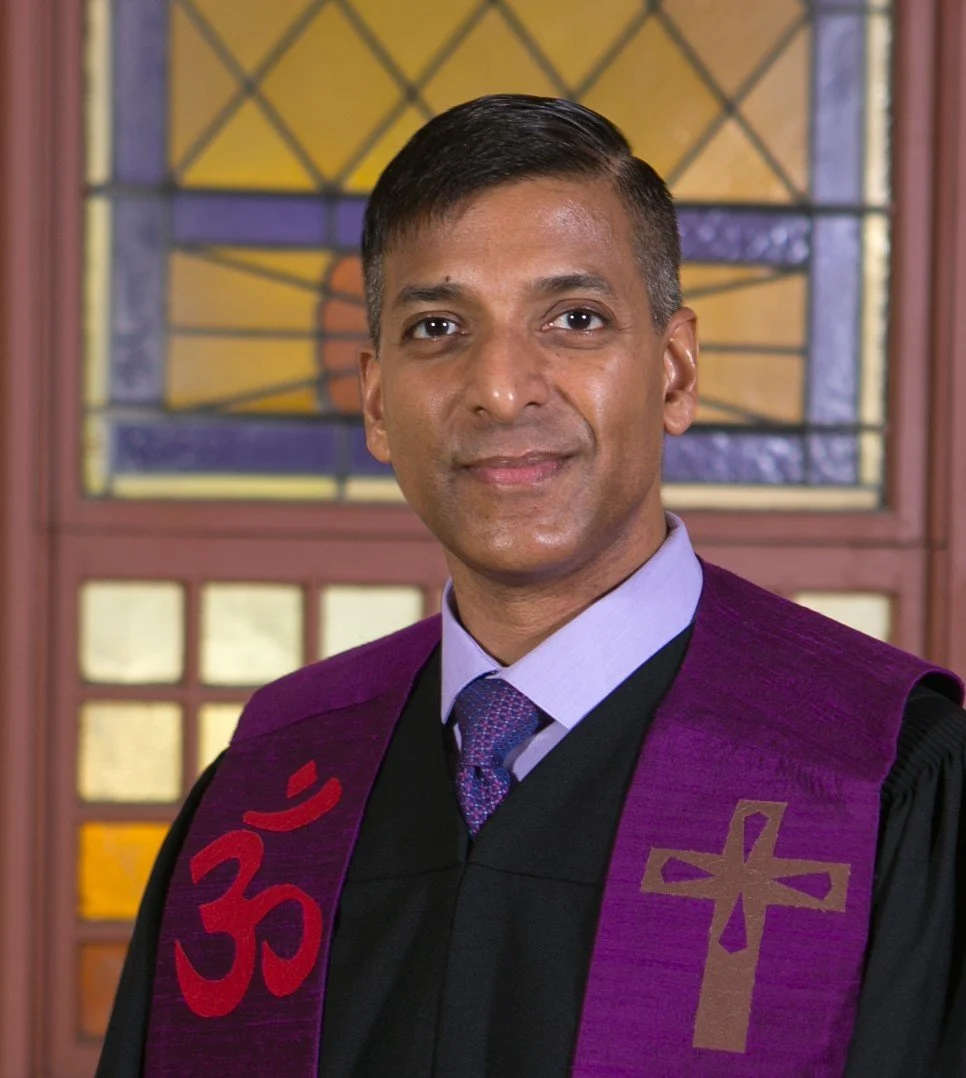
Rev. Manish Mishra-Marzetti (he/him) serves as senior minister of the First Unitarian Universalist Congregation of Ann Arbor, Michigan. He is the co-editor of Seeds of a New Way: Nurturing Authentic & Diverse Religious Leadership (2024), Conversations with the Sacred: A Collection of Prayers (2020), and the 2018-2019 UUA common read, Justice on Earth: People of Faith Working at the Intersections of Race, Class, and the Environment. He has served extensively in Unitarian Universalist leadership, including as co-chair of the Unitarian Universalist Service Committee (UUSC) Board of Trustees, a member of the UUA Board of Trustees, president of the Diverse and Revolutionary Unitarian Universalist Multicultural Ministries (DRUUMM), commissioner on the UUA Commission on Appraisal, secretary of the board of Starr King School for the Ministry, and as an author and advocate of the 2007 General Assembly resolution confronting gender identity-related discrimination. He brings to the ministry his multicultural experience serving as a U.S. diplomat during the Clinton administration.