
Five Years Without Trial: Supreme Court Denies Bail to Umar Khalid and Sharjeel Imam
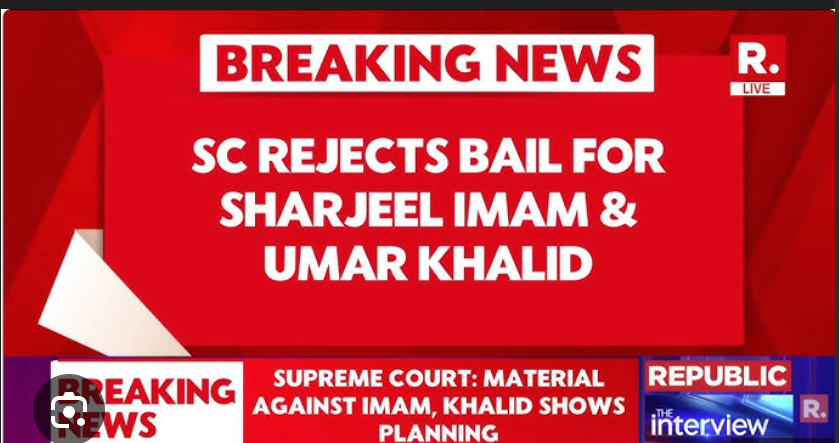
via Republic World
India’s Supreme Court has denied bail to student activists Umar Khalid and Sharjeel Imam, extending what has become five years of incarceration without trial under the Unlawful Activities (Prevention) Act (UAPA) in the “larger conspiracy” case linked to the February 2020 violence in northeast Delhi.
The denial comes even as the Court granted bail to several other accused in the same matter—further sharpening public concern about how UAPA’s restrictive bail framework can turn pretrial detention into de facto punishment, especially in cases connected to protest movements and political speech.
These proceedings remain closely watched in India and abroad. Human rights groups have repeatedly criticized the prolonged detention and the use of counter-terror provisions in dissent-related cases, and recent international attention—including from U.S. lawmakers—has underscored the broader implications for civil liberties, fair trial standards, and democratic space.
Below is Hindus for Human Rights’ press release responding to the Supreme Court’s decision, the continuing use of UAPA in this case, and the urgent need for due process, transparency, and equal accountability for the February 2020 violence.
FOR IMMEDIATE RELEASE
Hindus for Human Rights condemns the Government of India’s weaponization of UAPA to chill dissent.
January 5th, 2025 (Washington, DC) — Hindus for Human Rights urges the Supreme Court of India to reverse its decision to deny bail to Umar Khalid and Sharjeel Imam, who have been detained in pre-trial detention under the draconian Unlawful Activities Prevention Act. HfHR calls for Khalid and Imam’s immediate release. We urge the Government of India to uphold the universally recognized right to a free, fair, and speedy trial for the thousands of Indians detained under the Unlawful Activities Prevention Act.
The UAPA, which was created to combat terrorism in India, has been weaponized against those who criticize the Indian government. The UAPA is known as a “no-bail” law, meaning that courts have discretion over whether to grant bail. The UAPA also gives judges up to 7 years before they have to provide arrestees a trial, meaning police have 7 years to gather evidence. The conviction rate for the UAPA is less than 3%. In the most recent reforms to the UAPA, the Indian Supreme Court also made it legal to charge individuals with terrorism for being associated with “banned organizations” or organizations that are alleged to be connected with terrorist activity.
Khalid and Imam were charged under this draconian law in the aftermath of the deadly 2020 Delhi pogroms, where rioters burned Muslim homes, businesses, and mosques, and 53 people died. The violence was a Hindu nationalist response to months of peaceful protests by Muslims, led by leaders like Khalid and Imam, against the discriminatory Citizenship Amendment Act and the ruling Bharatiya Janata Party’s systematic Islamophobia. Instead of punishing the mobs who terrorized Delhi, the Government of India punished Khalid, Imam, and dozens of other Muslim leaders for daring to speak out.
“While we are glad that five of the co-accused were released on bail, the Supreme Court of India’s decision to deny bail to Umar Khalid and Sharjeel Imam is an unacceptable miscarriage of justice,” said Senior Policy Director Ria Chakrabarty. “As Hindus, we are appalled that Hindu nationalists are using our faith to crush the voices of Muslims like Khalid and Imam.”
We echo the calls from eight US lawmakers to ensure that Khalid and Imam are guaranteed a free trial and that their rights as Indians to life and liberty are respected. We urge the Indian Parliament to honor its commitments in the International Covenant on Civil and Political Rights and overhaul the UAPA to align with the rights to a speedy trial and the presumption of innocence. Khalid and Imam, who have now been in jail for over five years, have been systematically denied these rights. For Khalid, Imam, and thousands of other Indians, justice has been delayed for far too long.
Correction: An earlier version of this press release incorrectly stated that Khalid Saifi had been released on bail. He remains incarcerated under UAPA.
###
For Media Inquiries, please contact
Faria Rehman, Campaigns and Press Relations Manager, Hindus for Human Rights — faria@hindusforhumanrights.org
For press inquiries, interview requests, or additional context on the implications of UAPA for protest-related cases and prolonged pretrial detention, please reach out using the media contacts listed in the release. We encourage journalists covering India’s courts, civil liberties, communal violence accountability, and democratic backsliding to connect with our policy team for further analysis.
FAQs
1) Who are Umar Khalid and Sharjeel Imam?
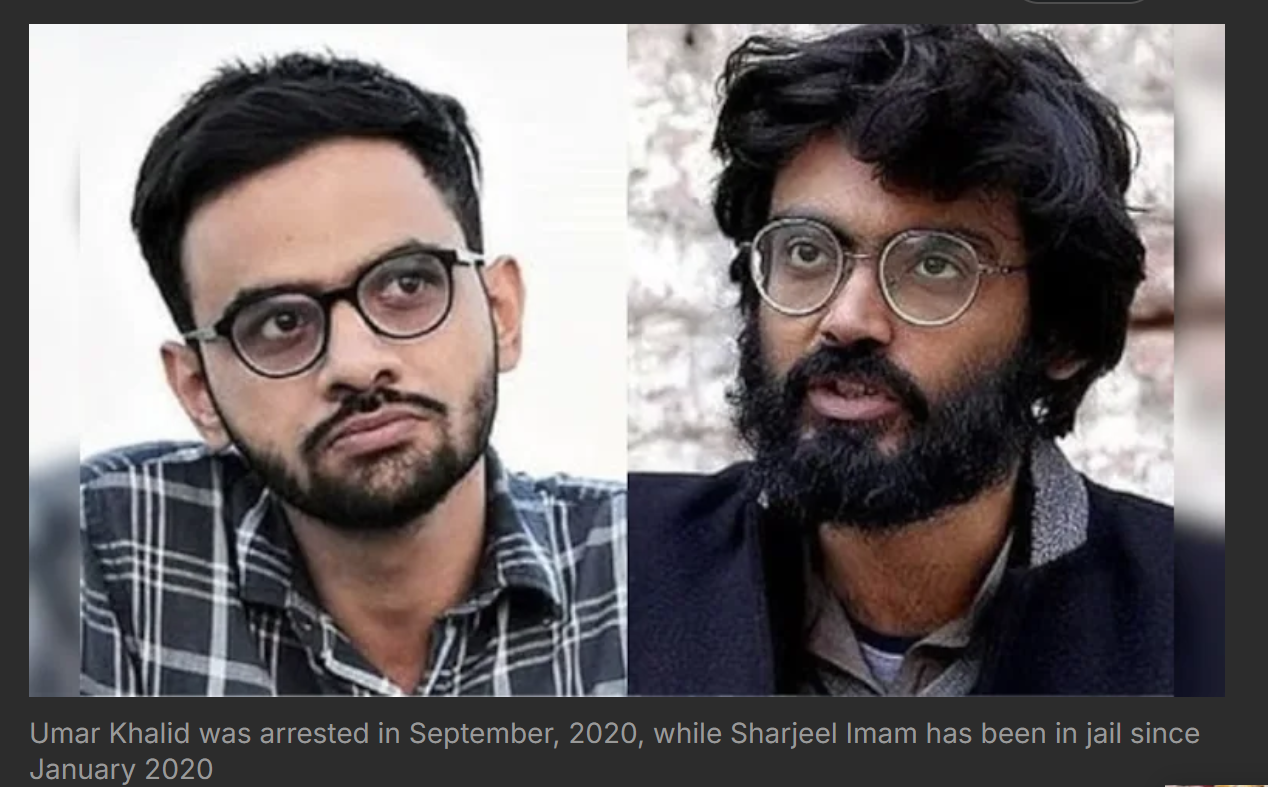
Umar Khalid and Sharjeel Imam are Indian student activists and public speakers who became widely known during nationwide protests against the 2019 Citizenship Amendment Act (CAA). They have been jailed for years in connection with a police “larger conspiracy” case related to the February 2020 violence in northeast Delhi.
2) What did the Supreme Court of India decide on January 5, 2026?
On January 5, 2026, the Supreme Court denied bail to Umar Khalid and Sharjeel Imam in the UAPA case linked to the February 2020 northeast Delhi violence, while granting bail to several other accused in the same matter.
3) How long have Umar Khalid and Sharjeel Imam been in jail without trial?
They have spent roughly five years in pretrial detention without a completed trial in the UAPA “larger conspiracy” case.
4) What is UAPA?
UAPA stands for the Unlawful Activities (Prevention) Act, a national security law in India. In practice, UAPA cases often involve stricter bail standards and can lead to prolonged pretrial detention while investigations and trials move slowly.
5) Why is UAPA controversial in protest- or dissent-related cases?
UAPA is controversial in these contexts because its bail framework and investigative timelines can make it difficult for accused individuals to secure release before trial, raising concerns that incarceration becomes punitive even before guilt is proven.
6) What is the “larger conspiracy” case in the Delhi violence prosecutions?
The “larger conspiracy” case is a framing used by investigators to allege that the February 2020 violence in northeast Delhi was planned rather than spontaneous, and it has been used to justify charging certain activists and organizers under UAPA.
7) What happened in northeast Delhi in February 2020?
In February 2020, communal violence erupted in parts of northeast Delhi, resulting in 53 deaths, with most of the people killed reported to be Muslim. The violence unfolded amid a tense political environment following months of protests against the CAA.
8) What are the key human rights concerns raised by prolonged pretrial detention?
Prolonged pretrial detention raises concerns about due process, the presumption of innocence, and fair trial rights. When detention lasts for years, it can function as punishment before conviction and can chill freedom of expression and association.
9) Why has this case drawn international attention?
The case has drawn international attention because it involves years of detention without a completed trial under a national security law, prompting statements from human rights organizations and concern from lawmakers outside India about due process and civil liberties.