
Dhurandhar: Ranveer Singh and the Seductions of Rage, Masculinity and Nationalist Spectacle
The franchise’s real achievement is its sleek conversion of injury, masculinity, and political rage into mass pleasure, with Ranveer Singh’s star body as one of its most potent delivery systems.
By the time Dhurandhar: The Revenge opened, it was already doing the work of a franchise that understands modern politics better than most pundits do. The first film arrived on December 5, 2025. The sequel followed on March 19, 2026, after paid previews on March 18 and a rare global re-release of the original beginning March 12. It also opened in New York, including at AMC 34th Street 14. That is an absurdly fast turnaround for a film of this scale, but the speed is the point. The sequel did not wait for the first movie to become memory. It came while the first was still functioning as mood, argument, and reflex.
This is why the usual debate around Dhurandhar — patriotism or propaganda? — feels too neat, almost comfortingly neat. It lets everyone keep their assigned position. The nationalist viewer gets to say the critics hate India. The liberal viewer gets to say the masses are being manipulated. Neither response is especially illuminating. A film this successful, this quickly sequelized, and this internationally legible is doing something more interesting than issuing talking points. It is selling an emotional technology: grievance with production values.
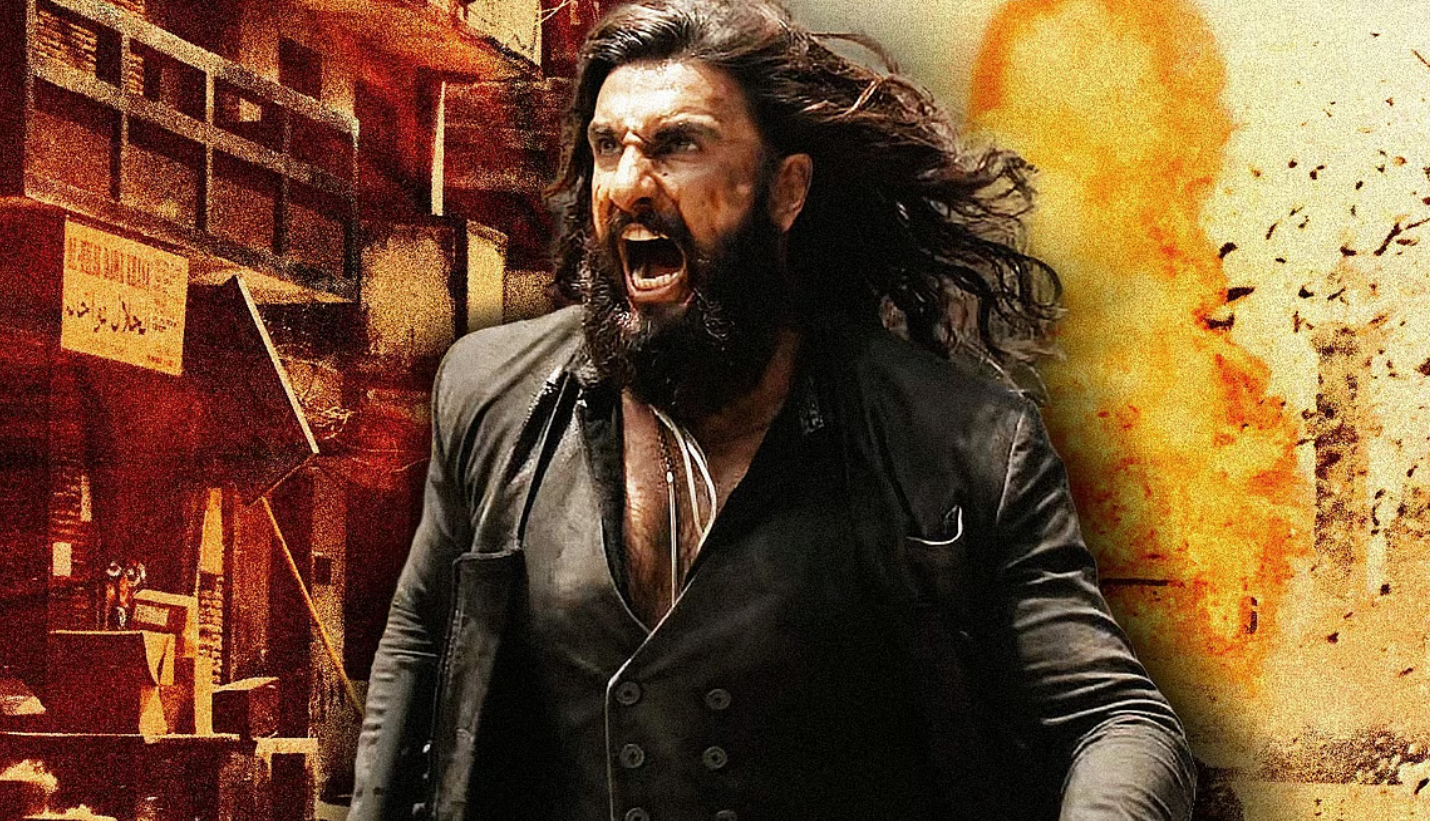
What director Aditya Dhar appears to understand, perhaps more clearly than many of his detractors, is that contemporary audiences do not only want ideology. They want density. They want velocity. They want the pleasure of feeling that a giant machinery is moving with purpose. Even positive reviews from more serious critics make this clear. That matters, because it explains why sneering at the audience misses the point. People are not showing up only to be instructed. They are showing up to be overwhelmed.
That overwhelming quality is central to the franchise’s political method. Dhurandhar does not simply tell viewers that India has enemies and avengers. It gives fantasy the texture of evidence. The films braid real events — the Kandahar hijacking, the Parliament attack, 26/11, the ghostly figure of Ajit Doval, the specter of Dawood Ibrahim — into a thriller architecture of infiltration, vengeance, and sovereign competence. Even when a sequel carries a disclaimer saying it is fiction, the point is not to create distance from reality. It is to borrow reality’s authority and convert it into catharsis. What the films offer is not realism. It is retaliatory plausibility.
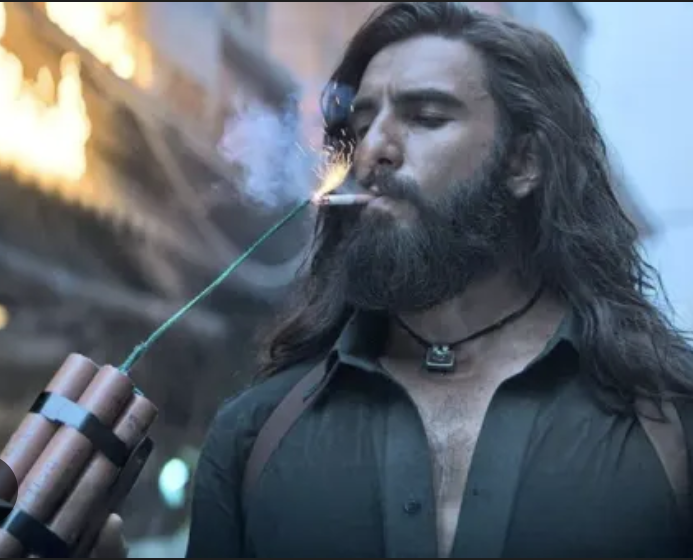
That is also where the critique has to get smarter. The problem with Dhurandhar is not merely that it vilifies Pakistan or flirts with chauvinism. Plenty of bad films do that and vanish. The problem is that it packages national injury as premium sensation. It turns geopolitical rage into something glossy, rhythmic, almost luxurious.
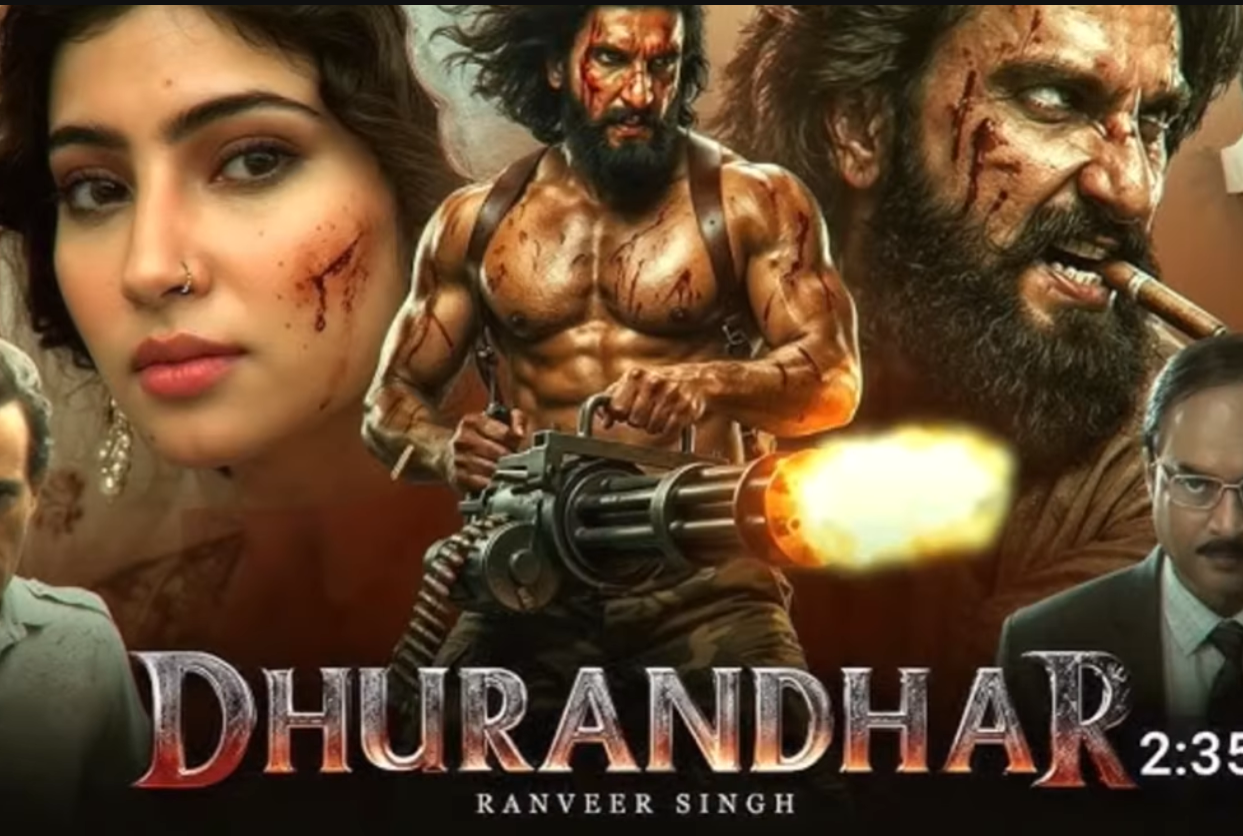
The star system matters here. Ranveer Singh’s performance — feral, controlled, charismatic in that watch-me-burn way he has — gives the film a body big enough to hold contradiction. He is not simply the hero; he is the site where the film manages a whole set of tensions about masculinity, nation, and looking. Action cinema has always relied on the male body as spectacle, even when it refuses to admit that this is what it is doing. The camera lingers on endurance, wounds, musculature, stillness under pressure, the body pushed to its limit and made more beautiful by punishment. What is being offered is not only identification — I am him — but a more unstable pleasure: I want what he has, I want to be what he is, I want to keep looking at him.
The form’s genius is to route this charged looking through acceptable channels: discipline, patriotism, sacrifice, mission. Desire is not eliminated; it is laundered into admiration. Beauty is armored as toughness. Singh is especially useful to a film like this because he can make that unstable economy visible without letting it break the frame. His body is offered up as an object of attention, but never passively; it is always converting visibility into force. Violence becomes the alibi for display. Woundedness becomes proof of moral seriousness. Brutality does not interrupt charisma; it secures it. That is not incidental to the film’s appeal. It is the delivery mechanism.
More broadly, Dhurandhar belongs to a wider era of grievance blockbusters, but with a specifically Indian sharpness. Its fantasy is not merely revenge. It is efficacy. In democracies full of drift, compromise, corruption, bureaucracy, and mediated suffering, efficacy is erotic. The hero knows. The state knows. The target deserves it. The plan works. That sequence of satisfactions is worth more than narrative subtlety. It is why people who may be perfectly capable of detecting crude politics still submit to the movie’s pull. The attraction is not ignorance. It is relief — relief from ambiguity, relief from helplessness, relief from the tiresome labor of having to think historically about violence.
The speed of the sequel’s release makes that even clearer. This was not just a follow-up; it was an extraction strategy. The first film became a phenomenon and then spilled into streaming, where the argument around it only widened. The sequel was rushed in before the discourse cooled, while the affect was still hot enough to monetize. Controversy was not collateral to the release; controversy was part of the release. The re-release, the previews, the premium screens, the eventized rollout: all of it suggests a studio that understood it was not selling part two of a story but the continuation of a feeling.
That feeling also escaped the theater. Critics who objected to the first film’s politics were hit with enough abuse that the Film Critics Guild of India publicly condemned the harassment. Once that happens, reception becomes part of the text. You are not just being asked to watch Dhurandhar; you are being asked to prove yourself by how you watch it, how loudly you cheer, how little hesitation you display. The movie becomes a test of alignment masquerading as entertainment.
The most revealing thing about Dhurandhar, then, is not that it is nationalist. Indian cinema has always known how to flatter the nation. What is new is the sleekness with which nationalism, platform success, box-office engineering, online combat, and prestige spectacle have fused into one machine. Dhurandhar is less a film than a total environment: a revenge fantasy, a discourse factory, a streaming triumph, a theatrical event, and a highly efficient conversion of injury into revenue.
That is why the sequel came so fast. It was never really a sequel. It was a rerun of the same seduction: pain turned into power, power turned into spectacle, spectacle turned into profit for opening weekend.