
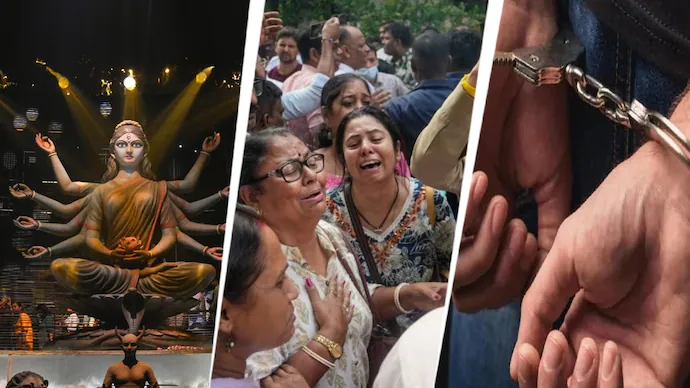
Kolkata stampede: Puja treasurer arrested over announcement that triggered panic
PC: India Today
Nineteen people died outside a Durga Puja pandal in north Kolkata. The word stampede makes the dead sound responsible for their own deaths.
It was raining in north Kolkata on Saturday evening, and the lanes around Chorbagan were full. Maha Saptami had drawn the usual crowds, moving from pandal to pandal in the shuffle the city calls pandal hopping. At around 7:15, an announcement went out over a loudspeaker. The crowd outside the Chorbagan Sarbojanin pandal pushed forward. People fell. Nineteen did not get up, among them a girl of seven. Another 25 were taken to hospital.
The word does the work
Within hours the word had been settled. Stampede. It is the word officials and the press reach for, and it carries an accusation. Stampedes are what panicked herds do. The word places the cause inside the crowd, and so inside the dead.
Researchers who study crowd disasters have long noted that it describes almost nothing that happens. People packed at high density do not run. They cannot. Past five or six people to a square metre, individual movement ends, and the crowd behaves like a fluid, a push at the back travelling forward as a wave. Most who die are not trampled. They suffocate standing up. The accurate word is crush, and a crush is not a moral failure of the people caught in it. It is a consequence of density, and density is something planners and police either manage or do not.
A festival built for looking, not for moving
Kolkata put up roughly 3,500 pandals this season. Durga Puja is among the largest public spectacles anywhere, listed by UNESCO and courted by sponsors and politicians. The money flows toward what can be seen: theme, artistry, idol, lighting. Far less goes toward what cannot be photographed.
The rain did not kill anyone at Chorbagan. Rain in a Bengal October is no surprise, and neither are Saptami crowds. Investigators are examining the narrow lanes, the exit arrangements and the announcement said to have caused the panic. Each was a decision somebody made weeks earlier, on paper, in an office.
The same failure, again and again
The answer to why festival gatherings turn tragic is rarely offered plainly. In 2024, 121 people died at a satsang in Hathras after panic spread through a crowd with nowhere to go, as examined in what we can learn from the 2024 stampede in Hathras. Last year 30 died at the Maha Kumbh in Prayagraj, a toll many disputed, and 11 were crushed outside a Bengaluru stadium. Another 36 died at a political rally in Karur.
The response barely varies either:
Condolences from the highest offices.
Compensation within hours: two lakh rupees for a life, fifty thousand for an injury.
A special investigation team under a High Court judge.
Arrests of committee members, security staff and whoever was on duty.
Then attention moves on, and the next festival is planned much as the last. Hindus for Human Rights argued after the Kumbh crush, in why deadly stampedes keep happening and how we can prevent them, that these are failures of planning rather than inevitable consequences of crowd size.
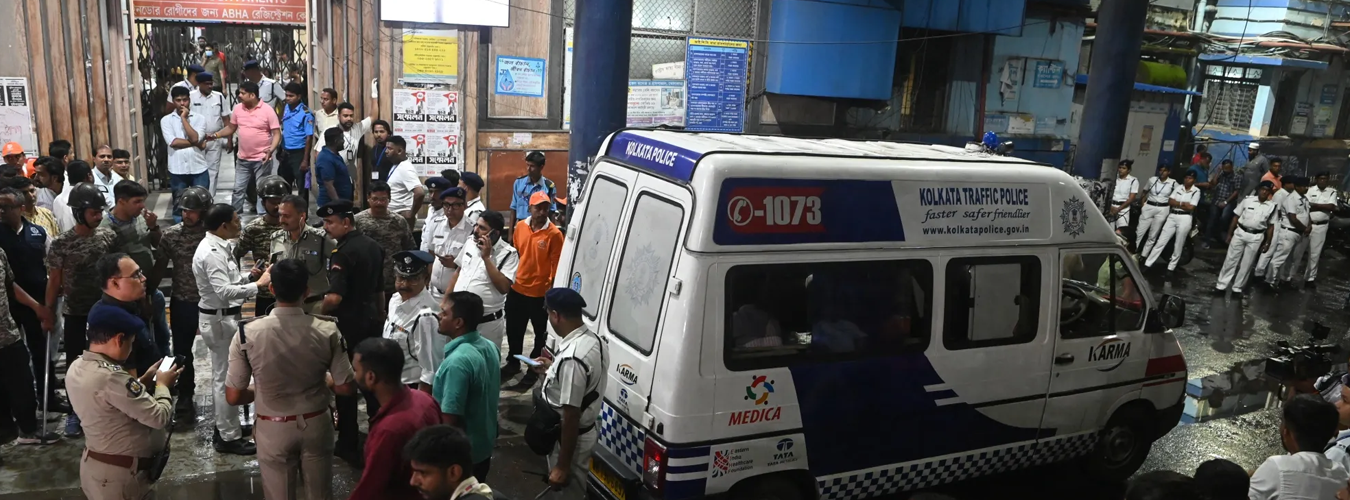
Victims of the Durga Puja Pandal stampede are transported by ambulance to Calcutta Medical College and Hospital on October 17. Photo credit: AFP/Getty Images / Bloomberg India
What safety would actually look like
None of this is mysterious. Crowd safety is an established discipline with unglamorous requirements:
Density limits that are counted and enforced, not estimated afterwards.
Separate routes for entry and exit, wide enough that two flows never meet.
Stewards trained to hold or halt a queue rather than wave it forward.
Announcements designed to settle a crowd instead of moving it.
Licensing and inspection with real enforcement behind them.
Bengal has a new government, and north Kolkata's puja committees are woven into the networks of the one it replaced. But an inquiry that ends with arrests and no change to how pandals are licensed will have failed, whatever political score it settles.
A government that must answer for this
Bengal's new government has spent its first festival season reorganising who owns the celebration. Established puja committees have been pushed aside and replaced at the top by the government's own people, many of whom have never managed a crowd of this kind. Chorbagan's committee had run the puja for decades. The people running it this year had not.
At the same time, the state has concentrated attention and resources on a handful of showcase pujas, drawing enormous crowds toward a few sanctioned venues instead of spreading them across the city as Kolkata has always done. Funnelling a city's crowds into fewer pandals and then staffing them with people who have never done the work is not a plan. It is an accident waiting for a date.
While this was happening, the administration found the manpower to send bulldozers and police to pull down Left bookstalls across the state. A government that can clear bookshops in several districts over a weekend cannot plead that it lacked the hands to steward one gate at a ninety year old puja.
The consequences were visible in the minutes after the crush. Ambulances could not reach the pandal. Residents and young men from the neighbourhood carried the injured and the dead out through the narrow lanes themselves, towards whatever transport they could find. Whatever the inquiry concludes about the trigger, the emergency response was not there when it was needed.
Kolkata has celebrated Durga Puja through Partition, the Emergency, famine and pandemic. In all those years, through all those crowds, the city has never seen a tragedy of this scale at a pandal. That is not a coincidence of weather. It is the product of decisions taken this year, by this administration, and the government must take responsibility for its handling of the situation rather than for the rain.
Sarbojanin means belonging to all
The pandal's name holds the argument. Sarbojanin means belonging to all people. The community puja was created to bring Durga out of the wealthy household courtyard and give her to the neighbourhood. That was a democratic act, and it carried an obligation: worship that invites everyone must be built to hold everyone.
Darshan is an act of the body. You go, you stand, you see the goddess and are seen by her. A tradition that asks people to come in the hundreds of thousands has taken on responsibility for their bodies. In a religion of darshan, safety is not an administrative footnote to devotion. It is a condition of worship.
Nineteen people went to see the goddess on Saptami evening and did not come home. They were not a herd. They were a congregation, and a congregation is always somebody's responsibility.
Frequently Asked Questions
-
On the evening of Saturday 17 October 2026, during Maha Saptami, a crowd crush occurred outside the Chorbagan Sarbojanin Durga Puja pandal in north Kolkata. Nineteen people died and about 25 were injured. Among the dead was a girl of seven.
-
The investigation is ongoing. Police have pointed to heavy rain, dense crowds of pandal visitors, and an announcement over a loudspeaker that caused people waiting outside to surge forward. Investigators are also examining the narrow approach lanes and the entry and exit arrangements.
-
A stampede implies a crowd running in panic. In most fatal crowd incidents people are too tightly packed to run at all. Deaths usually result from compressive asphyxia, where the pressure of surrounding bodies prevents the chest from expanding. Specialists prefer the term crowd crush, which locates the cause in density and layout rather than in the behaviour of those who died.
-
A case was registered and arrests were made, including members of the organising committee and security personnel on duty. A special investigation team headed by a High Court judge was announced. Compensation of two lakh rupees was announced for the families of those who died and fifty thousand rupees for the injured. Several heavily visited pandals were advised to close temporarily.
-
Yes. In 2024, 121 people died at a satsang in Hathras. In 2025, 30 died at the Maha Kumbh in Prayagraj, 11 were crushed outside a Bengaluru cricket stadium, and 36 died at a political rally in Karur. Religious gatherings are not uniquely dangerous. The common factor is crowd management, not faith.
-
Through decisions made long before the crowd arrives: enforced density limits, separated entry and exit routes, stewards trained to halt a queue, calm public address procedures, barriers designed to relieve pressure, and licensing backed by real inspection.
-
No. The argument is the opposite. A tradition that invites millions to gather has a corresponding duty to bring them home safely. Treating pilgrim and devotee safety as essential to worship, rather than an administrative afterthought, defends the festival rather than attacks it.
Our Trending series is produced in collaboration with an editorial partner. The perspectives expressed in individual articles are those of the writers and do not necessarily represent the views of Hindus for Human Rights.