
On Janmashtami, Krishna reminds us of a Hinduism filled with darkness, mischief, longing, beauty, and a love of the divine that refuses to stay respectable.
Every Janmashtami, Hindus celebrate the birth of one of the tradition's most beloved and unruly figures.
Krishna arrives in the world at midnight. He is smuggled out of a prison. He grows up among cowherds rather than kings. He steals butter, plays tricks, charms his neighbors, dances, flirts, plays the flute, falls in love, and becomes the object of a longing so intense that generations of poets would eventually turn desire itself into a language for approaching God.
There is much worth rexploring in that Krishna. Especially at a moment when Hindu identity is so often presented to us in the language of discipline, masculinity, purity and power, Krishna offers another religious imagination altogether.
He is playful rather than solemn. Beautiful rather than fearsome. Intimate rather than distant. His power is repeatedly expressed through attraction, affection and relationship. The Sanskrit word kṛṣṇa itself means black or dark. Across centuries of Hindu art and poetry, Krishna appears black, blue-black, the color of a rain cloud, or the deep blue with which many of us now immediately associate him. He is Shyam, the dark one, and Shyamasundara, the beautiful dark one.
A God who misbehaves
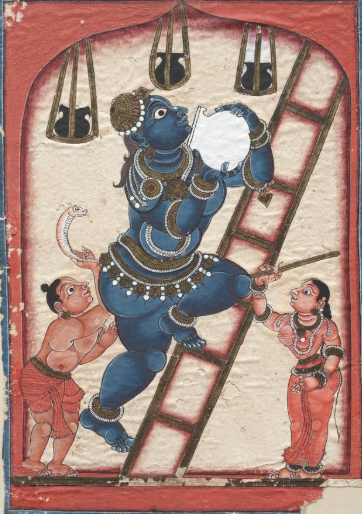
Krishna Stealing Curds | Cleveland Museum of Art
Krishna is also remarkably difficult to make respectable. The child Krishna steals butter. He conspires with his friends. He frustrates his mother. He gets caught and smiles his way through it. The youthful Krishna is no easier to discipline. He flirts. He disappears. He plays his flute at night. He provokes jealousy. He meets the gopis beyond the boundaries of conventional domestic life. Later devotional traditions did not erase this unruliness. They made it sacred.
The Gita Govinda, composed by Jayadeva in the twelfth century, gives us a Krishna and Radha whose relationship is filled with desire, jealousy, separation, reconciliation and erotic intensity. The tradition did not simply tolerate this language and quietly move past it. It made these emotions vehicles of devotion. The love between Radha and Krishna became one of the great metaphors for bhakti. Religions frequently become uncomfortable with bodies. Religious authorities can become even more uncomfortable with pleasure. Desire becomes something to suppress, regulate or police, particularly when it belongs to women, queer people, young people, or anyone whose love does not conform neatly to social expectation. Krishna Bhakti gives us the possibility of desire and yearning that can bring us closer to the divine?
To want God
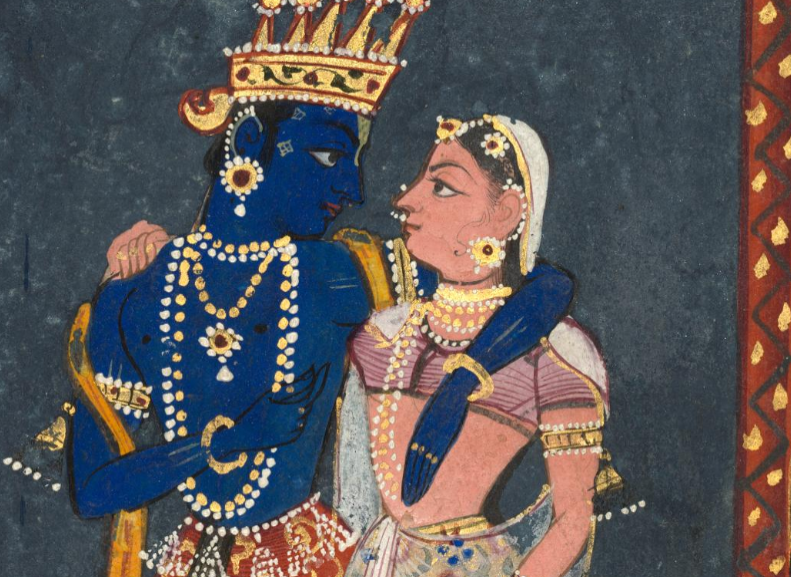
Radha and Krishna Embracing, Leaf from a Gita Govinda c. 1650, Aurangabad
This may be one of Bhakti's most beautiful insights. There are ways of imagining religion primarily through obedience. There are commandments to follow, rituals to perform, doctrines to affirm and hierarchies to respect. Bhakti introduces a vocabulary of love. Krishna Bhakti takes that proposition to extraordinary lengths. The devotee can love God as a parent loves a child. As a friend loves a friend. As one lover desires another. In Krishna traditions, the gopis hear the flute and leave what they are doing to seek him. Radha aches when Krishna is absent. Separation itself becomes viraha, a longing so intense that absence can make the beloved more present. Scholars of Krishna devotion have long noted how thoroughly its religious vocabulary draws upon eroticism, intimacy and yearning. The point is not simply that sexual imagery disguises some purer, more respectable spiritual meaning. The tradition is doing something more interesting. Human longing, in all its embodied intensity, becomes one of the ways human beings can imagine the longing for God. God can be someone you miss, seek., whose absence hurts, whom you desire.
Radha desires
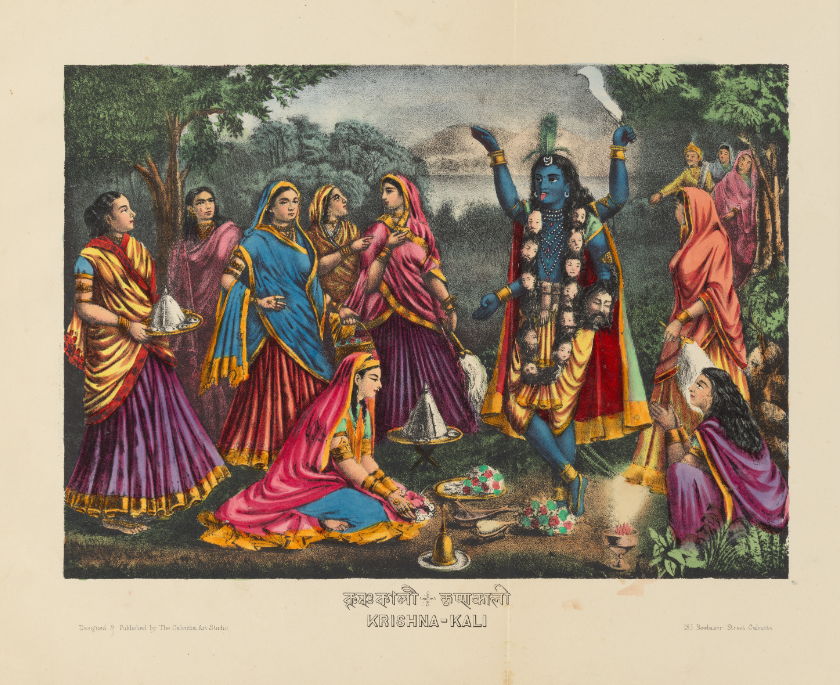
There is another reason these traditions deserve attention. Radha is not simply a passive object of Krishna's affection. She wants. She becomes angry. She refuses Krishna. She experiences jealousy. She suffers separation. She demands reconciliation. In some Vaishnava traditions, her love becomes so spiritually powerful that devotees place Radha above Krishna himself. Scholarship on these traditions has noted precisely this ambiguity in their relationship: Radha is attached to Krishna, but not simply submissive to him. None of this magically makes medieval Hindu literature feminist by twenty-first-century standards. Nor should we romanticize stories that developed within deeply patriarchal societies. Nonetheless these are a part of the tradition in which women's longing and anger and erotic desire can become metaphors for the highest reaches of spiritual experience.
When God crosses the lines
Krishna's stories are full of boundaries crossed, between human and divine; male and female; sacred and sensual; respectable and mischievous. There are Bengali traditions in which Krishna assumes the form of Kali to conceal a rendezvous with Radha, producing the wonderfully destabilizing image of Radha worshipping her male lover in the bodily form of the Goddess. It’s not that Krishna fits neatly into our contemporary categories of gender or sexuality, he’s considerably more unruly than that.
A Hinduism with room to breathe
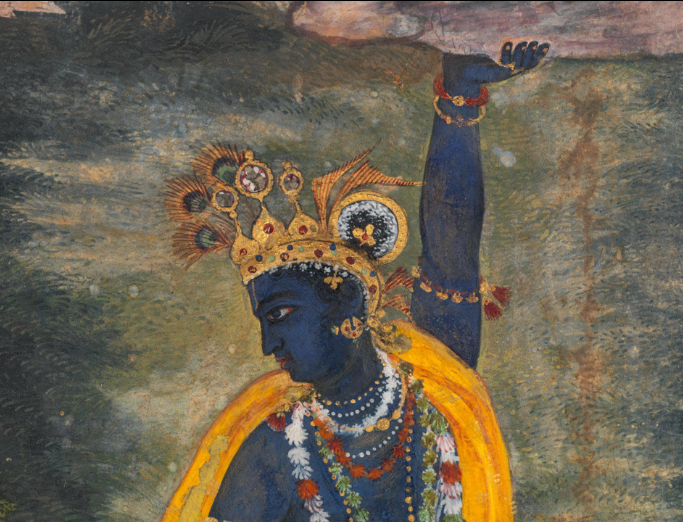
Krishna Holds Up Mount Govardhan to Shelter the Villagers of Braj", Folio from a Harivamsa The Metropolitan Museum of Art
Perhaps that is something Janmashtami can give us now: a Krishna who cannot be reduced to a political symbol, remade as a muscular emblem of civilizational power, or stripped of ambiguity until he can be made useful to religious nationalism. The Krishna of Bhakti is much harder to control. He is dark and beautiful, mischievous in ways that resist solemnity, and sensual in ways that refuse to separate the spiritual life neatly from the body. He is also the object of a devotion in which longing matters as much as certainty, and in which faith can be expressed not only as belief or obedience, but as desire: the ache to be nearer. Religion has often been built around disciplining or suppressing desire, but Krishna Bhakti offers another possibility, in which desire itself can become a path toward God. On Janmashtami, we can celebrate a Hinduism spacious enough for that mystery, one in which darkness is the beautiful, play is sacred and divine love can be passionate enough to make us ache. In that religious imagination, the divine seduces us into devotion by awakening love, longing, beauty and desire.
The views expressed are the author’s own.