
Who Gets Erased? Assam’s Elections and the Politics of Writing Voters Out
Assam’s voter roll crisis is about more than paperwork
If you are new to this issue, start with the simplest point: an electoral roll is just the official list of people allowed to vote. If your name is missing from that list, you can lose your vote. In Assam, that list is being revised ahead of the 2026 Assembly election. The Election Commission of India (ECI) — the constitutional body that runs India’s elections — says the exercise is meant to update the rolls by adding new eligible voters and removing names of people who have died, moved away, or appear more than once. Election authorities have also clarified that Assam’s current exercise is a Special Revision (SR), not the broader Special Intensive Revision (SIR) being discussed elsewhere.
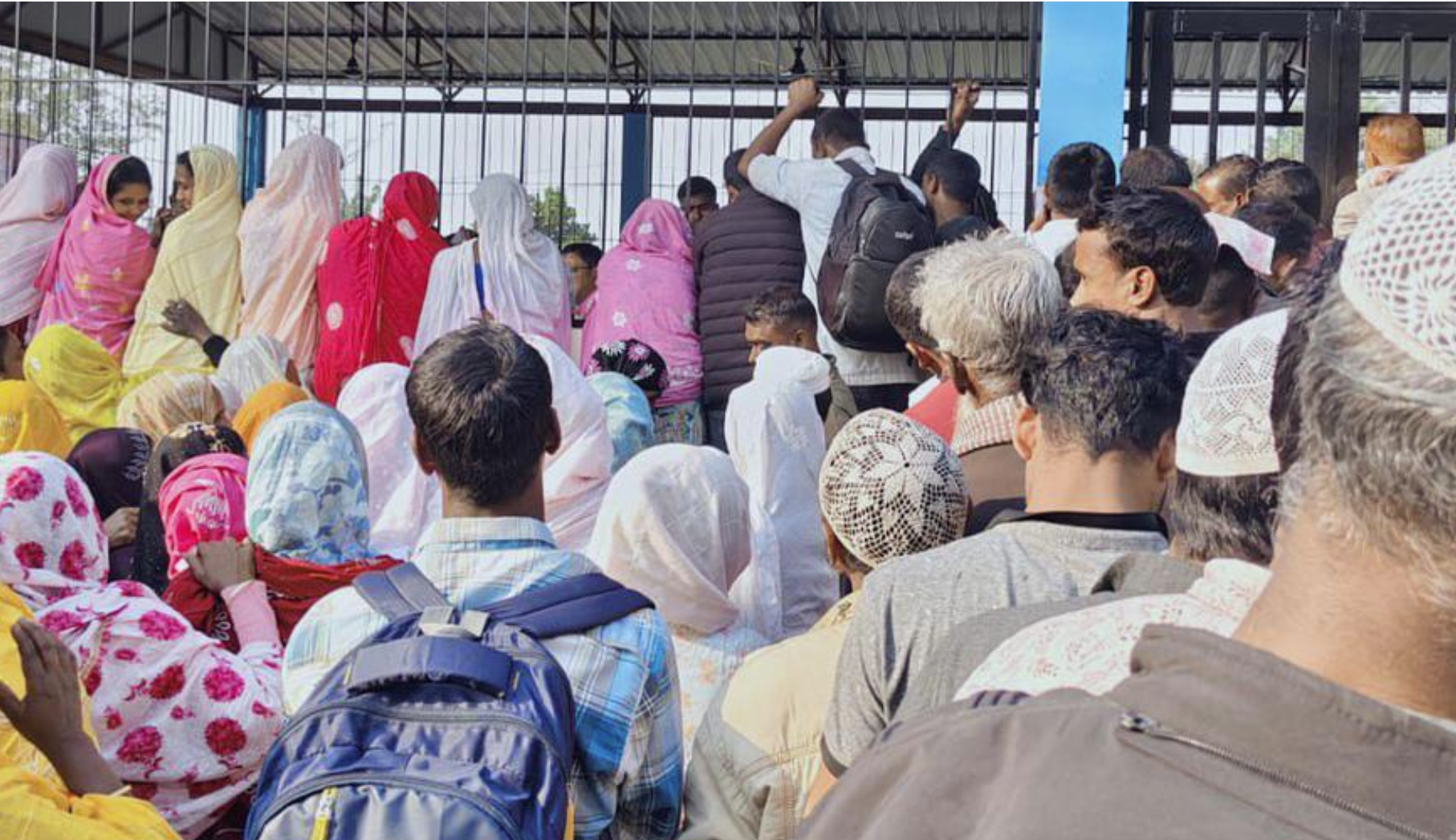
Hundreds turn up for hearings in Assam on January 19 this yeat during the special revision process. via Scroll
That may sound routine. In many places, voter-list maintenance is mundane. In Assam, it is not. Here, the voter list sits inside a much older and much more dangerous political argument: who belongs, who is treated as an “outsider,” and who has to keep proving their right to remain. The modern background to that argument is the Assam Accord of 1985, which emerged after years of agitation around migration and set 24 March 1971 as the key cut-off date for identifying who would be treated as a foreigner in the state. In other words, in Assam, citizenship and voting have long been bound together in unusually combustible ways.
That history produced a set of institutions and acronyms that can be bewildering to anyone outside Assam, so it is worth slowing down and naming them plainly. The NRC, or National Register of Citizens, was a citizenship register updated in Assam to identify who would be recognized as an Indian citizen there; when the final NRC was published in 2019, 19,06,657 people were left out. A D-voter means a “doubtful voter” — a category used only in Assam since 1997 for people whose citizenship is under question. Their cases can be sent to Foreigners Tribunals, quasi-judicial bodies that decide whether someone is legally to be treated as a foreigner. Until they are cleared, D-voters cannot vote. And Form 7 is the Election Commission form used to object to a person’s inclusion on the voter list or to seek deletion of a name from it. None of this is ordinary democratic housekeeping. It is a system in which paperwork can determine whether a person is treated as a full political subject at all.
HfHR’s webinar “Right to Belong in Assam” is a resource that gives readers historical and ethical context for the present moment. The conversation took place in September 2025
With that context, the numbers become easier to read. In December 2025, when the draft electoral rolls were published, election authorities said that more than 10.56 lakh names had been deleted, leaving about 2.51 crore voters in the draft roll, excluding 93,021 D-voters. Then, in February 2026, after the claims-and-objections process, authorities said another 2.43 lakh names were deleted from the draft, while roughly 5.86 lakh new names were added, leaving a final roll of 2,49,58,139 voters. These are huge numbers. Even when some deletions are lawful or expected, the scale alone makes this a major democratic event, not a clerical footnote.
Officials say that many missing names can be explained in routine terms: death, duplication, relocation, or failure to verify that a voter was still living at the registered address. That should be taken seriously. Not every deletion is sinister. But Assam is not a neutral landscape for this kind of exercise. Once a state has already built a long apparatus of citizenship checking — the NRC, D-voter tagging, tribunal proceedings, repeated documentary scrutiny — another round of deletions will not be experienced as mere maintenance. Communities read it through memory, and that memory is full of exclusion.
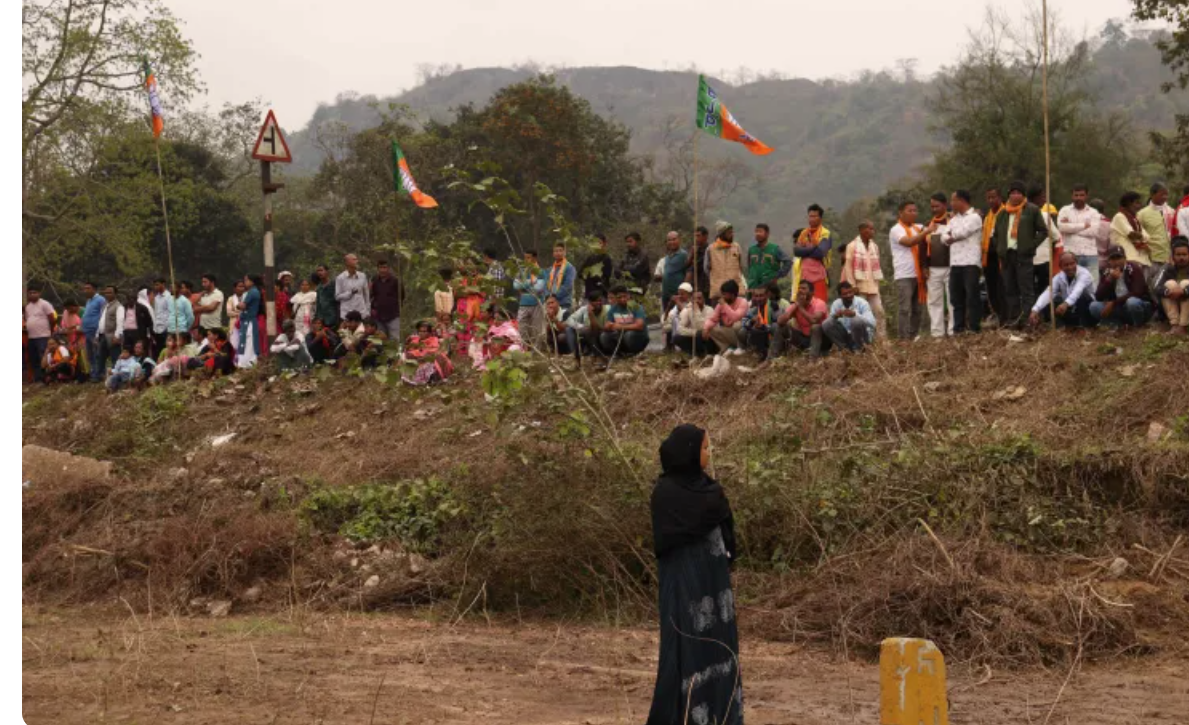
A Muslim woman stands before an election rally of the ruling BJP in Assam, India [Arshad Ahmed/ Al Jazeera
That is why the controversy around claims and objections matters so much. Journalists and rights advocates have reported that Form 7 was used in bulk in some Muslim-majority areas to seek the deletion of voters from the rolls. Whether every single allegation is proven is not the only question. The larger political problem is already visible: once a democracy normalizes the idea that entire populations are perpetually reviewable, the burden shifts. The state no longer has to justify exclusion with extraordinary care; ordinary people are made to prove, again and again, that they deserve to remain inside the electorate. That is not what democratic confidence looks like. It is what democratic suspicion looks like.
What should the Election Commission do in a situation like this? First, it should act as though wrongful deletion is itself a democratic injury. That means clear individual notice, enough time to respond, hearings that are genuinely accessible, materials available in the languages people actually use, and public district-wise data showing why names were removed. It also means treating bulk objections with heightened scrutiny rather than bureaucratic neutrality. A serious election authority should not only ask how to remove ineligible names. It should ask how to make sure eligible people are not quietly erased. In a state like Assam, that is what integrity requires.
The stakes reach beyond Assam. What Assam shows, with unusual clarity, is how democracies under strain can turn administration into a filter on belonging. The United States is not Assam, and the legal histories are different. But the family resemblance is real. The SAVE Act and related proposals in the U.S. would require documentary proof of citizenship to register or re-register to vote; one version passed the House in 2025, failed to advance in the Senate, and has since been revived in new forms. Critics note that this kind of system can burden or disenfranchise eligible voters, especially people who do not have easy access to documents like passports or birth certificates. The shared logic is the danger: exaggerate fraud, elevate paperwork, and call the resulting exclusions “election integrity.” Assam is a warning of what happens when that logic becomes a governing habit.
A democracy worthy of the name does not begin from suspicion. It begins from membership. It assumes that the franchise is precious, that exclusion must be rare, and that the state bears the highest burden when it moves to take a voter off the rolls. Assam’s crisis matters because it asks the oldest democratic question in one of the starkest possible forms: Who gets counted as part of the people? And once a state learns to answer that question through endless verification, the danger is not only that some names disappear from a list. It is that the idea of equal belonging disappears with them.
FAQ: Assam voter rolls, NRC, D-voters, and democracy
What is happening in Assam’s voter rolls before the 2026 election?
Ahead of the 2026 Assam Assembly election, the Election Commission of India carried out a Special Revision (SR) of the electoral rolls, which are the official lists of people eligible to vote. The Commission has said the goal was to update the rolls by removing names linked to death, duplicate registration, or people who had shifted residence, and by adding eligible voters who should be on the list.
What is an electoral roll, and who controls it in India?
An electoral roll is the official voter list for a constituency. In India, the Election Commission of India (ECI) is the constitutional authority that administers elections and oversees processes such as electoral-roll revision, voter registration, and claims or objections about who is included on the rolls.
What is the NRC in Assam, and why does it still matter?
The NRC, or National Register of Citizens, was an exercise to identify who would be recognized as an Indian citizen in Assam. When the final updated NRC was published in 2019, 19,06,657 people were left out. It still matters because every later debate about documents, citizenship, and voter eligibility in Assam is read against that history; for many communities, today’s voter-roll revision does not feel like a fresh administrative exercise but a continuation of an older politics of scrutiny.
What does “D-voter” mean in Assam?
A D-voter is a “doubtful voter” — someone whose citizenship has been put under question in Assam’s electoral system. This category is specific to Assam’s long citizenship crisis. People marked as D-voters cannot vote unless they are cleared through the legal process, which is one reason the category carries such high stakes for political belonging and basic democratic rights. In the 2025 draft rolls, 93,021 people were listed in this category.
How many people were removed from Assam’s voter lists?
During the 2025 draft revision, the Election Commission said 10,56,291 names were deleted, leaving 2,51,09,754 registered voters in the draft roll, excluding D-voters. Then, when the final roll was published in February 2026, officials said 2,43,485 more names had been removed from the draft during the claims-and-objections stage, leaving a final electorate of 2,49,58,139. Even if some deletions were valid, these are not small numbers; they are large enough to shape the democratic field itself.
Why are people worried about Form 7 in Assam?
Form 7 is the Election Commission form used to object to a person’s inclusion on the electoral roll or to request deletion of a name. In principle, it is an administrative tool. In practice, reports from Assam’s revision process raised alarms that objections were sometimes filed in bulk and that minority voters, especially Muslims, were being disproportionately targeted. That is why critics argue this is not just a paperwork issue but a question of whether democratic procedures are being turned into instruments of exclusion.
Why is this such a serious democracy issue, and not just a technical clean-up?
Because voting rights are not secure if large groups of people can be pushed into repeated cycles of proof, objection, and re-verification. In Assam, electoral administration sits inside a longer history of citizenship checks, tribunal proceedings, and suspicion directed at vulnerable communities. Once that history exists, “roll revision” cannot be treated as neutral in the abstract; it has to be judged by whether it protects eligible voters from wrongful exclusion.
What should the Election Commission of India do now?
The Election Commission should treat wrongful deletion as a democratic injury, not as acceptable collateral damage. At a minimum, that means clear notice to affected voters, fair hearings, scrutiny of mass objections, transparent public data on why names were removed, and fast restoration for eligible people who were wrongly dropped. Because the ECI is the body constitutionally responsible for administering elections, its job is not only to keep rolls tidy but to protect the franchise itself.
What does Assam have to do with the SAVE Act and voter suppression debates in the United States?
Assam and the United States are not the same, but they reveal a similar democratic temptation: to answer political anxiety with more paperwork. In the U.S., House Republicans passed versions of the SAVE Act / SAVE America Act that would require documentary proof of citizenship for voter registration, and major analysts have warned such laws could burden or disenfranchise eligible voters who lack ready access to passports, birth certificates, or matching documents. The warning from Assam is not that the systems are identical. It is that once democracy begins to treat membership as something people must constantly prove, exclusion starts to look normal.
Why does Assam matter beyond Assam?
Because Assam concentrates a problem many democracies now face: the use of administrative systems to decide who counts as fully part of the political community. That is why Assam is not only a regional story. It is a warning about what happens when the state stops beginning from the presumption that people belong, and starts instead from the presumption that they must continuously prove it.
Further Reading and Resources
The official mechanics
If readers want to understand how India’s voter rolls are supposed to work, start with the Election Commission’s overview of electoral rolls and revision procedures.
https://www.eci.gov.in/electoral-rollHow deletion works on paper
This is the Election Commission’s Form 7 page — the form used to object to a name on the rolls or seek deletion. It is useful because your article discusses how a procedural tool can become politically consequential in Assam.
https://voters.eci.gov.in/form7The sharpest investigation on the current controversy
Scroll’s reporting on allegedly forged objection forms is one of the strongest pieces on how the special revision process has played out on the ground, especially for Muslim voters.
https://scroll.in/article/1090187/in-assam-forged-forms-aimed-at-deleting-thousands-of-muslim-voters-ring-alarm-bellsThe clearest explainer on D-voters
For readers new to Assam, this Deccan Herald piece is one of the most accessible explainers on “D-voters,” why the category exists, and why it matters so much in the electoral context.
https://www.deccanherald.com/india/explained-who-are-d-voters-in-assam-will-special-revision-of-electoral-rolls-impact-them-3801665
A broader HfHR resource hub on NRC, CAA, and citizenship politics
This is a good internal link for keeping readers inside the HfHR ecosystem while giving them a wider map of the citizenship debates that shape Assam’s politics of belonging.
https://www.hindusforhumanrights.org/en/blog/helpful-resources-on-cabcaanrcnbsp
The U.S. parallel
For the section linking Assam to the SAVE Act and documentary barriers to voting in the United States, the Brennan Center’s analysis is a strong comparative read.
https://www.brennancenter.org/our-work/analysis-opinion/new-save-act-bills-would-still-block-millions-americans-voting